

Carpenter Ants in Texas — Complete Guide
Large black ants that excavate damp wood — sawdust piles and rustling in walls
Not sure it's a Carpenter Ant?
Snap a photo — our free AI tool identifies Texas pests in seconds.
Quick facts — carpenter ants in Texas
- Species: several Camponotus species — the black carpenter ant (C. pennsylvanicus) and Texas carpenter ant (C. texanus)
- Size: 1/4 to 1/2 inch — among the largest ants in Texas
- What they do: excavate damp wood for nests — they do not eat wood (that's termites)
- Key sign: coarse sawdust-like frass piles below small openings, plus rustling in walls at night
- Nest structure: parent nest outdoors + satellite nests inside the structure
- Fix the moisture first: they target wood softened by leaks and rot
About Carpenter Ants in Texas
Carpenter ants are the wood-destroying ants — large black or black-and-red ants that excavate galleries in structural wood. Texas has several Camponotus species, including the black carpenter ant (Camponotus pennsylvanicus) in East Texas and the Texas carpenter ant (Camponotus texanus) statewide. They are a genuine structural concern — but with an important asterisk: they almost always colonize wood already softened by moisture, so a carpenter ant problem is usually also a leak or rot problem. For other Texas ants, see our ant control guide.
Identifying Carpenter Ants
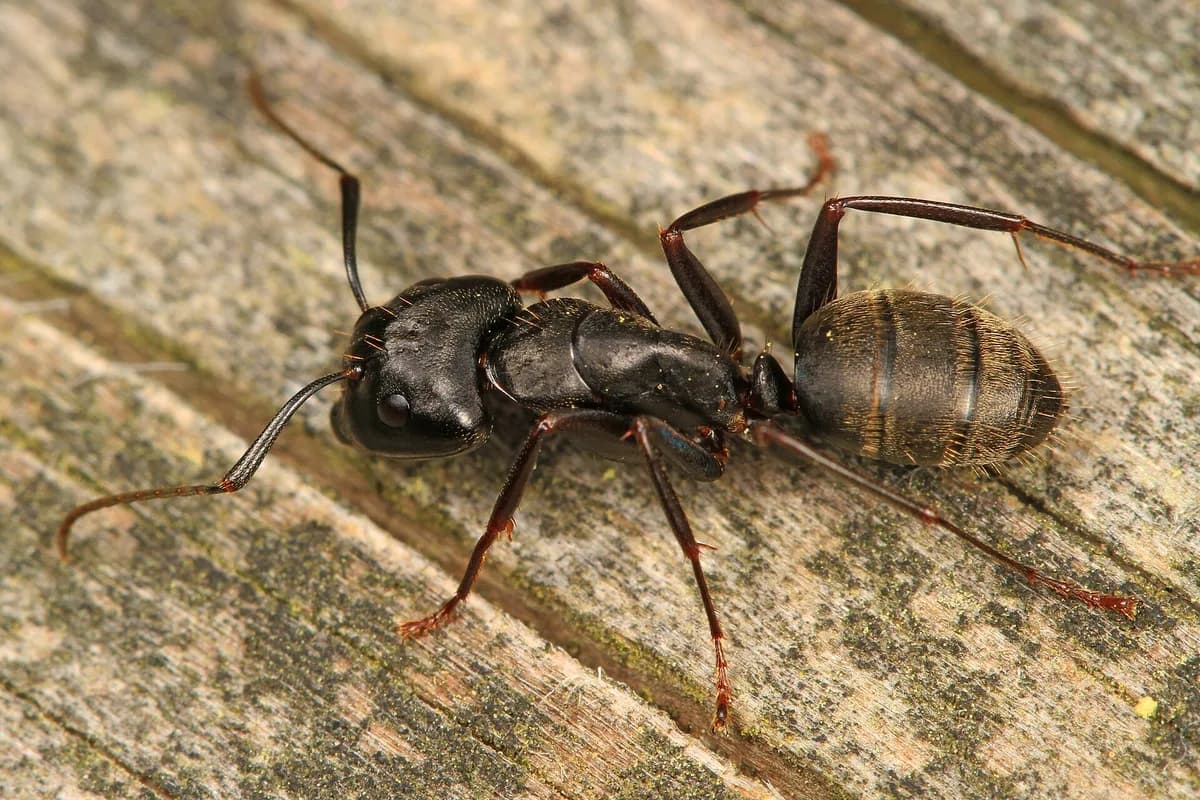
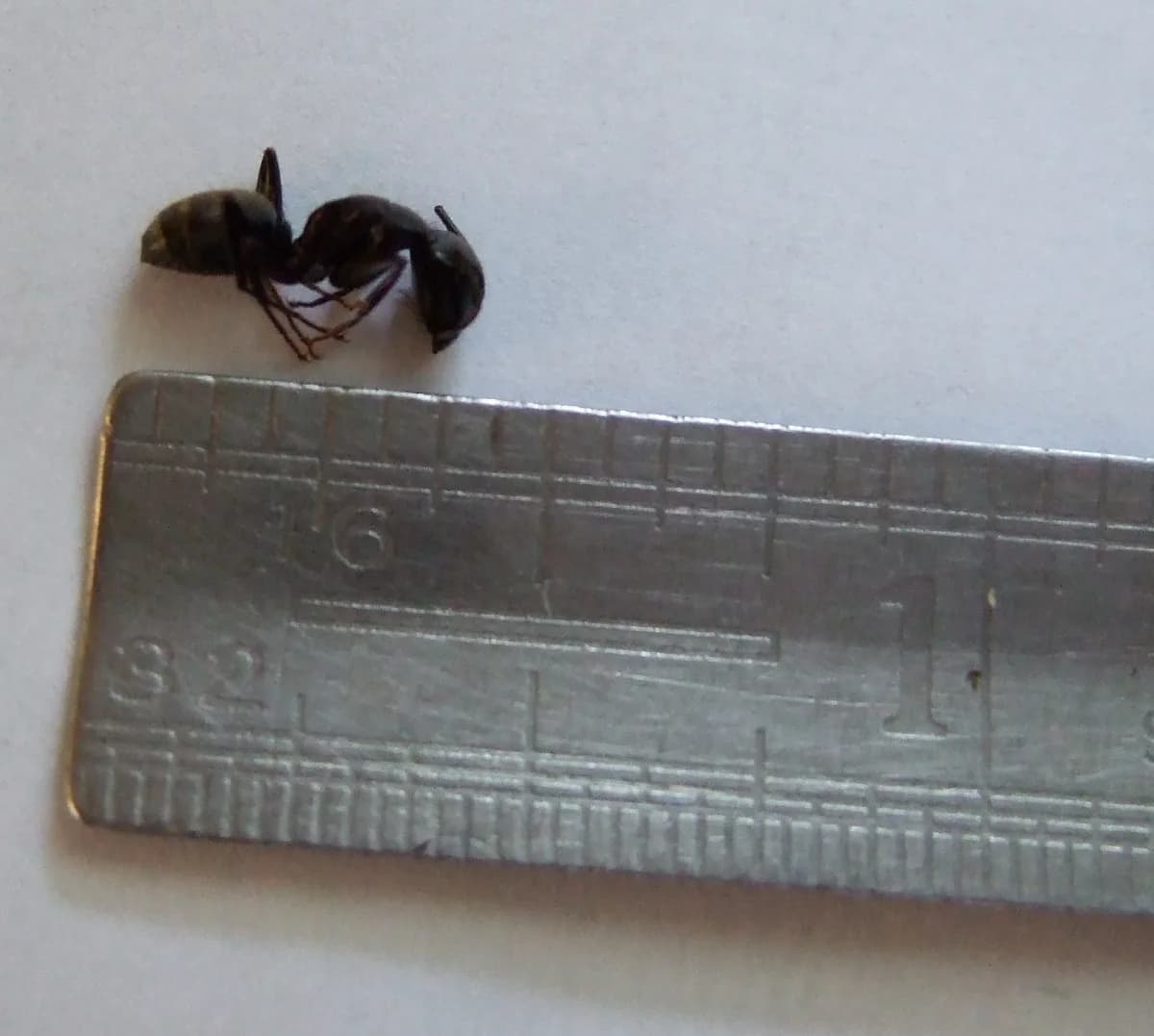
Carpenter ants are big: workers 1/4 to 1/2 inch, typically black or black with a reddish middle section. Key marks: elbowed antennae, a single narrow node (bump) at the waist, and a smoothly arched, rounded thorax when viewed from the side — field ants and other lookalikes have an uneven thorax profile. Winged reproductives (swarmers) appear in spring and are often the first sign homeowners notice indoors. Carpenter ants do not sting; large workers can pinch and spray formic acid into the pinch, which stings briefly.
Signs of a Carpenter Ant Nest
- Frass: coarse, fibrous sawdust — like pencil-sharpener shavings, often mixed with insulation bits and dead insect parts — pushed out of small slit-like openings and piling up on windowsills, baseboards, and garage floors. Piles that reappear after sweeping mean an active nest.
- Sounds: faint rustling or crackling inside walls at night, when the colony is most active.
- Foragers: large black ants indoors, especially at night, in spring, or trailing along foundations, fence tops, and tree branches touching the house.
- Swarmers: winged ants emerging indoors in spring — a mature nest inside the structure.
Carpenter Ants vs Termites
Both damage wood, but differently. Carpenter ants excavate — they chew out smooth, clean galleries for nesting and push the wood out as sawdust frass; they eat insects and sweets, not wood. Termites eat the wood itself, leave no sawdust, and either build mud tubes (subterranean termites) or leave hard six-sided pellets (drywood termites). Carpenter ant galleries look sanded; termite galleries are rough and dirt-lined. And while termites attack sound dry wood, carpenter ants strongly prefer wood already softened by water damage — so their presence is often a moisture alarm.
Parent Nests and Satellite Colonies
Carpenter ant biology explains why spot-spraying fails. The parent colony — with the queen — sits outdoors in a stump, tree cavity, landscape timber, or firewood pile, sometimes 100 yards away. It sends workers to establish satellite nests in favorable indoor spots: wall voids, window and door frames with old leak damage, hollow-core doors, foam insulation, bathroom and kitchen walls. The ants you see in the kitchen are foragers from one of these satellites. Killing foragers does nothing to either nest — control must locate and treat the nests themselves. Following forager trails after dark with a flashlight is the standard professional technique for finding them.
Carpenter Ant Control in Texas
Professional treatment is a three-legged stool: find the nests (trailing foragers, probing moisture-damaged wood, inspecting trees and stumps on the property), treat the nests — dust or foam insecticide injected into voids and galleries, plus non-repellent sprays and baits on foraging trails that workers carry back to the colony — and fix the conditions: repair the leak, replace rotted wood, remove stumps and firewood near the house, trim branches off the roofline. Initial service typically runs $200 to $500 with follow-ups at $75 to $150. Skipping the moisture repair guarantees reinfestation.
Carpenter Ant Prevention Tips
- Fix leaks promptly — roof, plumbing, and window leaks create the softened wood carpenter ants require.
- Replace water-damaged and rotting wood; don't just caulk over it.
- Remove stumps, dead trees, and landscape timbers near the house; store firewood 20 feet away and elevated.
- Trim tree branches and shrubs away from the roofline and walls — the main foraging highway.
- Keep gutters clean and downspouts draining away from the foundation.
- Seal cracks around windows, doors, and utility penetrations.
- Ventilate crawl spaces and attics to keep wood dry.
See our ant control guide for the full Texas ant picture, or browse licensed ant control companies in your area below.
Licensed Texas Companies
2027 companies offering pest control
2,027 companies
Romex Pest & Termite Control
Urbanex Pest Control
A-Action Home Inspection Houston
Forterra Pest Control
EnviroCon Pest Control
X Out Pest Services
Adams Exterminating

Innovative Pest Control

Cerv Property Solutions San Antonio
Ace Pest Control
Integrity Pest and Termite

The CanMan
Bill Clark Pest Control, Inc.

Bug Blasters Pest Control

Pest Solutions of North Texas

Pinnacle Pest Defense
BugMan Pest Control & Termite Control
Justice Pest Services
Frequently Asked Questions
Best Professional Treatment
General pest management for common household pests including roaches, ants, spiders, and more
Find Local Exterminators for Carpenter Ant Near You
Use our interactive map to find licensed carpenter ant control companies near your Texas location.
Find Licensed Companies by Texas City
Licensed carpenter ant control companies in major Texas cities