
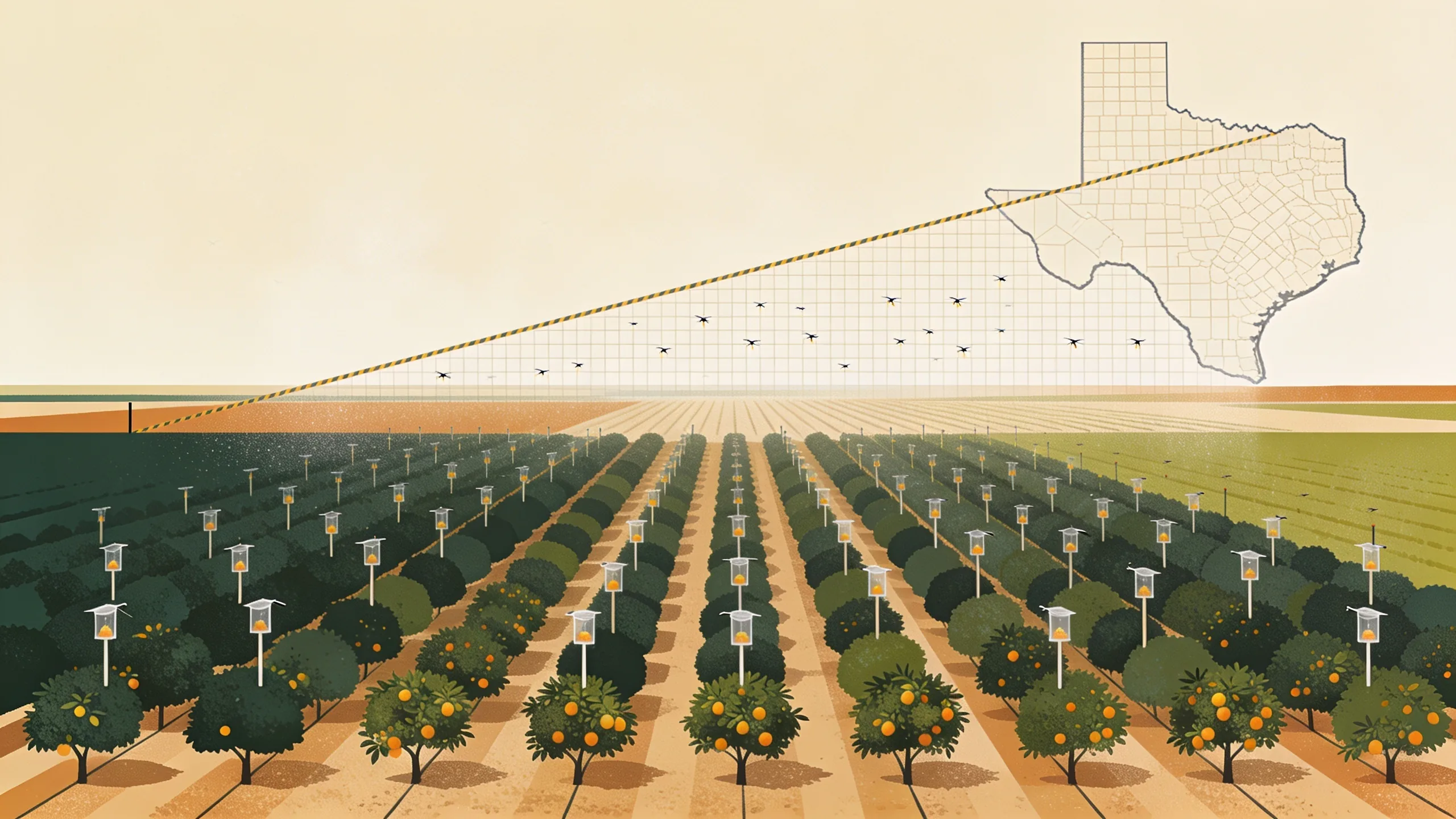
Texas Handed Back 105 Square Miles of Fruit Fly Quarantine. The Clock That Ended It Counts Generations.
The federal quarantine wrapped around Laredo and Zapata came off on Nov. 18, and the paperwork that came with it went with it. The Animal and Plant Health Inspection Service, acting with the Texas Department of Agriculture, removed the Mexican fruit fly quarantines in Webb County and Zapata County in a single notice, DA-2026-48, releasing 105.4 square miles. Neither quarantined area contained commercial citrus, so no grove's certification status changed. What makes the two-page document worth reading is the clock it does not explain.
That clock shows up in an earlier release, the one that lifted the Donna quarantine in Hidalgo County in October 2025. There the agency was explicit: release came "after three generations elapsed since the date of the last detection, based on a degree-day model." The unit is insect generations, not weeks. A generation is measured in accumulated heat, so the same quarantine clock runs at different speeds in a Zapata July and a Zapata December. Neither the November notice nor the October one publishes the accumulated degree-days, the last detection date for the released area, or where the model's threshold sits. The release is a finding that a threshold was crossed, issued without the arithmetic behind it.
The Zapata quarantine itself dates to March 19, when APHIS and the state established it around a single wild mated female caught in a trap in a sweet orange tree on a residential property, confirmed on March 11. It covered roughly 55 square miles and, per the establishment notice, no commercial agriculture. The Laredo quarantine's start date is not stated in the removal notice, and no establishment notice for it appears in the agency's program-update listing back through early December 2025.
Read together, the notices describe a churn rather than a crisis. The Valley went into the fall of 2025 with three quarantines in two counties: La Feria in Cameron, opened Dec. 5 on a larva found in a grapefruit and enlarged Dec. 16 to 124.2 square miles naming 970.6 acres of commercial citrus; Peñitas in Hidalgo, opened Dec. 12 on a larva in a sour orange in a yard and enlarged Dec. 22 to 56.14 square miles and 323.68 acres; and Granjeno, also Hidalgo, opened Jan. 26 on a mated female in a commercial grove, at about 50 square miles and 213 acres. By the end of January those three quarantines named 1,507.28 acres of commercial citrus between them, which is arithmetic on the notices rather than a figure any agency published.
Then the releases. The sapote fruit fly quarantines at Harlingen, Rio Hondo and Alamo came off Aug. 13, returning 212.64 square miles and 1,138.61 acres of citrus. The merged Peñitas-Granjeno quarantine closed in September with 58.66 square miles and 45.03 acres. Donna, Edinburg and part of Brownsville had already gone in the fall of 2025, at 71, 69 and 67 square miles respectively. The acreage named at establishment is several times the acreage named at release, because the quarantines shrank zone by zone as detections stopped, and the final release only had to cover what was left.
None of this happens without the trap line. APHIS runs more than 160,000 fruit fly traps across California, Florida, New York, Texas and Puerto Rico, and three of the four quarantines above started with one insect or one larva in one piece of fruit. For a homeowner in Zapata or Laredo, the practical change is narrow and real: host fruit, soil and container plants can move out of the area again without a compliance agreement, which matters to backyard growers even when it means nothing to the packinghouse.
The contrast with the same week's other animal health notice is hard to miss. The Texas Animal Health Commission's screwworm page listed 40 counties under movement restrictions on Monday, three more than on Friday, after orders dated Nov. 21 added Andrews, Martin and Midland. Screwworm zones do not close on a degree-day model. The commission's release orders describe a different test, one built on fly trapping, sterile fly dispersal and visual inspection, and the zones in West Texas have stayed on the books for months.
Release also is not the same as clean. The West Indian fruit fly quarantine at Port Isabel, established Oct. 7 in Cameron County, remains on APHIS's current quarantine map list, and the Mexfly detections that started these quarantines arrived from Mexico into a subtropical orchard belt that will keep producing them. The Nov. 18 notice authorizes the action under the Plant Protection Act and the fruit fly regulations at 7 CFR 301.32 through 301.32-10, and says a Federal Register notice will follow. What it certifies is narrower than it sounds. For two South Texas counties, three generations have passed without a fly in a trap, and the paperwork has moved on.
Sources
- APHIS Removes Mexican Fruit Fly (Anastrepha ludens) Quarantines in Webb and Zapata Counties, Texas, DA-2026-48
- APHIS Establishes a Mexican Fruit Fly (Anastrepha ludens) Quarantine Area in Texas (Zapata, March 19, 2026)
- APHIS Removes Mexican Fruit Fly (Anastrepha ludens) Quarantine in Hidalgo County, Texas
- APHIS Removes Sapote Fruit Fly (Anastrepha serpentina) Quarantines in Cameron and Hidalgo Counties, Texas
- USDA APHIS Exotic Fruit Flies program page
- Texas Animal Health Commission, New World Screwworm current situation
Texas Bug Slayers Editorial Team
Editorial Board
The Texas Bug Slayers editorial team brings together licensed pest control professionals, entomologists, and writers dedicated to helping Texans protect their homes and families from pests.
Related Articles
The Screwworm Fight Runs on 150 Million Flies a Week. The Blueprint Says 500 Million.
Three years into the outbreak, Panama and Mexico together make under a third of the sterile flies the 1960s campaign used, and Texas's own plant is months away.

The Third Cattle Port Reopens Oct. 26, and New Mexico's Infested Zones Will Be Eleven Days Old
USDA set Oct. 26 for the Columbus, N.M. crossing, four days after a calf and a horse in Grant County tested positive for screwworm.
Colorado Now Wants Five-Day-Old Paperwork From Livestock Coming Out of Texas
Colorado's updated screwworm emergency rule adds pre-movement inspections, permits and treatments for animals arriving from Texas and New Mexico infested zones.