
Colorado Now Wants Five-Day-Old Paperwork From Livestock Coming Out of Texas
Colorado's Agricultural Commission took up an updated emergency rule on New World screwworm, reviewed it, and recommended that Commissioner of Agriculture Kate Greenberg adopt it by Oct. 9 — the same day the previous emergency rule expired. The state did not describe the change as a precaution against something that might arrive. It described it as a response to detections in Texas and New Mexico, rising case numbers in northern Mexico, and the reopening of international ports for livestock movement.
"With ongoing NWS outbreaks in neighboring regions and increased international livestock transport, updating our emergency rule is essential to protect the health and safety of Colorado's animals and livestock industry," State Veterinarian Dr. Maggie Baldwin said in announcing the action.
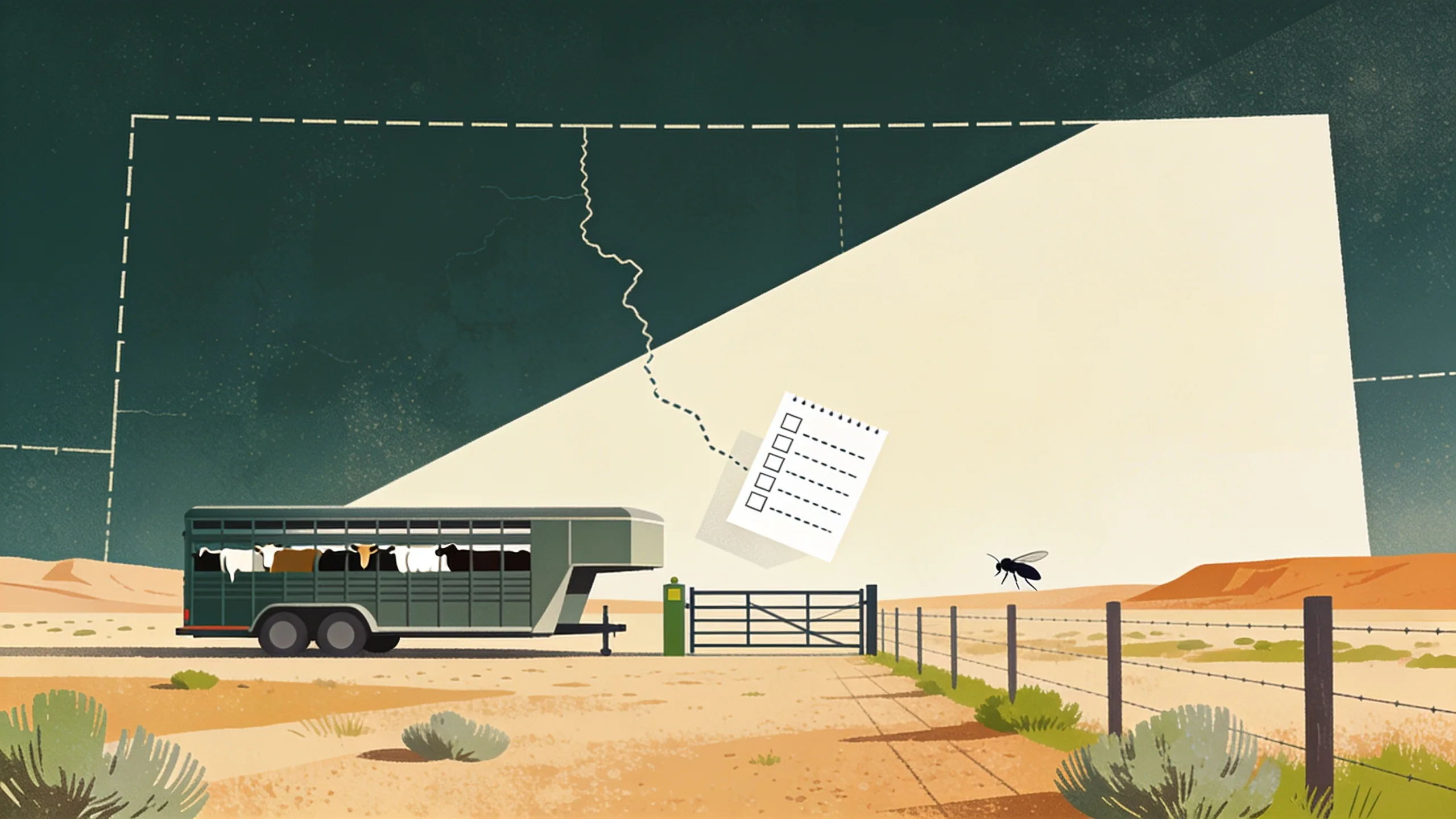
For anyone hauling animals west out of Texas, the new rule is mostly a paperwork clock. Livestock originating in an established screwworm-infested zone now needs a pre-movement inspection, a Certificate of Veterinary Inspection issued within five days of the move, an entry permit for Colorado, treatment of any open wound performed by an authorized person, and an inspection on arrival. That five-day window is the part that changes an operation's schedule: a health certificate that would normally be pulled a week or two ahead of shipping has to be issued inside the narrow band before the trailer rolls.
The updated rule reaches past the infested zones as well. It sets requirements for animals arriving from countries affected by New World screwworm, Mexico included. Animals that already satisfy federal import conditions set by the U.S. Department of Agriculture, the Centers for Disease Control and Prevention and U.S. Customs and Border Protection automatically satisfy Colorado's requirements, which keeps the two systems from stacking. Additional safeguards apply to species and movements that federal monitoring does not already cover.
Colorado also gave itself teeth. Under the emergency rule, state officials can quarantine animals that do not meet the requirements or order them sent back to their premises of origin, and violations can draw civil or criminal enforcement.
The parasite behind all of this is a fly whose larvae feed on living tissue rather than dead tissue, which is why the animal-health response looks more like wound management than like ordinary pest control. A female lays eggs at the edge of a wound — including wounds small enough that a producer might not have flagged them — and the larvae burrow in and enlarge the damage as they grow. Left untreated in livestock, the infestation is often fatal; in pets and people it requires surgical removal.
Colorado is the newest jurisdiction to write its own rules rather than wait on a federal process that has been moving deliberately. Texas took the first step on Oct. 1, when the Texas Animal Health Commission issued an executive director order setting entry requirements for livestock, exotic livestock and fowl arriving from affected states, framed as a condition-triggered action rather than a list of named states. Earlier this month the Canadian Food Inspection Agency layered its own restrictions on live cattle from affected states, including a rule about animals that transit those states. Colorado's version is narrower in geography but broader in paperwork, and it arrives as a straight replacement for a rule that would otherwise have lapsed.
What none of these rules do is shrink the outbreak. USDA has logged more than 50 confirmed U.S. cases since the first detection in Texas in June, with a small number still active. The agency's answer to the parasite at scale is the sterile insect technique — flooding the landscape with irradiated flies that mate without producing offspring — and the capacity build-out for that is still under construction at Moore Air Base in Edinburg, in Hidalgo County, where a first phase of 100 million sterile flies per week is scheduled to be ready in April 2027 and a second phase would take the total to 300 million weekly.
Until that capacity is on line, the map of who can move livestock and under what conditions keeps being redrawn by individual states and countries, one emergency rule at a time. For a Texas producer with cattle or horses headed to Colorado this fall, the practical list is short: schedule the pre-movement inspection, make sure the CVI is dated within five days of departure, get the entry permit before the truck is loaded, and treat anything that is even slightly open before an inspector has to make that call at the state line.
Sources
Texas Bug Slayers Editorial Team
Editorial Board
The Texas Bug Slayers editorial team brings together licensed pest control professionals, entomologists, and writers dedicated to helping Texans protect their homes and families from pests.
Related Articles
Del Rio's Horse Lane Is Open Again, and the First Week Arrived as a Backlog
Horse exports from Texas to Mexico resumed at the Del Rio crossing after a months-long screwworm halt. One San Antonio hauler moved 130 head in week one.
USDA Says the Data, Not the Calendar, Decides When the Next Cattle Port Reopens
Fifty-two U.S. screwworm cases and two still active: USDA's Dudley Hoskins explains the inspection regime behind port reopenings and a fly-supply plan aimed at 300 million sterile insects a week.
US and Mexico Open Massive Sterile Fly Facility in Chiapas to Combat Screwworm Threatening Texas
A new $50+ million sterile fly production plant in Metapa, Mexico will produce 100 million flies weekly to suppress New World screwworm populations threatening Texas livestock.