
The Screwworm Fight Runs on 150 Million Flies a Week. The Blueprint Says 500 Million.
The number that governs the New World screwworm outbreak is not a case count. It is flies per week, and it has been short for three years.
Panama and Mexico together now produce roughly 150 million sterile flies a week, according to US and Mexican government data cited in a Reuters investigation published Monday. The 1960s campaign that eradicated the pest from the United States ran on 500 million a week, the same figure experts still recommend as the level needed to hold the fly south of Panama. That puts current output below a third of the benchmark, at a moment when federal officials have confirmed 121 infestations across Texas, New Mexico and Arizona since June.
Texas Public Radio's running tracker, updated Sunday evening, put the total at 121 with 59 active and 62 inactive, an increase of more than 53 percent in a single week. Reuters, working from its own reads of federal figures, reported 120 cases to date. The two counts are a data pull apart, and no agency publishes a running total that reconciles them.
What the Reuters account adds is the machinery behind the map. Fifteen current and former officials and experts described a response that kept arriving at the right answer late. In late February 2023, Panama's Darién province recorded about 800 cases inside the jungle corridor that had served as North America's last line of defense. The Panama-United States commission that maintains that barrier, COPEG, decided in April 2023 to raise production from 20 million flies a week to 100 million. It reached 100 million in November 2024, nineteen months later. By then, officials already understood that 100 million was not enough, a Panamanian official involved in the response told Reuters.
That same month, Mexico confirmed its first cases in Chiapas, the southern state on the Guatemalan border, and began releases. The plan centered on converting an existing fruit-fly plant at Metapa rather than building one, and the handover from Andrés Manuel López Obrador's administration to Claudia Sheinbaum's delayed the work by three to four months. The United States announced $21 million for the Metapa project in May 2025, with officials saying the plant could eventually produce 60 million to 100 million flies a week. It was inaugurated on June 27, more than eighteen months after Mexico's first case. By that point the parasite had reached 27 states, including the cattle country of Coahuila and Durango, hundreds of miles from where it started.
Trade policy moved faster than production did. The first US case was confirmed June 3, 2026, and the country still had no plant of its own. Cattle imports from Mexico had been closed since May 2025, a shutdown that ran more than fifteen months and disrupted a multibillion-dollar trade. Sterile-fly drops from COPEG shifted north to the Texas-Mexico border in February 2026, which is to say the barrier became a border operation.
The Texas plant is the one date that matters now. Agriculture Secretary Brooke Rollins named Moore Air Force Base in Edinburg as the site in June 2025, on ground that hosted the retired fly plant behind the 1960s campaign. This March the administration awarded a $610 million construction contract to M.A. Mortenson, limiting bids on the argument that open competition could slow a time-sensitive project, according to federal spending records. A USDA spokesperson, Nancy McNiff, told Reuters the department had initially assumed the build could take up to five years, and said the agency has "acted urgently and pursued every practical avenue to get more sterile flies into the field as quickly as possible."
Then the schedule moved twice. At a September meeting of the Texas A&M Board of Regents, Rollins said Defense Secretary Pete Hegseth had pushed the project to the top of the Army Corps' priority list, cutting the timeline to about eighteen months, or fall 2027. John Bellinger, her adviser on screwworm and a member of that board, told the regents he kept pushing: "For only $250 million more, we got it moved to April 1 of next year." Construction updates out of the Army Corps this fall already carried April 2027 as the initial operating capability. What was not public until this week was the price of the six months.
Sonja Swiger, an entomologist at Texas A&M, put the arithmetic plainly to Reuters. "We don't have enough flies," she said. "They knew that right away." She also described the part that makes the shortage bite: even where cases have been suppressed, protection lasts only as long as the flies keep arriving, week after week.
On the ground, that shows up as paperwork. The Texas Animal Health Commission signed its third modified order for El Paso and Hudspeth counties on Sunday, after a canine in El Paso County and a bovine in Hudspeth County were both detected on Nov. 7. The ground had been under restriction since Oct. 24, when an order created Infested Zone 25 after two Hudspeth bovines tested positive. A dog in El Paso County on Oct. 27 turned it into 25.A. A trapped fertile wild fly in Hudspeth on Oct. 30 turned it into 25.B. Sunday's order replaced all of that with 25.C, the same corner of the border drawn a fourth time in fifteen days. Twenty-one Texas counties now sit under movement restrictions.
None of that is a claim that the quarantine failed. The order does not say how long either animal had been infected, where it came from, or whether the detections are connected. It says the parasite was found again inside ground that was already closed, which is the ordinary shape of an outbreak that is being managed rather than ended.
Mexico's confirmed cases now stand at about 51,000, with Chiapas the hardest-hit state at roughly 8,200 infestations, and USDA says every sterile fly produced in Panama and Metapa is currently being released in northern Mexico and the United States. That leaves southern Mexico and Central America on surveillance and treatment instead of eradication. Some experts told Reuters it could take a decade to push the infestation back to Panama.
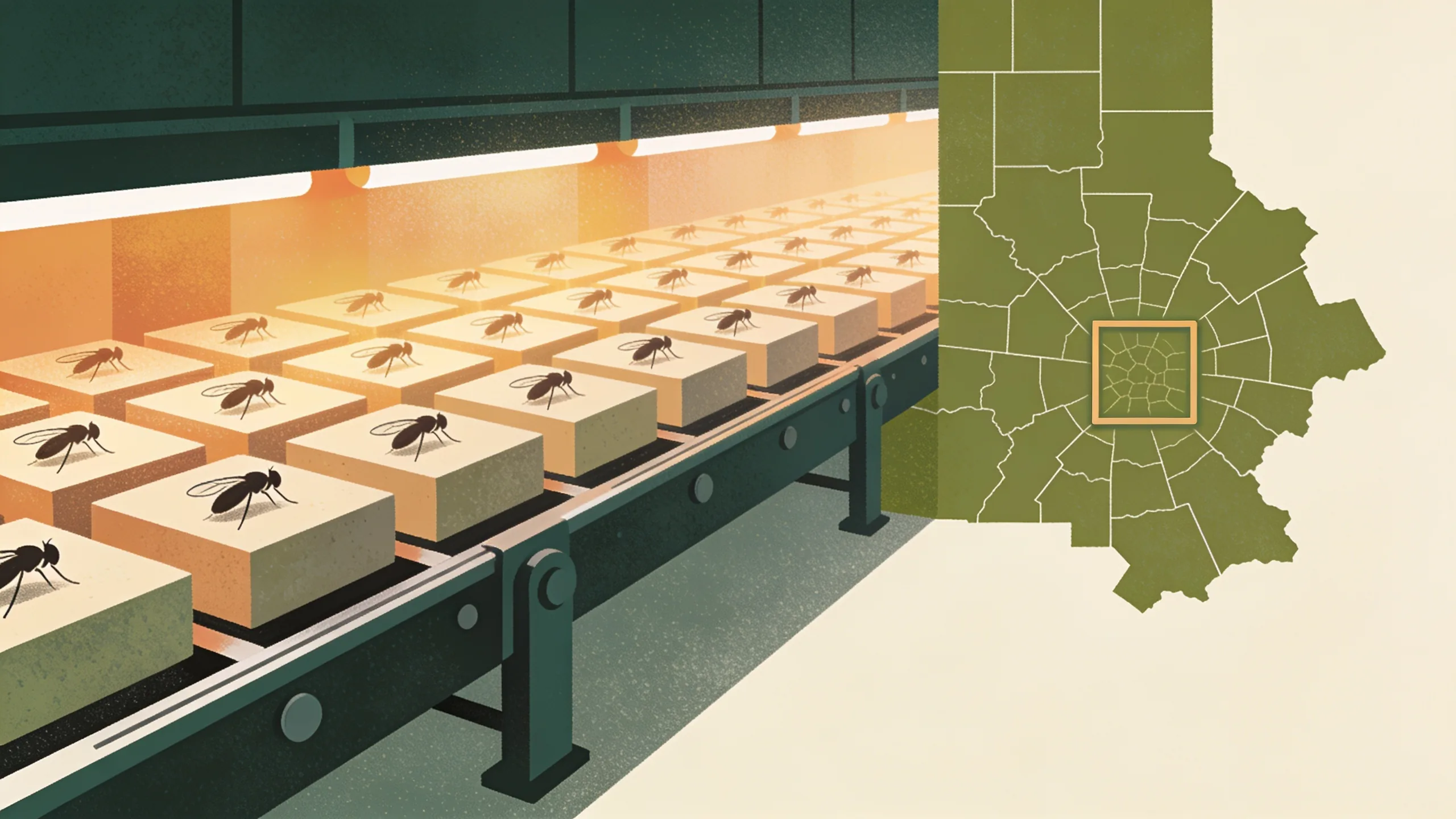
Which brings the story back to the conveyor. Nothing in the fly supply changes before spring, and until it does, the map is being managed with orders signed a county at a time. Spokespeople for Sheinbaum, Mexico's agriculture ministry, COPEG and the Panamanian government did not respond to Reuters' requests for comment.
Sources
- Reuters — How the US was left exposed to the flesh-eating screwworm, years into the outbreak (Nov. 9, 2026)
- Texas Public Radio — New World screwworm outbreak grows by more than 50% in one week, reaching 121 U.S. cases (updated Nov. 8, 2026)
- Texas Animal Health Commission — Third Modified Executive Director Order, El Paso and Hudspeth Counties (signed Nov. 8, 2026)
- Texas Animal Health Commission — New World Screwworm: current infested zone notice and executive director orders (checked Nov. 9, 2026)
Texas Bug Slayers Editorial Team
Editorial Board
The Texas Bug Slayers editorial team brings together licensed pest control professionals, entomologists, and writers dedicated to helping Texans protect their homes and families from pests.
Related Articles

The Third Cattle Port Reopens Oct. 26, and New Mexico's Infested Zones Will Be Eleven Days Old
USDA set Oct. 26 for the Columbus, N.M. crossing, four days after a calf and a horse in Grant County tested positive for screwworm.
Colorado Now Wants Five-Day-Old Paperwork From Livestock Coming Out of Texas
Colorado's updated screwworm emergency rule adds pre-movement inspections, permits and treatments for animals arriving from Texas and New Mexico infested zones.
Del Rio's Horse Lane Is Open Again, and the First Week Arrived as a Backlog
Horse exports from Texas to Mexico resumed at the Del Rio crossing after a months-long screwworm halt. One San Antonio hauler moved 130 head in week one.