
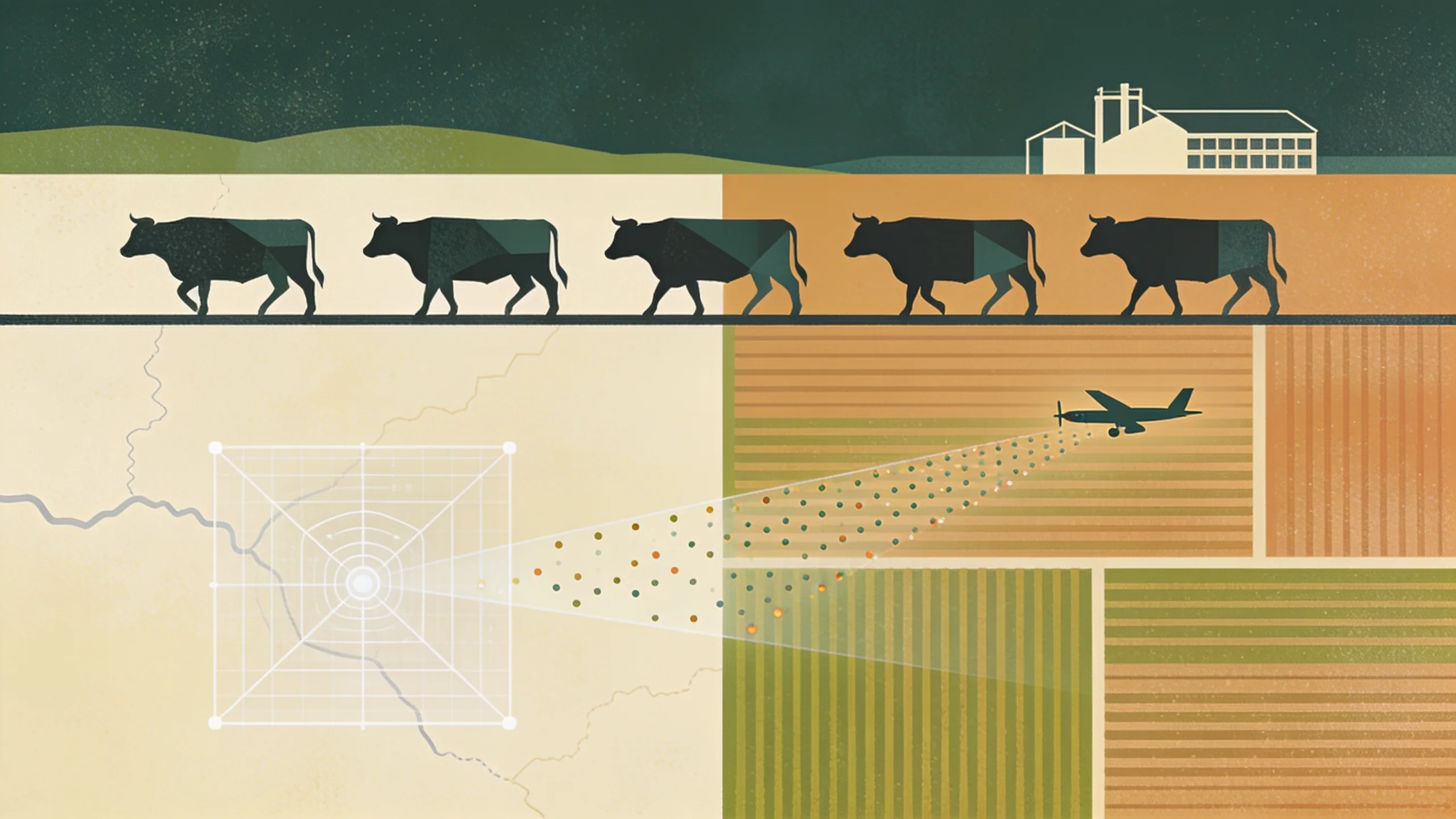
USDA Says the Data, Not the Calendar, Decides When the Next Cattle Port Reopens
Two cattle ports on the southern border are open again, a third is under assessment, and on Friday the USDA official who oversees the agency's marketing and regulatory programs explained why the order to move cattle had less to do with a calendar than with trap counts.
"The good news is only two of those are currently active," Under Secretary Dudley Hoskins told RFD-TV's Market Day Report, describing the 52 confirmed New World screwworm cases recorded in the United States since June 3. "That's really a reflection and a credit to the work that USDA, APHIS — our whole-of-government approach — federal partners, state partners."
The two reopened crossings are Douglas, in Arizona, and Santa Teresa, in New Mexico, and the cattle moving through them are not doing so on the strength of a signing ceremony. Hoskins described a chain of inspections that begins at gathering centers and continues through examinations by accredited veterinarians, inspections of the port facilities themselves, administration of FDA-approved products for screwworm, hands-on inspection by APHIS personnel, detector dog teams and dipping baths for individual animals. Assessments have run around the clock since the ports reopened. "The assessment we do on the ground is so important," he said, noting that Veterinary Services and Wildlife Services crews handle the trapping and monitoring in the surrounding country.
Reopening, in other words, is not the end of the process. Hoskins listed what would put it back under review: a breakdown in the protocol for any reason, or infestations flaring in and around the ports. He said Agriculture Secretary Brooke Rollins has made clear that cattle movement could be suspended again if conditions warrant. That structure explains why the Texas Animal Health Commission's own entry requirements for animals arriving from other affected states — written on Oct. 1 — still stand even as the federal posture loosens.
Behind the inspection regime sits a supply problem measured in insects. The sterile insect technique, developed by USDA's Agricultural Research Service in the 1960s, breaks the fly's reproductive cycle by releasing irradiated males that father nothing. Hoskins said the COPEG facility in Panama produces roughly 100 million sterile flies a week through a regional partnership, and that USDA helped convert a former fruit fly plant in Metapa, Mexico, which is now producing about 50 million a week with production expected to climb through the end of the year. "Ultimately, that facility will be able to produce another 100 million-plus sterile flies per week," he said.
The plant that matters most to Texas is still being built. The sterile fly facility at Moore Air Base in Edinburg, in Hidalgo County, was originally on a three-to-five-year construction schedule, a timeline Hoskins attributed to the site's power, water, logistics and security requirements. Coordination with the Army Corps of Engineers and the contractor pulled the completion date to April 2027. Production will not begin the day construction ends, he cautioned, because the fly colony has to be established and scaled. Phase one is expected to reach 100 million sterile flies a week; phase two, within the following year, adds another 200 million. "Effectively, 300 million sterile flies per week coming out of Moore Air Base once it's fully operational after phase two."
For Texas ranchers, that is the number that will decide how this outbreak is remembered. The state has been the American front line since the Department of State Health Services announced a screwworm detection in a three-week-old Zavala County calf on June 4, and the fly has since been confirmed in more than 20 Texas counties across livestock, pets and wildlife. Movement rules for cattle, horses, dogs and deer have followed, while the fly supply to fight the parasite still arrives by air from Central America.
The ports, then, are a test that runs continuously rather than a milestone that has been passed. Surveillance data opened them. The same data — and the volume of sterile flies the federal government can put into the air downwind of them — is what keeps them open.
Sources
Texas Bug Slayers Editorial Team
Editorial Board
The Texas Bug Slayers editorial team brings together licensed pest control professionals, entomologists, and writers dedicated to helping Texans protect their homes and families from pests.
Related Articles

US and Mexico Open Massive Sterile Fly Facility in Chiapas to Combat Screwworm Threatening Texas
A new $50+ million sterile fly production plant in Metapa, Mexico will produce 100 million flies weekly to suppress New World screwworm populations threatening Texas livestock.
Free Screwworm Inspector Course in Texas: How to Get Certified (AgriLife Online)
Texas' free 4-hour online screwworm inspector course on AgriLife Learn: who is eligible, what the training covers, and how certification lets you issue movement certificates.
AgriLife Puts Screwworm and Pasture Mealybug in the Same Room on Oct. 26
Texas A&M AgriLife Extension heads to Franklin with a screwworm deep dive, pasture mealybug control guidance and seven TDA CEUs on the schedule.