
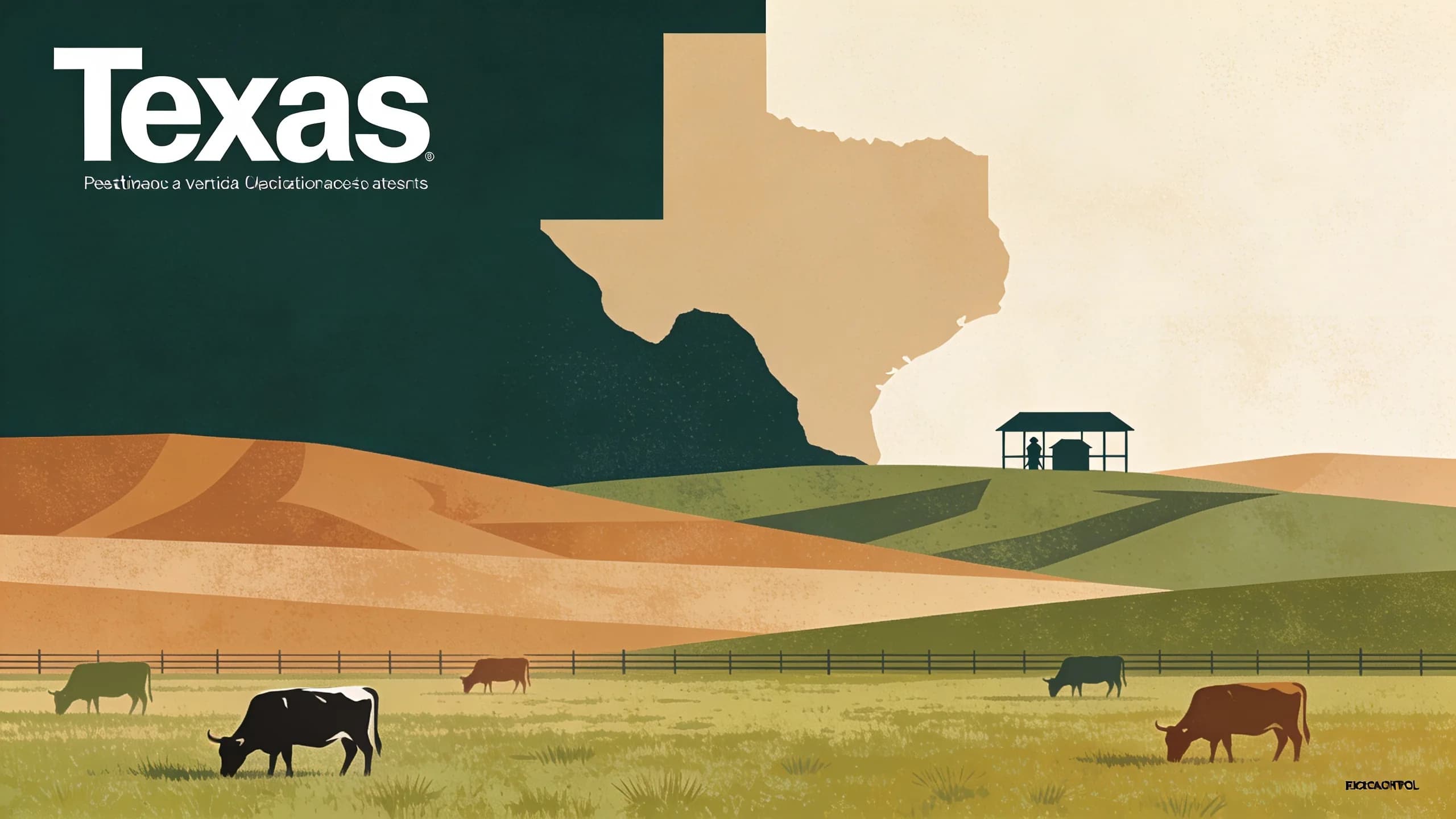
Screwworm Spreads Beyond Initial Zone as Texas Cases Reach a Dozen
The New World screwworm has pushed past its initial containment boundaries in Texas, with confirmed infections reaching at least a dozen animals across multiple counties and spreading roughly 200 miles from where the parasite first reappeared in the United States.
Track every confirmed case on our live Texas screwworm tracker and county map.
Late last week, USDA Animal and Plant Health Inspection Service confirmed the parasitic fly in a sheep in Sutton County and a head of cattle in Tom Green County — both located in West Texas, far from the original detection in Zavala County near the Mexican border. The total case count now includes at least twelve infected animals, eight of them cattle, according to federal tracking data.
This geographic expansion represents a concerning development for containment efforts. The parasite, which lays eggs in open wounds of warm-blooded animals and whose larvae burrow into living flesh, had previously been confined to a defined control zone in South Texas. The Sutton and Tom Green county detections demonstrate the screwworm's capacity for rapid dispersal across substantial distances.
"Further spread in Texas or in other states would be a very bad milestone," said Andy Moorhead, associate professor at North Carolina State University and president of the American Association of Veterinary Parasitologists. Moorhead noted that screwworm dominated discussions at the association's annual meeting earlier this month — the first time in recent memory a single pest has commanded such exclusive attention from veterinary parasitology experts.
The outbreak threatens an already stressed U.S. cattle industry. Drought conditions and elevated production costs have driven the national herd to its lowest population in 75 years. Movement restrictions imposed to contain screwworm spread will likely complicate herd rebuilding efforts, potentially extending the timeline for production recovery and maintaining pressure on beef prices that have already reached record levels.
Under current Texas Animal Health Commission protocols, animals cannot be moved outside affected areas without federal authorization. TAHC representatives must inspect carcasses before removal from quarantine zones, adding logistical complexity for ranchers managing normal livestock operations.
Stephen Diebel, president of the Texas and Southwestern Cattle Raisers Association, characterized the current situation as offering "many more advantages" compared to the 1970s outbreak, when screwworm infected an estimated 1.5 million head of cattle across Texas. Modern surveillance networks, rapid diagnostic capabilities, and coordinated federal-state response mechanisms provide tools unavailable during that previous crisis.
However, the primary weapon for eradication remains more than a year from full deployment. The sterile insect technique — releasing massive numbers of sterilized male flies to disrupt reproduction — requires industrial-scale production facilities that do not yet exist in the United States.
Currently, the only operational sterile fly facility is a plant in Panama producing only a fraction of the insects needed for effective response across Texas and potentially affected neighboring states. The $750 million U.S. facility under construction at Moore Air Base in Edinburg, Texas, is not scheduled to begin significant production until November 2027.
Agriculture Secretary Brooke Rollins acknowledged the timeline challenge last week, stating the U.S. "will not be able to eradicate it until we've got the couple hundred million more flies coming in, but we will be able to contain it." Rollins declined to speculate on how far screwworm might spread before the Texas facility reaches operational capacity.
Arlan Suderman, chief commodities economist at StoneX Group, expressed concern that even after the Edinburg facility opens, effectiveness depends on how successfully sterile males compete with wild populations for mating opportunities. "My fear is that we're talking about two to three years" to curb the spread, Suderman said, noting the unknown quantity of screwworms already present and reproducing in Texas.
Governor Greg Abbott responded to the expanding threat by launching a free online certification program for New World screwworm inspectors. The training, developed in partnership with Texas A&M AgriLife Extension, USDA APHIS, Texas Animal Health Commission, and Texas Parks and Wildlife Department, enables private citizens and industry personnel to inspect and certify livestock movement — expanding inspection capacity beyond government personnel.
The Texas A&M AgriLife Extension Service is simultaneously conducting an intensive education campaign, hosting more than 300 events across the state to train livestock producers, wildlife managers, and rural residents in screwworm identification, prevention, and response protocols.
USDA continues releasing sterile flies from the Panama facility along the Texas-Mexico border and has expanded dispersal zones northward as detections occur. However, production limitations mean these releases cannot yet achieve the density necessary for effective population suppression across the full geographic range of current infections.
The screwworm's reappearance in Texas marks the first U.S. detection in domestic livestock in approximately five decades and the first case of any kind in ten years. The parasite was successfully eradicated from the United States during the 1960s through an intensive sterile fly program, but has persisted in parts of Central and South America where eradication efforts faced logistical and funding challenges.
Federal and state officials maintain that while eradication remains the ultimate goal, the immediate priority is containment — preventing spread beyond Texas into other cattle-producing states where the economic and logistical challenges would multiply exponentially.
Sources
Texas Bug Slayers Editorial Team
Editorial Board
The Texas Bug Slayers editorial team brings together licensed pest control professionals, entomologists, and writers dedicated to helping Texans protect their homes and families from pests.
Related Articles

USDA Unveils Quarterly Review Roadmap for Screwworm Response Playbook
USDA APHIS shares comprehensive roadmap for quarterly reviews of New World Screwworm Response Playbook as parasite cases reach 45 infestations across Texas and New Mexico.
Screwworm Count Reaches 44 as Brewster County Adds Two More Cases and the Infested Zone Extends Into Presidio
USDA's dashboard now lists 44 confirmed New World screwworm cases — 43 in Texas — after two cattle cases in Brewster County and a sheep in Pecos County closed out July. TAHC has extended the infested zone into Presidio County, bringing movement restrictions to parts of 23 counties.
Screwworm Count Reaches 42 as Three More Texas Counties Join the Case Map and Pet Transport Rules Tighten
USDA's dashboard now lists 42 confirmed New World screwworm cases — 41 in Texas — after goats tested positive in Sutton County on July 21. Jim Hogg, Pecos and Uvalde counties also carry confirmed cases, and interstate pet transport rules are squeezing Texas shelters.