
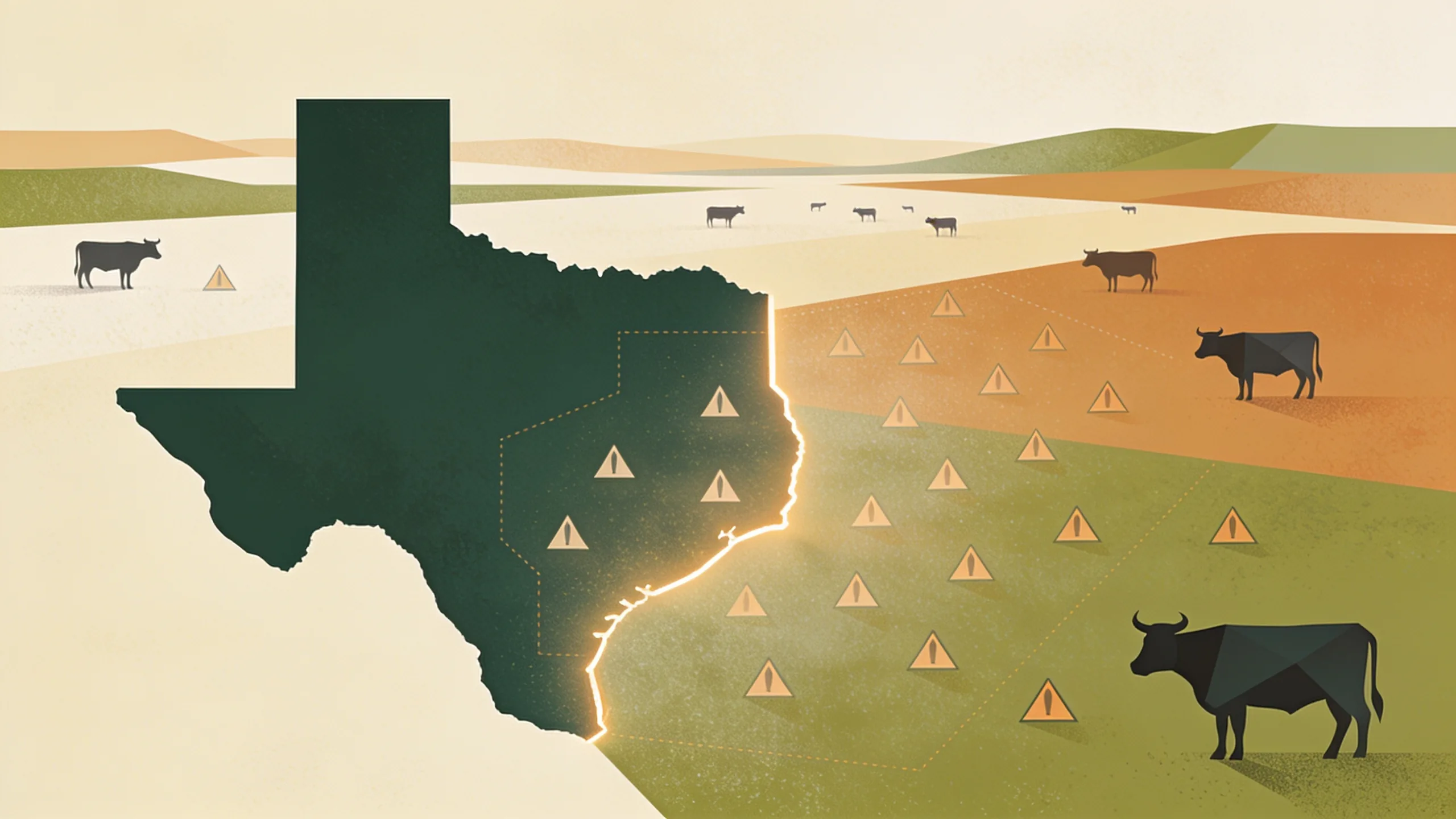
Screwworm Spreads Beyond Initial Zone as Texas Cases Reach a Dozen
The New World screwworm has pushed beyond its initial containment zone in South Texas, with recent detections in Sutton and Tom Green counties—approximately 200 miles from where the first U.S. case in decades was confirmed just two weeks ago.
For the running case count and the affected-county map, follow our Texas screwworm tracker.
The U.S. Department of Agriculture's Animal and Plant Health Inspection Service confirmed the latest infections late last week, bringing the total number of cases to at least twelve. Eight of the infected animals are cattle, with additional cases involving goats and at least one dog. All but one case have been identified in Texas.
The geographic spread represents a significant escalation in the outbreak. The initial detection on June 3 in Zavala County marked the first domestic livestock case in the United States in roughly 50 years. Now, with confirmed infections spanning multiple regions of the state, agricultural officials are racing to contain the parasite before it establishes a permanent foothold.
Economic Stakes Rise
The expanding outbreak comes at a precarious moment for the U.S. cattle industry. Drought conditions and high production costs have already reduced the national herd to its smallest size in 75 years. Movement restrictions imposed to contain screwworm threaten to slow herd rebuilding efforts further, potentially driving already-record beef prices even higher.
"Further spread in Texas or in other states would be a very bad milestone," said Andy Moorhead, an associate professor at North Carolina State University and president of the American Association of Veterinary Parasitologists. Moorhead noted that screwworm dominated discussions at the association's annual meeting earlier this month.
Containment Strategy Faces Timeline Pressure
The primary weapon against screwworm is the sterile insect technique—releasing millions of radiation-sterilized male flies to mate with wild females, gradually collapsing the population. However, the infrastructure needed for large-scale implementation remains months away from operation.
Currently, a single facility in Panama produces sterile flies, but its output falls far short of what's needed for an effective response in Texas. The USDA's planned $750 million sterile fly facility at Moore Air Base in Edinburg isn't scheduled to begin significant production until November 2027.
Agriculture Secretary Brooke Rollins acknowledged the timeline challenge last week. "We're not going to be able to eradicate it until we've got the couple hundred million more flies coming in, but we will be able to contain it," Rollins said, adding that the ultimate geographic extent of the outbreak remains uncertain.
Local Response Intensifies
As state and federal agencies work on long-term solutions, Texas counties are taking proactive measures. Travis County and Caldwell County issued disaster declarations last week—even though neither county has confirmed cases—allowing faster coordination of resources and increased public awareness.
"This declaration is a proactive measure that allows us to better coordinate resources, strengthen communication with our state and federal partners, and ensure we're prepared to respond quickly if this pest is detected in our region," said Travis County Judge Andy Brown.
The Texas Animal Health Commission has imposed quarantine restrictions on portions of ten counties, prohibiting animal movement without authorization and requiring inspection of carcasses before removal from affected zones.
What Producers Should Know
Stephen Diebel, president of the Texas and Southwestern Cattle Raisers Association, noted that modern containment protocols offer advantages unavailable during the last major U.S. screwworm outbreak in the 1970s, when the pest infected an estimated 1.5 million head of cattle in Texas.
Current movement protocols, combined with existing sterile fly dispersals from Panama, should keep producers in reasonable shape until domestic production ramps up, Diebel said. However, he urged livestock owners to remain vigilant and report any suspected cases immediately.
The parasite poses no food safety risk—screwworm does not affect meat quality or human health through consumption. The threat is purely economic, centered on animal mortality and movement restrictions that complicate ranching operations.
For now, the industry watches and waits, hoping containment efforts can hold the line until the full arsenal of sterile flies comes online in late 2027.
Sources
Texas Bug Slayers Editorial Team
Editorial Board
The Texas Bug Slayers editorial team brings together licensed pest control professionals, entomologists, and writers dedicated to helping Texans protect their homes and families from pests.
Related Articles

USDA Unveils Quarterly Review Roadmap for Screwworm Response Playbook
USDA APHIS shares comprehensive roadmap for quarterly reviews of New World Screwworm Response Playbook as parasite cases reach 45 infestations across Texas and New Mexico.
Screwworm Count Reaches 44 as Brewster County Adds Two More Cases and the Infested Zone Extends Into Presidio
USDA's dashboard now lists 44 confirmed New World screwworm cases — 43 in Texas — after two cattle cases in Brewster County and a sheep in Pecos County closed out July. TAHC has extended the infested zone into Presidio County, bringing movement restrictions to parts of 23 counties.
Screwworm Count Reaches 42 as Three More Texas Counties Join the Case Map and Pet Transport Rules Tighten
USDA's dashboard now lists 42 confirmed New World screwworm cases — 41 in Texas — after goats tested positive in Sutton County on July 21. Jim Hogg, Pecos and Uvalde counties also carry confirmed cases, and interstate pet transport rules are squeezing Texas shelters.