
Texas Activates State Emergency Operations Center as Screwworm Infested Zone Spreads to 10 Counties
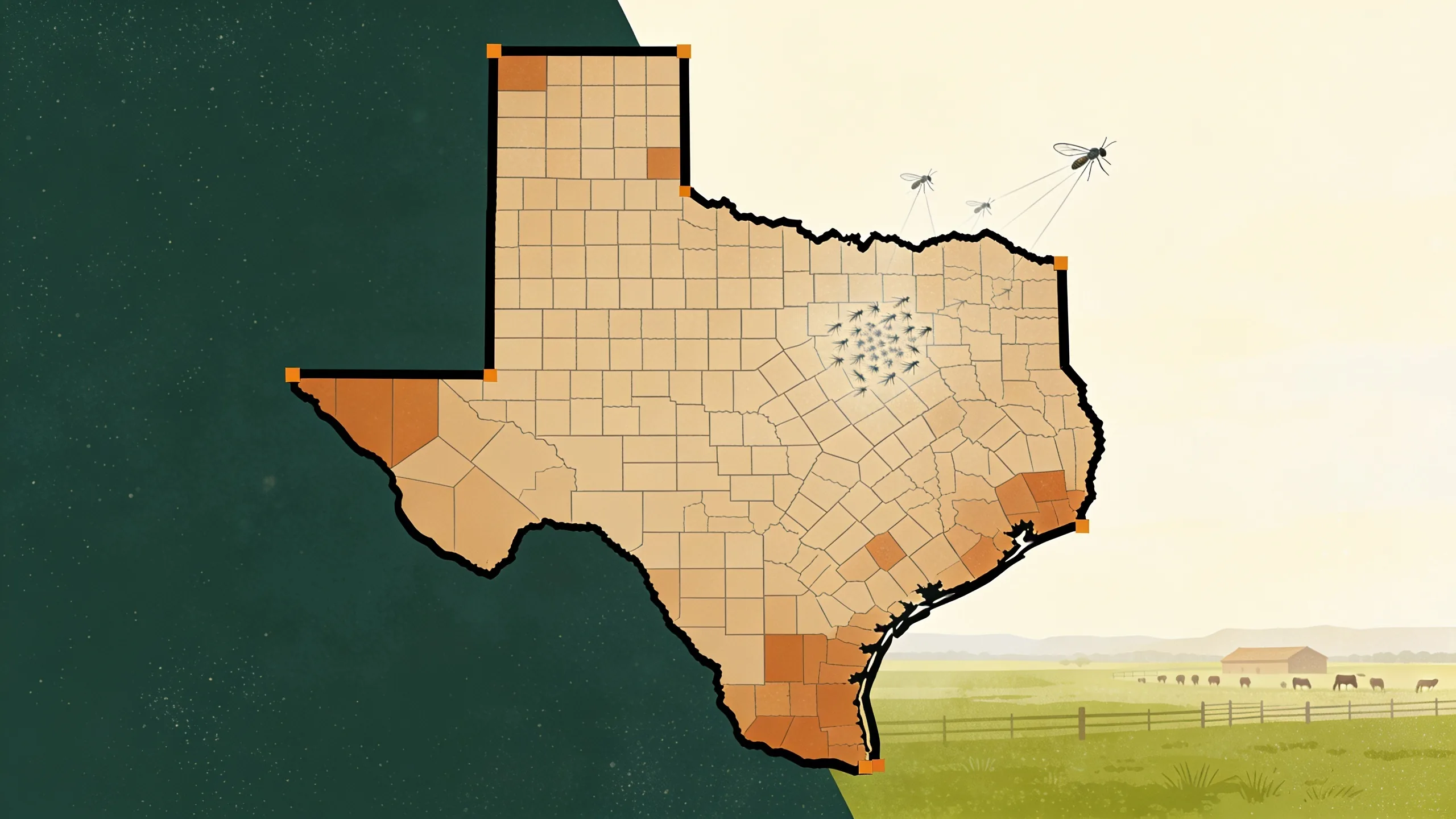
The flesh-eating parasite that crossed into Texas earlier this month is no longer a border worry confined to a single ranch. As of June 11, state and federal officials have confirmed six New World screwworm cases across Texas, and the quarantine net thrown around them now reaches into parts of ten counties. On June 8, Governor Greg Abbott responded by activating the Texas State Emergency Operations Center to Level II — its "Escalated Response" tier — and ordering every relevant state agency into the fight.
For the running case count and the affected-county map, follow our Texas screwworm tracker.
"I have activated the full use of all state resources to respond to the New World Screwworm threat," Abbott said in announcing the move. "The protection of our ranchers, livestock producers, deer breeders, and the Texas economy from this pest is a top priority."
From one calf to a multi-county zone
The first U.S. detection in six decades surfaced in a calf in Zavala County on June 3. In the days that followed, the count climbed to six confirmed cases, with new detections logged in La Salle, Gillespie and Edwards counties — a spread that pushed the parasite well north of the original site near the border. Cattle and goats have been the primary hosts so far, and a separate case once attributed to Texas was reclassified to neighboring Lea County, New Mexico.
To slow the insect's advance, the Texas Animal Health Commission has drawn an infested zone that now takes in portions of Edwards, Gillespie, Kerr, Kimble, La Salle, Sutton, Uvalde, Val Verde, Webb and Zavala counties. Inside that boundary the rule is blunt: no warm-blooded animal leaves without prior TAHC authorization. Livestock moving out of the area must be inspected and carry an animal movement certificate documenting prevention treatment — a paperwork checkpoint meant to keep an infested cow or goat from seeding a new outbreak hundreds of miles away.
All hands on the response
The emergency activation pulls together an unusually wide roster of agencies, a measure of how many fronts this pest touches. The Animal Health Commission, Texas Parks and Wildlife, Texas A&M AgriLife Extension, the Texas A&M Veterinary Medical Diagnostic Laboratory, the Department of Agriculture and the Department of State Health Services are all now working under the escalated structure — livestock regulators alongside wildlife managers, diagnosticians and public-health officials.
Eradication still leans on the tool that wiped the screwworm out the first time: sterile flies. USDA crews have been dispersing millions of sterilized screwworms in and around the affected counties so that wild females mate without producing viable offspring, collapsing the population over successive generations. The strategy works, but it is slow, and it depends on keeping infested animals from moving the larvae somewhere the sterile flies aren't being released — which is exactly what the quarantine is for.
What it means for Texans
No human cases have been reported, and officials continue to describe the risk to people as low. The screwworm's danger is to animals: females lay eggs in open wounds, and the hatching larvae burrow into living tissue, an infestation that can injure or kill an untreated animal within days. Health authorities are urging outdoor workers, hunters and livestock owners to keep wounds — on themselves and their animals — clean and covered.
For ranchers and pet owners in the affected counties, the practical advice is to inspect animals regularly and report anything suspicious. Livestock cases go to the Texas Animal Health Commission at 1-800-550-8242; wildlife concerns go to Texas Parks and Wildlife at (512) 389-4505. Early reporting is what keeps a single infested wound from becoming the seventh confirmed case.
Sources
Texas Bug Slayers Editorial Team
Editorial Board
The Texas Bug Slayers editorial team brings together licensed pest control professionals, entomologists, and writers dedicated to helping Texans protect their homes and families from pests.
Related Articles

USDA Unveils Quarterly Review Roadmap for Screwworm Response Playbook
USDA APHIS shares comprehensive roadmap for quarterly reviews of New World Screwworm Response Playbook as parasite cases reach 45 infestations across Texas and New Mexico.
Screwworm Count Reaches 44 as Brewster County Adds Two More Cases and the Infested Zone Extends Into Presidio
USDA's dashboard now lists 44 confirmed New World screwworm cases — 43 in Texas — after two cattle cases in Brewster County and a sheep in Pecos County closed out July. TAHC has extended the infested zone into Presidio County, bringing movement restrictions to parts of 23 counties.
Screwworm Count Reaches 42 as Three More Texas Counties Join the Case Map and Pet Transport Rules Tighten
USDA's dashboard now lists 42 confirmed New World screwworm cases — 41 in Texas — after goats tested positive in Sutton County on July 21. Jim Hogg, Pecos and Uvalde counties also carry confirmed cases, and interstate pet transport rules are squeezing Texas shelters.