
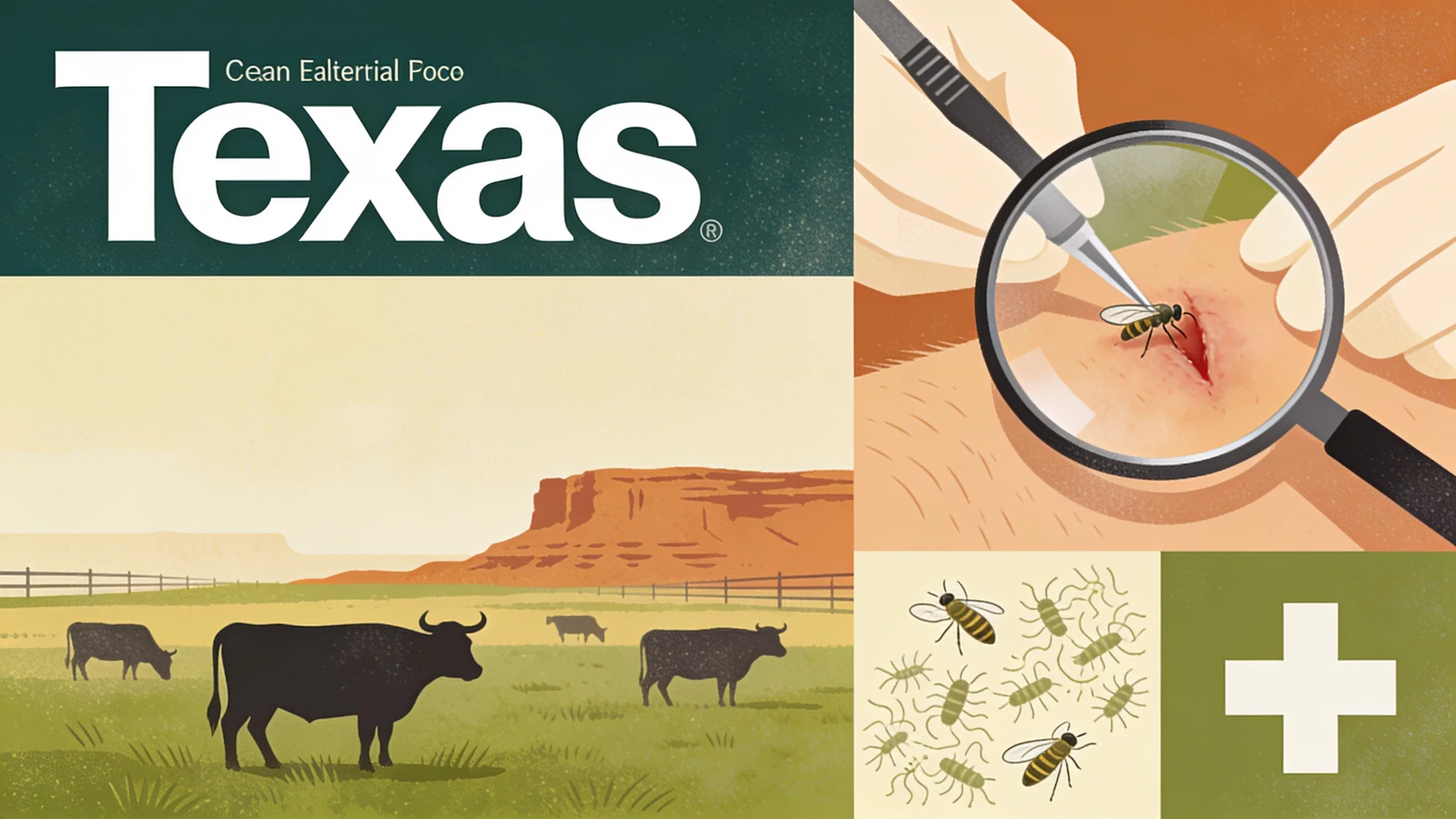
New World Screwworm Confirmed in Texas: What Livestock Owners and Residents Need to Know Now
On June 3, 2026, the U.S. Department of Agriculture's Animal and Plant Health Inspection Service (USDA-APHIS) confirmed what Texas agriculture officials had been dreading for months: New World screwworm has officially entered the state. A three-week-old calf in Zavala County, southwest of San Antonio, became the first confirmed case of this devastating parasite on Texas soil.
Our live Texas screwworm case tracker keeps the running count and county map as USDA updates land.
The detection marks a critical turning point in a months-long vigil that began when screwworm was first identified creeping north from Central America. While the news is serious, state and federal officials emphasize that Texas is not in crisis mode—but rather entering a period of heightened awareness and coordinated response.
What Is New World Screwworm?
New World screwworm (Cochliomyia hominivorax) is a parasitic fly whose name literally means "man-eater"—a chillingly accurate description of its behavior. Unlike common blow flies that feed on dead tissue, screwworm larvae attack living flesh. The adult fly lays eggs in open wounds, and within 24 hours, larvae hatch and begin consuming living tissue from the inside out.
Untreated infestations can kill an animal within days to weeks. The parasite affects all warm-blooded animals: cattle, horses, sheep, goats, dogs, cats, wildlife, and in rare cases, humans. Before eradication efforts began in the 1950s, screwworm cost the U.S. livestock industry an estimated $200 million annually—roughly $2 billion in today's dollars.
How Did We Get Here?
The road to this detection began months earlier. In late 2024, screwworm was confirmed in Mexico's southern states, breaking a decades-long barrier that had kept the parasite south of the border. By spring 2025, it had reached northern Mexico. Texas agriculture officials have been on high alert ever since.
In preparation, Texas A&M AgriLife launched an unprecedented educational campaign. Over the past year, extension specialists conducted 316 educational events reaching nearly 23,000 Texans. County agents and specialists logged more than 45,000 educational hours preparing livestock producers, veterinarians, and wildlife managers for this moment.
What Texas Is Doing Now
The response has been swift and multi-pronged. Governor Greg Abbott launched free New World screwworm inspector training programs to expand the state's detection capacity. The Texas Animal Health Commission, Texas Parks and Wildlife Department, and Texas A&M Veterinary Medical Diagnostic Laboratory are working alongside USDA-APHIS to contain the threat.
Texas A&M AgriLife has mobilized experts across multiple departments—entomology, animal science, rangeland and wildlife management—to provide science-based guidance. The university has created a centralized resource hub at tx.ag/screwworm offering fact sheets, identification guides, and reporting protocols in both English and Spanish.
Throughout June, AgriLife Extension is hosting community meetings across the state. Events are scheduled in Wilbarger, Sutton, Jim Wells, Karnes, Wilson, Atascosa, Burnet, Wichita, Hays, Kimble, Medina, Bandera, Montague, Hale, Floyd, and multiple other counties. Some meetings offer continuing education units for licensed pesticide applicators.
What Livestock Owners Should Watch For
Early detection is critical. Screwworm infestations are most commonly found around wounds, the navels of newborn animals, branding marks, tick bites, or any break in the skin. Key warning signs include:
- Animals excessively licking or biting at a specific area
- Restlessness and isolation from the herd
- Foul-smelling wounds with visible larvae
- Wounds that fail to heal or worsen despite treatment
- A characteristic "honeycomb" appearance in severe infestations
Larvae are cream-colored, cylindrical, and have dark, hook-like mouthparts that distinguish them from other maggots. They typically feed head-down in wounds, creating a distinctive appearance.
What Pet Owners Need to Know
While screwworm is primarily a livestock threat, companion animals are also vulnerable. Dogs and cats with outdoor access, especially those with wounds or skin conditions, are at risk. Pet owners should:
- Check pets daily for any wounds, scratches, or skin irritations
- Keep pets indoors during peak fly activity (daylight hours)
- Seek immediate veterinary care for any wound showing unusual discharge or maggots
- Maintain regular flea and tick prevention, as these parasites create entry points
Human Health Considerations
Human cases are rare but possible. People with open wounds, especially those working with livestock or in outdoor environments, should take precautions. The Texas A&M AgriLife human health fact sheet recommends covering wounds, using insect repellent, and seeking medical attention immediately if maggots are found in any skin break.
The Economic Stakes
The economic implications extend far beyond individual animal losses. Texas leads the nation in cattle production, with a herd valued at over $15 billion. A widespread screwworm outbreak could trigger movement restrictions, quarantines, and trade barriers affecting the entire livestock industry.
Florida has already restricted livestock imports from six Texas counties over screwworm concerns. Additional restrictions could follow if the parasite spreads.
How to Report Suspected Cases
Anyone suspecting screwworm should contact their veterinarian or the Texas Animal Health Commission immediately. Do not attempt to treat suspected cases without professional guidance—improper handling can worsen infestations and delay official response.
The most effective control strategy remains the same as it was during the original eradication campaign: early detection and rapid response. When officials can suppress populations before they establish, the parasite can be contained.
Looking Forward
The confirmation of screwworm in Texas is a setback, but not a surrender. The infrastructure built over the past year—educational programs, surveillance networks, and interagency coordination—gives Texas tools that didn't exist during previous outbreaks.
USDA continues expanding sterile fly dispersal zones along the border, releasing millions of irradiated male flies that mate with wild females to collapse the population. The $750 million sterile insect facility under construction at Moore Air Base in Edinburg will eventually produce billions of these biological control agents.
For now, vigilance is the watchword. Every rancher checking their herd, every pet owner inspecting their animals, every outdoor worker covering their wounds—each action contributes to the collective defense against a parasite that once seemed consigned to history but has now returned to Texas soil.
For the latest updates, fact sheets, and educational resources, visit tx.ag/screwworm or contact your local Texas A&M AgriLife Extension office.
Sources
Texas Bug Slayers Editorial Team
Editorial Board
The Texas Bug Slayers editorial team brings together licensed pest control professionals, entomologists, and writers dedicated to helping Texans protect their homes and families from pests.
Related Articles
New World Screwworm Confirmed in Texas: 12 Cases Reported as Parasite Spreads
USDA confirms New World screwworm in Zavala County calf, triggering statewide response. Quarantine now covers 13 Texas counties as cases rise.
Screwworm Detected Just 60 Miles from Texas Border as Commissioner Declares Emergency
Texas Agriculture Commissioner Sid Miller sounds alarm after USDA confirms New World screwworm in Nuevo León, Mexico, only 60 miles from the Texas border.
East Texas Ranchers Confront Screwworm Threat as Parasite Nears Border
Texas A&M AgriLife Extension educates ranchers on screwworm prevention as the parasite spreads toward Texas, with sterile fly releases already underway in South Texas.