
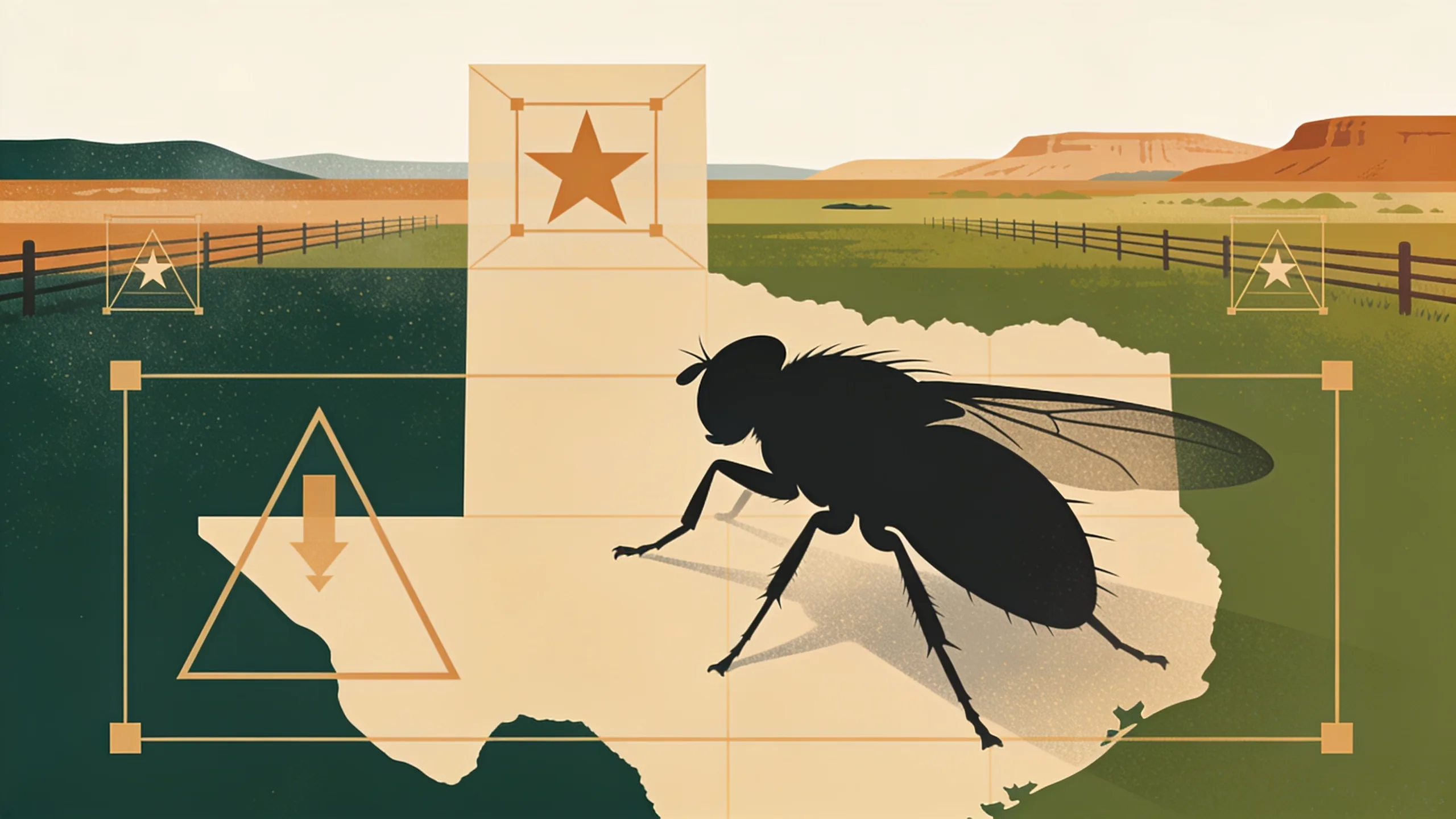
New World Screwworm Confirmed in Texas: 12 Cases Reported as Parasite Spreads
The New World screwworm has officially returned to Texas soil.
Track every confirmed case on our live Texas screwworm tracker and county map.
On June 3, 2026, the U.S. Department of Agriculture's Animal and Plant Health Inspection Service confirmed what agricultural officials had been dreading for months: a live New World screwworm infestation in a 3-week-old calf in Zavala County, Texas. The parasite, eradicated from the United States nearly 60 years ago through an ambitious sterile fly program, has now triggered a multi-agency emergency response stretching from South Texas to the state capital.
The Growing Crisis
What began as a single confirmed case has rapidly expanded. By mid-June, Texas officials reported 12 confirmed infestations across multiple counties, with the latest detection in Sutton County marking the parasite's spread beyond its initial South Texas foothold. The Texas Animal Health Commission has established an Infested Zone covering parts of 13 counties: Coke, Edwards, Gillespie, Kerr, Kimble, La Salle, Schleicher, Sutton, Tom Green, Uvalde, Val Verde, Webb, and Zavala.
The quarantine restrictions are stringent. No warm-blooded animals may leave the infested zone without prior TAHC authorization and inspection. During these inspections, animal health officials issue movement certificates documenting preventive treatments and official animal identification. For ranchers and livestock producers, this means additional costs, logistical complications, and constant vigilance.
What Makes This Parasite So Dangerous
New World screwworm flies lay eggs in open wounds or orifices of living animals. Unlike common blow flies that feed on dead tissue, screwworm larvae burrow into living flesh with sharp mouth hooks, creating progressively larger wounds. Untreated infestations can kill an animal within days through tissue destruction, secondary infection, and systemic shock.
The economic stakes extend far beyond individual animal losses. Texas leads the nation in cattle production, with a herd valued in the tens of billions of dollars. A widespread screwworm establishment could trigger export restrictions, increased production costs, and devastating losses for ranching families who have operated for generations.
The Response Mobilizes
Texas A&M AgriLife has emerged as a central hub for education and outreach. Extension specialists have already conducted 316 educational events reaching nearly 23,000 Texans, logging over 45,000 educational hours on screwworm preparedness. Now that the threat has materialized, that infrastructure is shifting from preparation to active response.
Throughout June, AgriLife Extension is hosting community meetings across the state. Events in Wilbarger, Sutton, Jim Wells, Karnes, Wilson, Atascosa, Burnet, Wichita, Hays, and Kimble counties are providing hands-on training in inspection protocols, wound management, and proper reporting procedures. Many sessions offer continuing education credits for licensed pesticide applicators.
Governor Greg Abbott has launched a first-of-its-kind New World Screwworm Preparedness and Response Education program, developed in partnership with USDA-APHIS, the Texas Animal Health Commission, and Texas Parks and Wildlife Department. The initiative includes free inspector training for producers and landowners in affected areas.
Eradication Strategy
The cornerstone of the eradication effort remains the sterile insect technique that successfully eliminated screwworm from the U.S. in 1966. USDA-APHIS is releasing millions of sterilized male flies across affected areas. These males mate with wild females, which then lay nonviable eggs. Without new larvae entering the population, the infestation collapses over several fly generations.
Aerial and ground dispersal operations are already underway, with additional sterile fly production capacity coming online at the Moore Air Base facility in Edinburg. The $750 million facility, currently under construction, represents a long-term investment in protecting North American agriculture from this persistent threat.
What Producers Should Do Now
For livestock owners across Texas, early detection remains the most powerful tool. Daily animal inspections, particularly focusing on navels of newborn calves, branding wounds, and any injuries, can catch infestations before they become life-threatening. The characteristic signs—larvae with backward-protruding spines creating a screw-like appearance in wounds—require immediate reporting to TAHC at (512) 719-0700.
Wound treatment with approved parasiticides provides effective protection, and several products offer residual activity that prevents infestation for days or weeks. Producers should consult with their veterinarians to develop appropriate prevention protocols for their specific operations.
The New World screwworm's return to Texas represents a sobering reminder that agricultural biosecurity requires constant attention. Six decades of freedom from this parasite created a generation of producers who had never encountered it. Now, through coordinated federal, state, and local efforts, Texas faces the challenge of eliminating this threat once again—before it becomes a permanent feature of the landscape.
Sources
Texas Bug Slayers Editorial Team
Editorial Board
The Texas Bug Slayers editorial team brings together licensed pest control professionals, entomologists, and writers dedicated to helping Texans protect their homes and families from pests.
Related Articles
East Texas Ranchers Confront Screwworm Threat as Parasite Nears Border
Texas A&M AgriLife Extension educates ranchers on screwworm prevention as the parasite spreads toward Texas, with sterile fly releases already underway in South Texas.

Texas A&M AgriLife Launches Statewide Alert System for Agricultural Threats and Invasive Pests
New Texas Agriculture Alert System delivers real-time notifications about pest outbreaks, wildlife diseases, and quarantine actions to farmers, ranchers, and residents across the state.

Texas A&M AgriLife Extension Deploys Massive Screwworm Education Campaign Across Texas
AgriLife Extension launches statewide educational events on New World screwworm, having already reached 23,000 Texans through 316 programs. Find upcoming workshops in your county.