
San Angelo Declares Disaster as Screwworm Cases Mount to 11 Across Texas and New Mexico
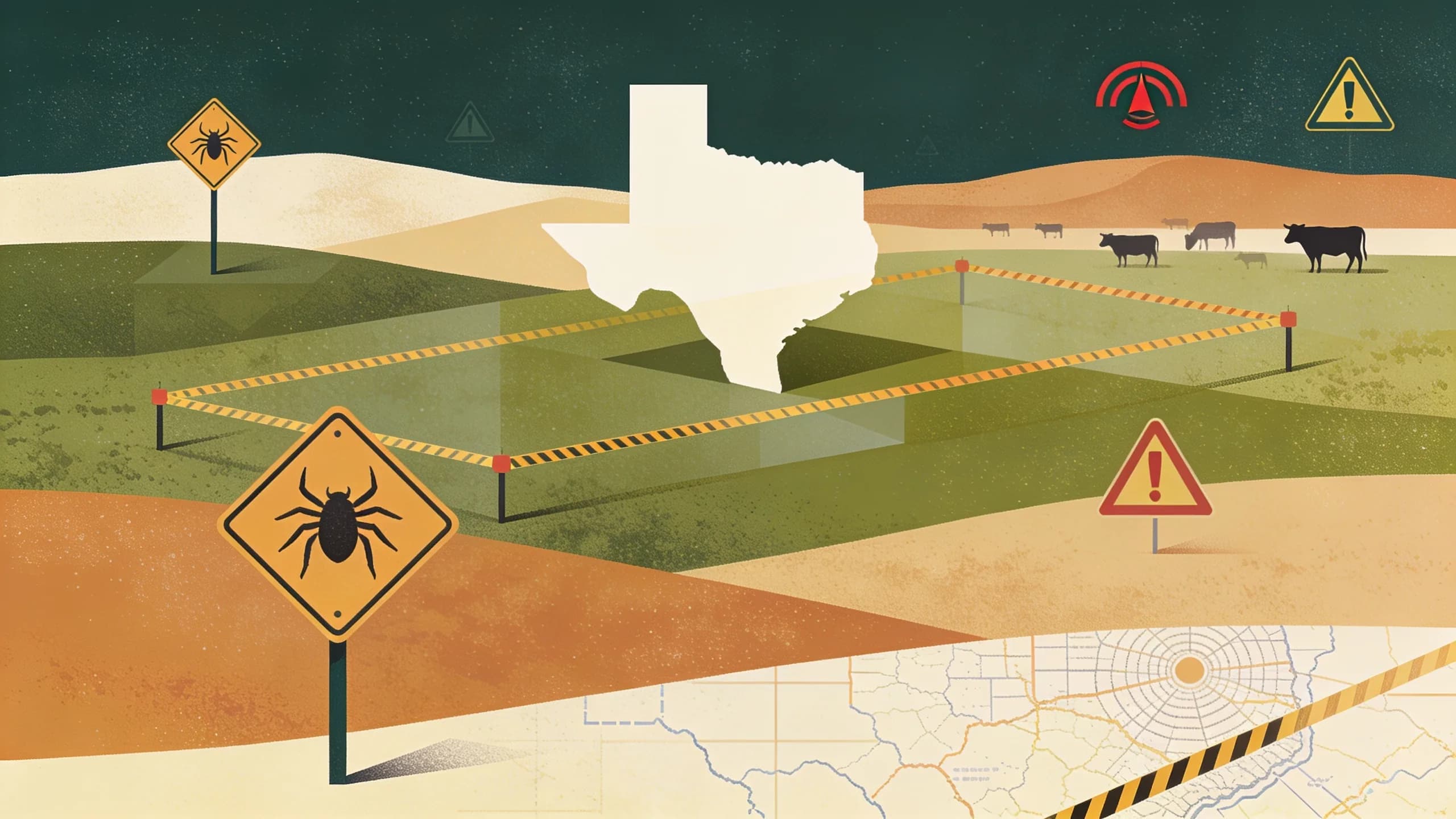
The New World screwworm outbreak sweeping through Texas claimed new territory Friday night when San Angelo and Tom Green County officials declared a local state of emergency following confirmation of a bovine case in northern reaches of the county.
Our live Texas screwworm case tracker keeps the running count and county map as USDA updates land. Local residents can browse licensed pest control companies in Tom Green County in our directory.
The declaration, issued jointly by city and county authorities, activates eligibility for state and federal assistance while underscoring how rapidly the flesh-eating parasite has expanded its range since first being detected in the United States on June 3. The San Angelo case brings the total confirmed infections to eleven across Texas and New Mexico—all in domestic animals including cattle, goats, and one dog.
According to the Texas Animal Health Commission, the infected animal was discovered on property between Grape Creek and Carlsbad, triggering immediate establishment of an infested zone visible on TAHC's interactive tracking map. The zone stretches into southern Coke County, with adjacent surveillance zones extending north past Robert Lee, west to Sterling City, south to Knickerbocker, and east beyond Miles.
Quarantine restrictions now cover twelve counties: Coke, Edwards, Gillespie, Kerr, Kimble, La Salle, Sutton, Tom Green, Uvalde, Val Verde, Webb, and Zavala. Within these zones, warm-blooded animals cannot move without prior TAHC authorization—a restriction designed to prevent human-assisted spread of the parasite while allowing essential commerce to continue under strict protocols.
The disaster declaration, initially effective for seven days unless extended, ensures Tom Green County residents can access available aid programs as the response effort mobilizes. State resources are already deployed, with coordination ongoing between local, state, and federal officials.
New World screwworm larvae pose a devastating threat to livestock and wildlife alike. The parasites burrow into living flesh, feeding on tissue and creating wounds that often prove fatal if untreated. Female flies are attracted to the scent of existing wounds or even minor scratches, laying eggs that hatch into destructive maggots within hours.
The outbreak's geographic spread has alarmed agricultural officials. What began as an isolated detection in Zavala County less than two weeks ago has now reached multiple counties across South and Central Texas, with a confirmed case in New Mexico's Andrews County signaling the threat's westward expansion.
USDA maintains daily updates to its confirmed case dashboard, providing ranchers and veterinarians with current information about affected areas. The agency has simultaneously ramped up sterile fly releases along the Rio Grande corridor, deploying millions of irradiated male flies weekly to mate with wild females and collapse the reproductive cycle.
For San Angelo, a community deeply rooted in ranching and agriculture, the local emergency declaration represents both immediate economic concern and longer-term uncertainty. The area's cattle operations must now navigate inspection requirements, movement restrictions, and heightened vigilance for signs of infestation among their herds.
State officials emphasize that the parasite poses minimal direct risk to humans—screwworm larvae do not infest healthy human tissue—but the economic ripple effects touch every corner of the agricultural economy. From feed suppliers to processing facilities, the restrictions necessary to contain the outbreak create cascading challenges throughout the supply chain.
The Texas Animal Health Commission continues serving as the lead state agency coordinating the response, operating a dedicated hotline at 512-719-0700 for questions and suspected case reports. Federal authorities urge anyone observing animals with unexplained wounds, unusual behavior, or visible parasites to contact authorities immediately for evaluation.
Sources
Texas Bug Slayers Editorial Team
Editorial Board
The Texas Bug Slayers editorial team brings together licensed pest control professionals, entomologists, and writers dedicated to helping Texans protect their homes and families from pests.
Related Articles

Screwworm Rules Follow the Herd North as Canada Turns Back Texas Cattle
Canada now lists Texas and New Mexico as screwworm-affected states, blocking live cattle imports and forcing returning herds into a 21-day detour.

First Wild Screwworm Fly Trapped in Texas as USDA Logs Brewster County Detection
USDA's case dashboard logged a wild screwworm fly from a Brewster County surveillance trap on Sept. 25 — the outbreak's first detection with no animal involved.
Screwworm Count Reaches 50 as New Mexico Confirms a Second Horse Case
USDA confirms the 50th U.S. New World screwworm case — a horse in Grant County, New Mexico, the outbreak's second equine case in two weeks — while the Texas count holds at 48 and a border port prepares to reopen to Mexican livestock.