
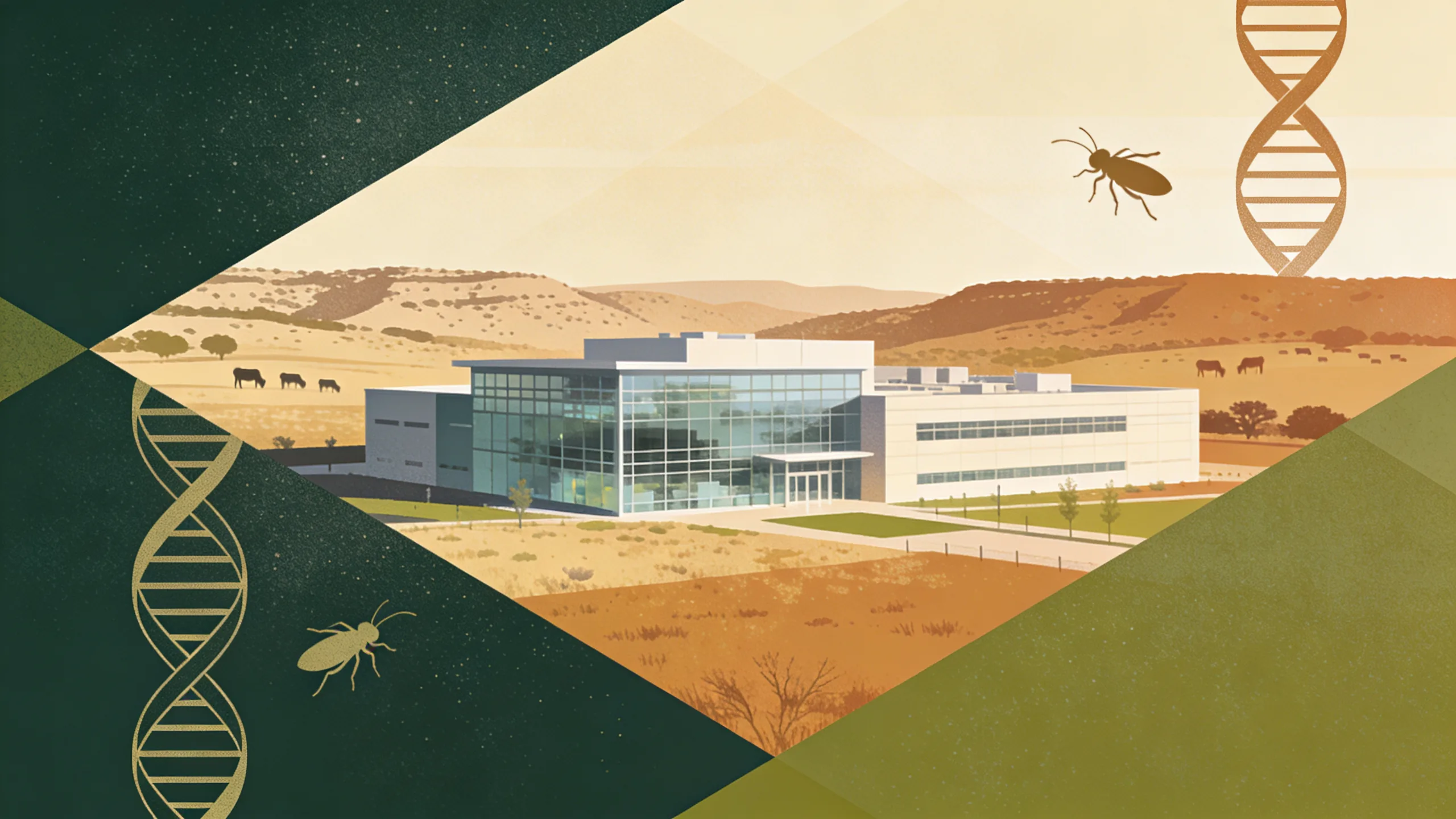
USDA Opens State-of-the-Art Research Lab in Texas to Combat New World Screwworm Threat
The United States Department of Agriculture has officially opened a cutting-edge research facility in the Texas Hill Country designed to combat one of the most devastating threats facing American livestock. The Knipling-Bushland U.S. Livestock Insects Research Laboratory, a 52,000-square-foot facility in Kerrville, Texas, represents the federal government's most significant investment in pest control research in decades.
For the running case count and the affected-county map, follow our Texas screwworm tracker.
Named after two pioneering USDA scientists whose work eradicated screwworms from the United States in the 1970s, the laboratory arrives at a critical moment. The New World screwworm, a parasitic fly that feeds on living tissue, has been detected within 100 miles of the Texas border in Mexico's Coahuila and Nuevo León states. The pest, which can kill cattle, goats, and even pets within days, poses an existential threat to the $94 billion Texas cattle industry.
"The Trump Administration has been committed to eradicating pests that could harm our American livestock since the President has been sworn in," said U.S. Secretary of Agriculture Brooke L. Rollins during the ribbon-cutting ceremony. "This brand new laboratory will allow us to research and find new active measures to keep current and future threats away from our borders."
A Legacy of Innovation
The facility honors Dr. Edward F. Knipling and Dr. Raymond C. Bushland, who developed the Sterile Insect Technique at the original Kerrville research station beginning in 1937. Knipling theorized that releasing sterilized male screwworms could collapse wild populations. Bushland proved it worked. By the 1970s, their method had eliminated the pest from the United States, Mexico, and Central America.
That same technique remains the cornerstone of screwworm defense today. The new laboratory will refine and expand upon it, housing two specialized research units: the Livestock Arthropod Pest Research Unit and the Veterinary Pest Genetics Research Unit.
Advanced Capabilities
The Kerrville facility features genomic research equipment, advanced cattle facilities, and cutting-edge laboratory spaces. Researchers will focus on multiple fronts: improving surveillance and trapping methods, developing novel insecticides and acaricides, enhancing pesticide delivery systems for both cattle and wildlife, and using insect genomics to identify pest vulnerabilities.
"This new laboratory will equip our researchers with advanced tools to combat the most destructive invasive insects already impacting the United States, as well as those posing future threats at our borders," said ARS Administrator Joon Park.
The research extends beyond screwworms. Scientists will study biting flies, ticks, and other arthropod pests that harm livestock, transmit disease, and cost American ranchers billions annually in lost productivity and treatment expenses.
The Screwworm Threat
The New World screwworm differs from common blowflies. While most fly species lay eggs on dead tissue, screwworm females seek out wounds, even tiny scratches, to deposit larvae. The maggots then eat living flesh, creating expanding wounds that attract more flies. Left untreated, infested animals die within days.
The pest was eradicated from the United States through decades of sterile fly releases along the Mexican border. But outbreaks in Central America have pushed the fly northward again. USDA data shows 15 active screwworm cases in Coahuila and 96 in Nuevo León as of late May 2026.
The department has already expanded sterile fly dispersal zones and established biological barriers. The Kerrville laboratory provides the research backbone for these defensive measures.
What This Means for Texas Ranchers
For Texas livestock producers, the laboratory represents both insurance and opportunity. The state's 12.8 million head of cattle represent the largest herd in the nation. A screwworm outbreak could trigger quarantines, movement restrictions, and devastating economic losses.
The research conducted at Kerrville will also address pesticide resistance, an growing problem in livestock pest management. As existing chemicals lose effectiveness, new compounds and delivery methods developed at the facility could provide ranchers with expanded toolkits for protecting their herds.
USDA Under Secretary for Research, Education, and Economics Dr. Scott Hutchins emphasized the long-term vision: "For the last 250 years, our nation has relied on research leading to science-based innovation as a means to overcome some of America's greatest agricultural challenges. The Knipling-Bushland U.S. Livestock Insects Research Laboratory will build on their legacy by protecting livestock health, ensuring that America's ranches remain productive, safe, and profitable for generations to come."
The laboratory's opening marks a full-circle moment for Kerrville, which has hosted USDA livestock insect research for over 80 years. From the same Texas soil where Knipling and Bushland changed pest control forever, their successors now take up the challenge of protecting American agriculture against the next generation of threats.
Sources
Texas Bug Slayers Editorial Team
Editorial Board
The Texas Bug Slayers editorial team brings together licensed pest control professionals, entomologists, and writers dedicated to helping Texans protect their homes and families from pests.
Related Articles
USDA Unveils Quarterly Review Roadmap for Screwworm Response Playbook
USDA APHIS shares comprehensive roadmap for quarterly reviews of New World Screwworm Response Playbook as parasite cases reach 45 infestations across Texas and New Mexico.

Texas A&M TVMDL Deploys Mobile Lab to Frontline of Screwworm Response
Texas A&M Veterinary Medical Diagnostic Laboratory establishes mobile diagnostic capability to support rapid screwworm detection and response efforts in South Texas.
Screwworm Count Reaches 44 as Brewster County Adds Two More Cases and the Infested Zone Extends Into Presidio
USDA's dashboard now lists 44 confirmed New World screwworm cases — 43 in Texas — after two cattle cases in Brewster County and a sheep in Pecos County closed out July. TAHC has extended the infested zone into Presidio County, bringing movement restrictions to parts of 23 counties.