
Screwworm Parasite Detected Just 57 Miles from Texas Border in Domestic Cat
The flesh-eating New World screwworm has crept closer to Texas than ever before. Mexican agriculture officials confirmed on May 16 that a 16-month-old domestic cat tested positive for the parasite just 57 miles from the US border — the closest documented case yet in an outbreak that has agriculture officials on both sides of the border scrambling to contain.
Our live Texas screwworm case tracker keeps the running count and county map as USDA updates land.
The infected feline represents a troubling evolution in the screwworm's advance. Previous cases had maintained a buffer of 60 to 90 miles from Texas soil. Now that margin has narrowed to a distance traversable by a strong wind or a single day's journey. For an insect capable of flying up to 200 miles with favorable conditions, 57 miles is no longer a comfortable margin — it's a warning shot.
The Sterile Fly Wall
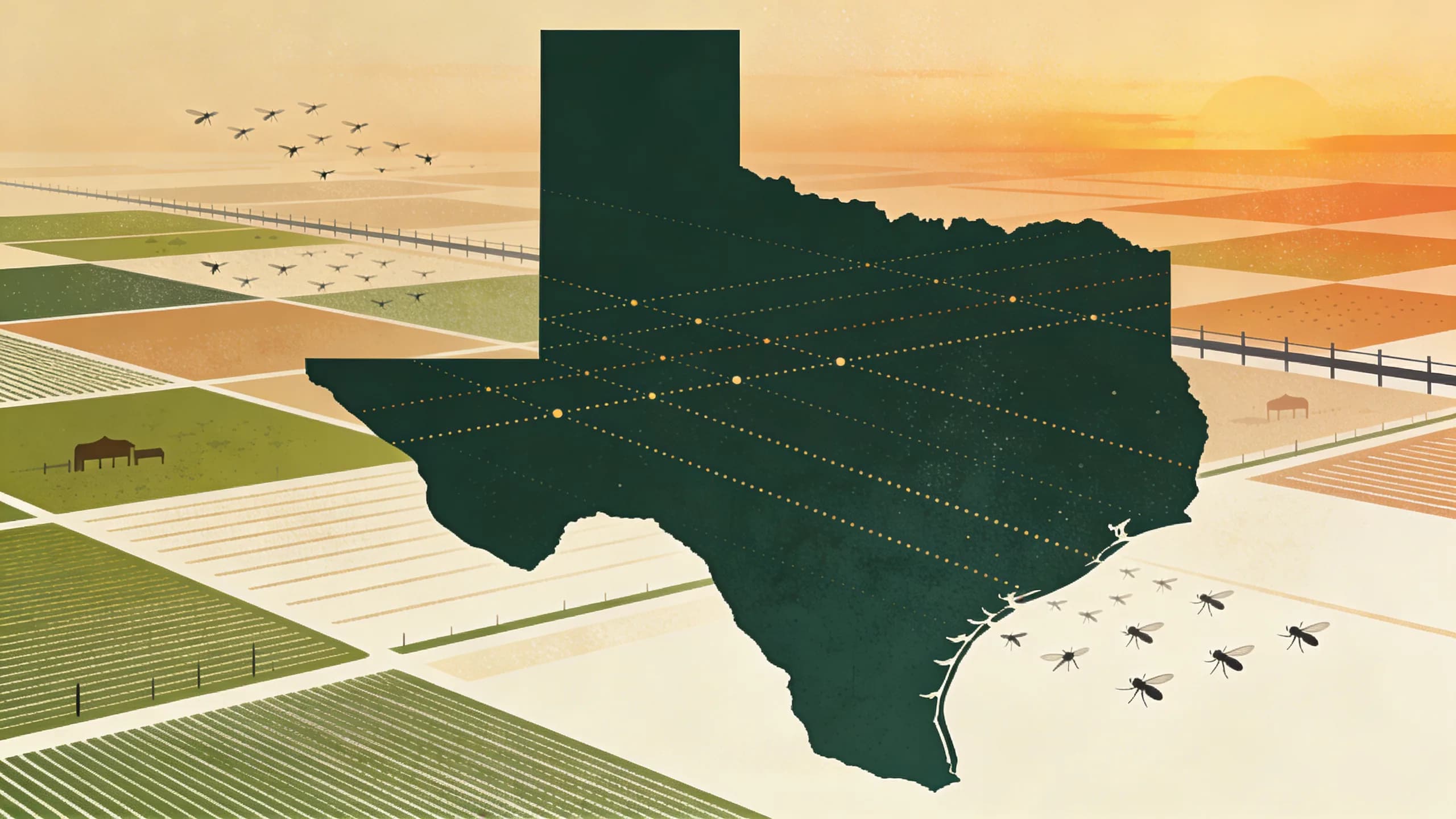
Behind the scenes, an unprecedented biological defense operation is underway. Right now, 100 million sterile screwworm flies rain down weekly across northern Mexico — released from aircraft in a decades-old eradication technique refined to precision. These irradiated males mate with wild females, who then lay only sterile eggs, collapsing the reproductive cycle one generation at a time.
The release zone stretches from Del Rio to Matamoros, blanketing Tamaulipas, Nuevo León, and Coahuila, with sterile flies penetrating roughly 25 miles into Texas territory as a defensive buffer. USDA crews have deployed surveillance traps along the entire border corridor, each one baited and monitored for the telltale sign: a fertile female that shouldn't exist this side of the barrier.
"Mexico, USDA, and Texas continue to take actions to prevent incursion of NWS into the United States," Oklahoma State Veterinarian Dr. Rod Hall wrote in an open letter to stakeholders. "Our hope is that the partners can keep the flies south of the border until fly reinforcements are available."
Those reinforcements are coming. Later this summer, Mexico expects to bring a second production facility online, doubling sterile fly output to 200 million weekly. The expanded capacity represents the largest screwworm suppression effort since the United States eradicated the parasite domestically in 1966.
The Economic Shadow
If the barrier fails, the economic consequences would be staggering. Texas Farm Bureau estimates project losses exceeding $8.5 billion from livestock impacts alone. But the real damage would unfold in daily increments — ranchers examining every wound on every animal, veterinary costs mounting, movement restrictions freezing trade, and the relentless labor of monitoring herds that can no longer be left unattended.
The screwworm fly doesn't kill quickly. It lays eggs in open wounds, no matter how small — a scratch from barbed wire, an insect bite, a branding mark. The hatched larvae burrow into living tissue, creating expanding lesions that attract more flies. Left untreated, animals die slowly from infection and tissue destruction. The parasite earned its name from the screw-like motion larvae use to drill deeper into flesh.
What Texas Ranchers Should Watch For
Despite the proximity of confirmed cases, no screwworm infections have been detected in the United States. Agriculture officials emphasize that vigilance, not panic, should guide the response.
Key identification markers distinguish screwworm larvae from common blowfly maggots:
- Egg patterns appear in distinctive shingle-like rows around wound edges
- Larval behavior differs critically — screwworm larvae burrow deep into tissue with their rear ends pointing outward, while blowfly maggots feed superficially
- Wound characteristics include a foul odor and persistent drainage that doesn't respond to normal cleaning
- Host specificity matters — screwworm targets only living, warm-blooded animals
Officials urge anyone spotting suspicious wounds to contact their state veterinarian before collecting samples. Misidentification is common during fly season, when ordinary maggots appear in countless wounds across livestock and wildlife.
A Proven Strategy Under Pressure
The sterile insect technique has defeated screwworms before. The same method eliminated the parasite from the United States between the 1950s and 1970s, then pushed the eradication line through Central America to the Darién Gap separating Panama from Colombia.
Tracy Tomascik, associate director of the Texas Farm Bureau, told Texas Public Radio that the current strategy is working better than models predicted. "A year ago, all the models said that we would have screwworm flies in Texas. But the work with our federal partners and then the Mexican government and the Mexican ranchers has prolonged that and given us time."
That time has allowed construction to advance on a new $750 million sterile fly facility at Moore Air Base near Edinburg, Texas — a permanent installation designed to sustain decades of suppression efforts should the parasite establish a foothold north of the border.
For now, the 57-mile gap represents both threat and testament. The screwworm has never been closer to returning to Texas. But the response has never been more coordinated, more resourced, or more prepared for the fight ahead.
Sources
Texas Bug Slayers Editorial Team
Editorial Board
The Texas Bug Slayers editorial team brings together licensed pest control professionals, entomologists, and writers dedicated to helping Texans protect their homes and families from pests.
Related Articles

USDA Unveils Quarterly Review Roadmap for Screwworm Response Playbook
USDA APHIS shares comprehensive roadmap for quarterly reviews of New World Screwworm Response Playbook as parasite cases reach 45 infestations across Texas and New Mexico.
Screwworm Count Reaches 44 as Brewster County Adds Two More Cases and the Infested Zone Extends Into Presidio
USDA's dashboard now lists 44 confirmed New World screwworm cases — 43 in Texas — after two cattle cases in Brewster County and a sheep in Pecos County closed out July. TAHC has extended the infested zone into Presidio County, bringing movement restrictions to parts of 23 counties.
Screwworm Count Reaches 42 as Three More Texas Counties Join the Case Map and Pet Transport Rules Tighten
USDA's dashboard now lists 42 confirmed New World screwworm cases — 41 in Texas — after goats tested positive in Sutton County on July 21. Jim Hogg, Pecos and Uvalde counties also carry confirmed cases, and interstate pet transport rules are squeezing Texas shelters.