
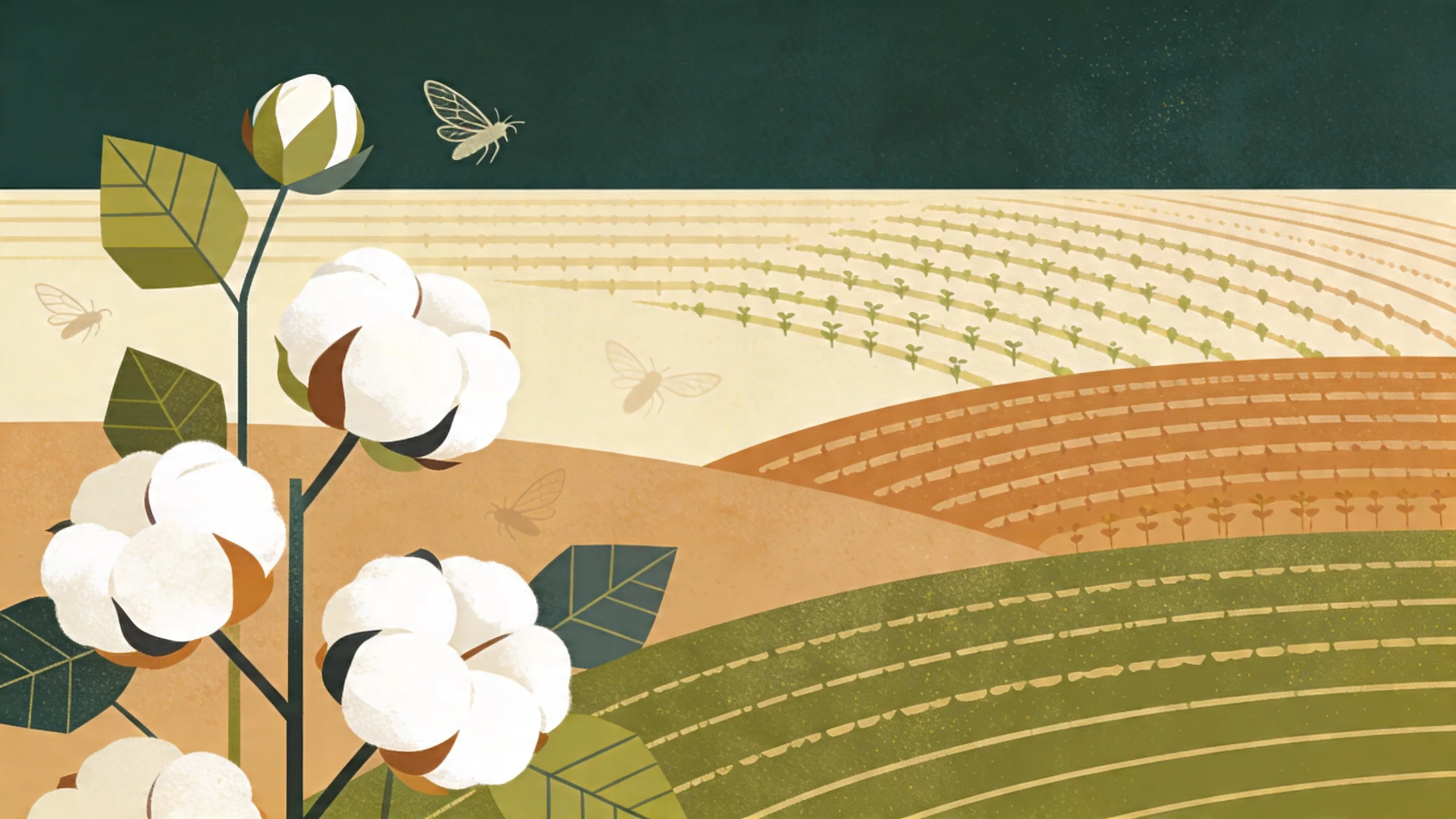
Cotton Jassid Invasion Threatens Texas's $5 Billion Cotton Industry
Texas produces roughly 40 percent of the nation's cotton, generating more than $5 billion in annual economic impact. Now an invasive pest no larger than Abraham Lincoln's nose on a penny is threatening to cut that revenue in half.
The cotton jassid, also known as the two-spot cotton leafhopper, has established a foothold in Southeast Texas, prompting the Texas Department of Agriculture to enact an emergency quarantine in February covering Cameron, Grimes, Fort Bend, and Wharton counties. Any county transporting hostable plants must now carry phytosanitary documentation or face shipment quarantines.
From Asia to the Gulf Coast
Native to Asia, the cotton jassid likely arrived in the United States through international trade or strong wind currents. The pest was first identified in Puerto Rico in 2023, then surfaced in South Florida in 2024. Since then it has marched steadily through the Southeast, establishing populations in Georgia, Alabama, Mississippi, Louisiana, and now Texas.
Late last year, entomologists spotted jassids on hibiscus plants in big-box stores across Texas. By that point, the insects had already begun appearing in cotton fields within the newly quarantined zones.
"This is a big potential threat to the Texas agricultural industry," said Suhas Vyavhare, Ph.D., associate professor and AgriLife Extension entomologist at Texas A&M. "At this stage, it's still a developing situation, but the potential impacts to production costs and insecticide applications are serious."
Identifying the Invisible Enemy
Adult cotton jassids are small, pale-green insects with yellow-tinted wings, roughly one-eighth of an inch long. Their telltale marking—two distinctive black dots at the tip of each wing—gives the species its common name and provides the clearest identification method for growers.
The insects feed on sap from the underside of cotton leaves while injecting a toxin whose exact nature remains unknown to researchers. Early infestation signs include "hopperburn," a condition where leaves yellow and curl inward. As damage progresses, leaf edges turn red and brittle, signaling the plant is dying.
"The rate at which a plant dies depends on the density of the jassid infestation, but it can be very quick," said David Kerns, Ph.D., professor and AgriLife Extension entomologist. "In severe infestations with as many as 30 jassids per leaf, plants have been observed to die within four days."
A Rapid Reproduction Cycle
What makes the cotton jassid particularly dangerous is its reproductive speed. Under favorable conditions, the pest completes a full generation approximately every two weeks. The Texas Department of Agriculture estimates that unchecked infestations could slash cotton yields by 50 percent.
Last year, jassids arrived late in the growing season, and colder temperatures helped keep populations suppressed. This year, extension specialists expect a surge as warmer spring temperatures coincide with prime flowering seasons.
Initial observations from Georgia suggest jassid infestations are most severe along field margins—the uncultivated strips between crops or at field boundaries. This pattern gives growers a potential early warning system if they know where to look.
Limited Arsenal, Urgent Response
Prevention and treatment options remain limited. Kerns encourages growers to plant early so crops can mature before jassid populations peak, and to avoid insecticide applications unless directly advised by specialists.
"Right now, the only viable treatment option is to spray insecticide on infested crops," Vyavhare said. "But before using those sprays, we need to make sure the insect is in fact a cotton jassid and not some other harmless leafhopper."
For organic growers like Jeremy Brown of Broadview Agriculture near Lubbock, the threat carries additional weight. Brown relies on regenerative agricultural practices that restore degraded soils and use limited pesticides. His remedies are restricted to nonchemical treatments, leaving him particularly vulnerable if jassids reach West Texas.
"Cotton jassid is on everyone's radar," Brown said. "Every year there is another challenge for us to overcome as farmers. My hope is that everyone is working together to mitigate whatever damage we can, especially as the warm weather comes."
What Growers Should Do Now
Vyavhare and Kerns emphasize vigilance without panic. Regular field scouting is essential to detect problems early and enable timely management. Plant nurseries should exercise caution and avoid transporting potentially infested host plants, particularly hibiscus, between regions.
"When pests like the sugarcane aphid or cotton jassid establish in new regions, there is always a learning curve to understand their biology and develop management strategies," Vyavhare said. "A key lesson from past experiences is the importance of not underestimating new pests."
Growers who suspect cotton jassid activity should contact their nearest AgriLife Extension office or extension entomologist immediately, and report findings to the Texas Department of Agriculture so officials can take steps to mitigate the situation or contain the spread.
The battle for Texas cotton is just beginning.
Sources
Texas Bug Slayers Editorial Team
Editorial Board
The Texas Bug Slayers editorial team brings together licensed pest control professionals, entomologists, and writers dedicated to helping Texans protect their homes and families from pests.
Related Articles
Lovebugs Swarm Houston in Late Summer Surge, Testing Patience and Paint
Houston drivers and homeowners face an unwelcome seasonal visitor as lovebugs swarm the region in higher-than-usual numbers this August.
New World Screwworm Confirmed in Texas: 12 Cases Reported as Parasite Spreads
USDA confirms New World screwworm in Zavala County calf, triggering statewide response. Quarantine now covers 13 Texas counties as cases rise.
USDA Declares Mexican Fruit Fly Quarantine in South Texas
APHIS establishes 55-square-mile quarantine in Zapata County after detecting invasive Mexican fruit fly, triggering restrictions on fruit movement and coordinated eradication efforts.