
Why Spiders Move Indoors Every Fall — and Which Texas Species to Watch
Every November somebody in a Texas suburb finds a spider the size of a drink coaster on the bathroom floor, and the household reacts as if the house has been breached. It hasn't, really. What usually happened is that a male wolf spider walked in through a door gap while looking for a mate, wandered into a room with nowhere to hide, and got stuck on tile until morning. He is not the front edge of an invasion. He is a lost guy on a bad date.
The season is real, though, and worth understanding before you reach for a spray can: the species behind the two bites that matter in Texas behave nothing like the big harmless ones people notice.
What fall actually changes
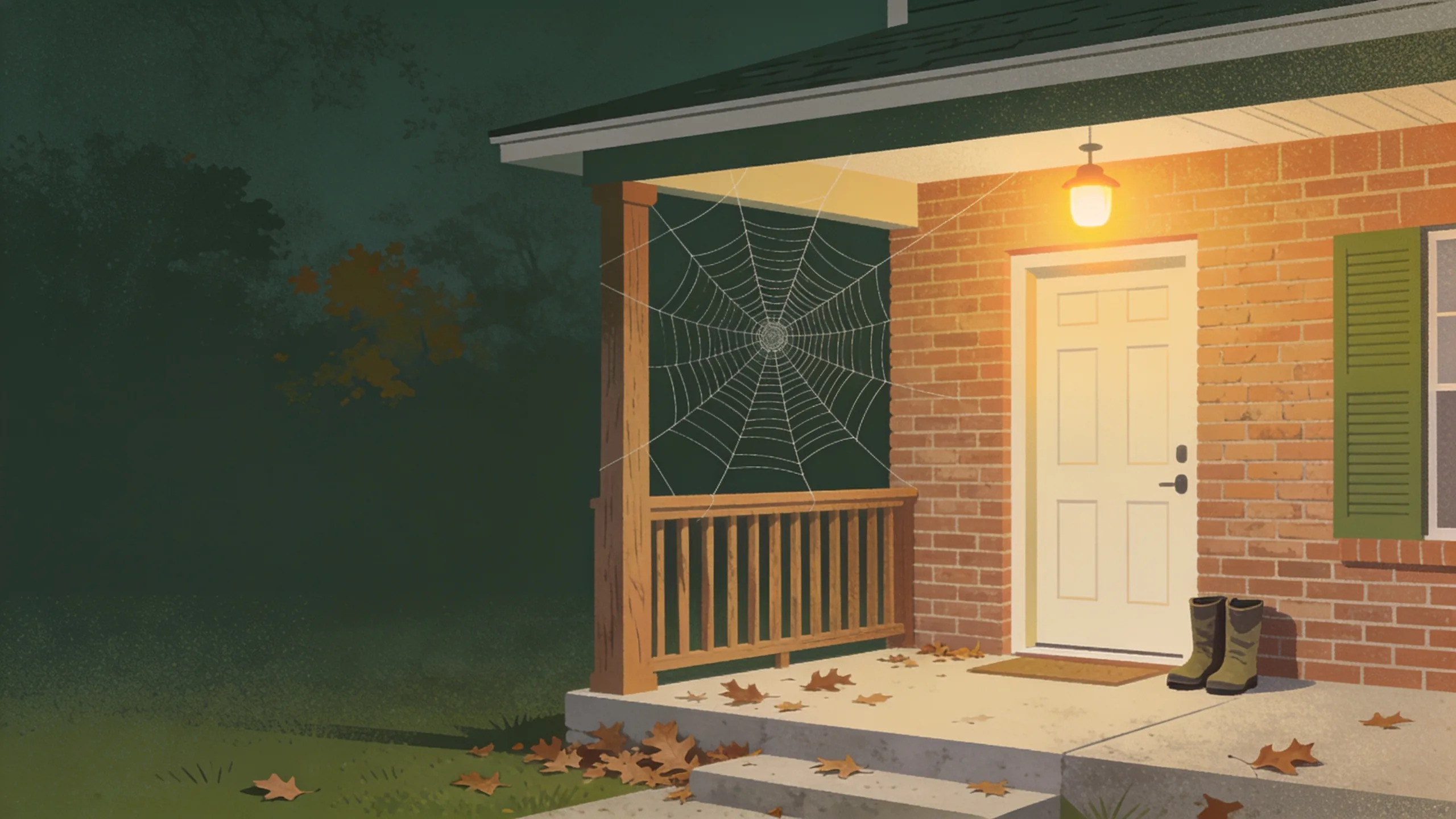
Most Texas spiders mature in late summer. Orb weavers — the fat, patterned ones hanging in a two-foot web between the porch column and the crepe myrtle — reach full size in September and October, lay their egg sacs, and die with the first hard freeze.
Males of wandering species do the opposite: once mature, they abandon web or burrow and walk for weeks, following pheromone trails. That is what lands them on garage floors and in bathtubs. They are not seeking your central heat — they are seeking a mate and finding a wall.
A house does offer three things a yard does not: steady temperature, no rain, and prey. Porch lights pull in moths and midges, and the corners around those lights hold a resident population of spiders that never needs to leave. That's the population worth managing — the ones already along the eaves, in the garage, behind the shutters.
The four you are most likely to meet
Wolf spiders are the big hairy ones that sprint across the floor at night. They hunt on foot, build no webs, and are so common here that most people have met one without learning the name. A female carrying a white egg sac, or spiderlings riding her back, is doing exactly what the species does. A bite, usually from one trapped against skin, is comparable to a bee sting.
Black widows are the ones to take seriously, and the easiest to overlook for years. Shiny black, globular abdomen, red hourglass underneath, and a web like careless cotton rather than a wheel, strung low in a dark corner. Garages, sheds, water meter boxes, the underside of outdoor furniture, the handle recess of a wheelbarrow that hasn't moved since spring. Along the Gulf Coast the mottled tan brown widow has largely taken that niche; its spiky, golf-ball egg sac gives it away, and its bite is generally reported as less severe — the avoidance rules are the same. Learn to tell them apart first.
Brown recluse is the identification homeowners get wrong most often, usually in the direction of panic. The real one is uniform sandy brown, no stripes or mottling, with a darker violin-shaped mark on the head region, neck pointing back toward the body. The detail that settles it is the eyes: six, in three pairs, instead of the usual eight. Recluses are established across Central, North, and East Texas and thin out toward far West Texas and the Lower Rio Grande Valley. They do not colonize a room in the open; they live behind things — closet corners, attic hatches, cardboard boxes that haven't moved, the gap between baseboard and slab, gloves in the garage.
Orb weavers and cellar spiders fill in the rest. The yellow-and-black garden spider hanging head-down in a web with a zigzag band of silk is an orb weaver, harmless and one of the better mosquito catchers on the property. Cellar spiders are the long-legged ones upside down in a shapeless garage web. Both are free pest control.
Two lookalikes cause most false alarms. A male southern house spider has long, straight feelers in front of its face and gets mistaken for a recluse constantly; it lives in brick cracks and is harmless.
The fall walkthrough, room by room
Fifteen minutes with a flashlight in November tells you more than a season of spraying. Start in the garage, where widows set up and where the treatment decision gets made. Look low: walls behind stored boxes, under the workbench, around the water heater pan, inside the rims of tires and buckets. Check any toy or garden shoe that has sat outside for a month.
Then the entry points: door sweeps that no longer touch the threshold, the gap under a garage door where daylight shows, the seal around a pet door, the space where the A/C line comes through the brick — the openings wandering males use, and the same ones that let in roaches and mice.
Next, interior hiding spots, in recluse country: closet floors behind shoes, cardboard storage in the spare bedroom, the gap behind a headboard, the attic access panel. Shake out gloves and boots before putting them on. That habit prevents a category of bite no pesticide application can.
Finally, the exterior at dusk with the porch light on. Most of what's on the wall and in the eaves is orb weaver and cellar spider work. Brush out the webs you can reach and note where they come back — that's the harborage, usually a light fixture, a shutter, or a gap between siding and trim.
Why the spray reflex disappoints
A perimeter spray kills spiders standing on treated surfaces the day it dries. It doesn't touch egg sacs tucked into a wall void, doesn't close the gap the next male walks through, and doesn't remove the porch light restocking the eaves. Three weeks later the wall looks the same.
What works is boring and mostly physical. Switch exterior lighting to warm yellow bulbs or move fixtures away from the door, because light drives the whole food chain here. Knock down webs before egg sacs hatch. Seal the perimeter with door sweeps, weatherstripping, weep hole covers on brick veneer, and quarter-inch mesh over crawlspace and gable vents on pier-and-beam homes. Fixing the prey supply matters too: ants trailing to a kitchen bin or silverfish in a damp closet keep spiders fed.
Where chemical work earns its place is inside voids and cracks rather than across a wall. Dust applied into weep holes, behind baseboards, into the gap between brick and sheathing, and along sill plates lasts far longer than a liquid spray and reaches the places recluses and widows sit. That's a job for someone with the equipment.
When it's worth calling someone
A single wolf spider in the hallway is a broom-and-a-glass problem. A black widow with egg sacs in a garage where kids keep their bikes is a different conversation, and so is a cluster of recluses in a bedroom closet. Then the useful call is about inspection and exclusion as much as pesticide: which species, where the harborage is, what gets dusted versus sealed.
Licensed pest control work in Texas runs under TDA categories, and household spider work sits in category P, pest control. A category describes a license, not a service list, so ask what the technician will actually do — crack-and-crevice dusting, web removal, exclusion, or a broadcast spray across the baseboards. Re-entry time for kids and pets matters too.
Spiders are also the pest where the cheapest fix is a $6 door sweep, so ask a provider what they'd seal before agreeing to a recurring plan. You can find licensed operators through the Texas pest control directory, and neighborhood scheduling for routine pest control service is common in the bigger metros — Austin and Fort Worth both have options, though exclusion is what changes the outcome.
One last piece of perspective. The webs on your porch in October belong to spiders that will be dead by December, their egg sacs waiting out winter. The widow in the garage belongs to a population that has been there for years. Two different problems, only one needs a plan.
Frequently Asked Questions
Is a large brown spider in my bathtub a brown recluse? Almost never. Most are wolf spiders or male southern house spiders that can't climb smooth porcelain. A recluse has a uniform abdomen, a violin mark on the head region, and six eyes in three pairs — and it prefers undisturbed corners to open floors.
Do I need to spray the whole house for spiders? No. Crack-and-crevice dusting in voids and weep holes, plus door sweeps and web removal, does more than a broadcast spray, and cutting the insects that feed spiders removes the reason they settled.
Should I kill the spiders in the garden? Leave the orb weavers and cellar spiders alone. They're harmless, they eat mosquitoes, and their webs are seasonal. The species worth acting on are widows near where people put their hands, and recluses inside living space.
Texas A&M AgriLife's insect field guide at texasinsects.tamu.edu is the reference to check before you decide what you're looking at.
Texas Bug Slayers Editorial Team
Editorial Board
The Texas Bug Slayers editorial team brings together licensed pest control professionals, entomologists, and writers dedicated to helping Texans protect their homes and families from pests.