
Scorpion Control in Texas — Complete Guide
Common in Hill Country and West Texas, painful stings
Not sure it's a Scorpions?
Snap a photo — our free AI tool identifies Texas pests in seconds.
Quick facts — Texas scorpions
- Species you'll see: striped bark scorpion (Centruroides vittatus) — ~99% of residential encounters
- Active season: April – October, peaks May–June and September
- Sting severity: painful (like a wasp) but rarely life-threatening for healthy adults; higher risk for children under 5, seniors, and allergic individuals
- Emergency numbers: Texas Poison Center Network 1-800-222-1222 (24/7, free). Call 911 for breathing difficulty, muscle twitching, or severe reaction
- Typical treatment cost: $200–$400 initial, $75–$150 monthly follow-up, $300–$1,000 for entry-point sealing (exclusion)
- Detection: UV blacklight at night — scorpions glow bright blue-green
About Scorpions in Texas
If you see a scorpion in your Texas home, it is almost certainly a striped bark scorpion (Centruroides vittatus) — this single species accounts for the vast majority of residential encounters and stings statewide. Texas is home to roughly 18 scorpion species total, but most live in remote West Texas habitats and almost never enter homes.
Scorpions are arachnids — relatives of spiders and ticks — that have thrived in Texas for millions of years. They are nocturnal predators that feed on insects, spiders, and other small invertebrates.
Wind Scorpions in Texas — Not a True Scorpion
Texas is also home to the wind scorpion — also called a camel spider or sun spider — a large, fast-moving arachnid that terrifies homeowners across West and South Texas. Despite the name, wind scorpions are not true scorpions: they belong to a separate arachnid order (Solifugae) and have no tail, no stinger, and no venom. Their oversized jaws look alarming, but they are harmless to people beyond a defensive pinch. For full identification and facts, see our wind scorpion (camel spider) guide.
Where Scorpions Live in Texas
Striped bark scorpions are found across much of the state, with the heaviest populations in the Hill Country and rocky suburban developments. Residential encounters are most frequent in:
- Hill Country & surrounding suburbs: Austin, Round Rock, Cedar Park, Georgetown, Dripping Springs, Wimberley, Fredericksburg, Kerrville, Boerne, New Braunfels
- San Antonio metro: especially the northern and western suburbs on limestone-rich terrain
- West Texas: San Angelo, Abilene, Midland, Odessa, El Paso
- DFW outskirts: expanding into newer developments in Denton, Rockwall, and western Tarrant County as construction pushes onto rocky ground
As housing construction pushes into rocky, rural terrain, homeowner encounters have increased dramatically over the past two decades. The pattern is simple: new homes built on limestone bedrock with desert-style landscaping tend to see more scorpion activity than older homes with mature soil and lawn.
Identifying the Striped Bark Scorpion
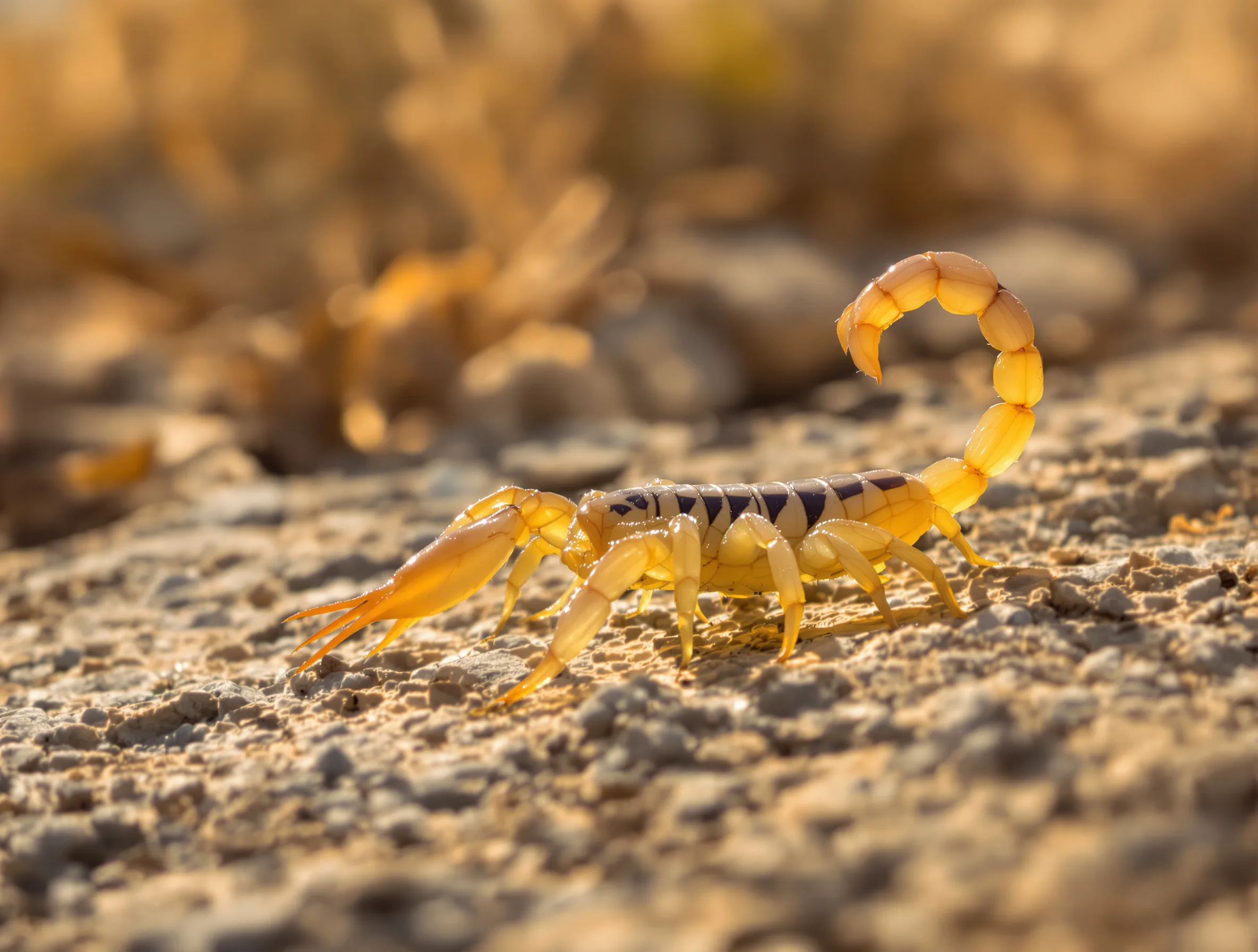
The striped bark scorpion is pale yellowish-tan with two dark longitudinal stripes on its back and a dark triangular mark on the head. Adults are 2 to 3 inches long including the tail. They are slender with relatively thin pincers. Unlike many scorpion species, striped bark scorpions are excellent climbers and can scale rough surfaces including stucco, brick, and tree bark — which is how they often end up inside homes, sometimes appearing on walls and ceilings.
Texas Scorpion Species — Quick Comparison
Texas Parks & Wildlife and Texas A&M AgriLife Extension recognize roughly 18 scorpion species in the state. The table below covers the ones a homeowner might actually encounter:
| Species | Size & color | Where in Texas | Sting severity | Home encounter risk |
|---|---|---|---|---|
| Striped bark scorpion Centruroides vittatus | 2–3 in, pale yellow-tan, 2 dark dorsal stripes | Statewide — heavy in Hill Country, SA, W Texas, DFW outskirts | Painful (wasp-like), rarely life-threatening in healthy adults | High — ~99% of residential stings |
| Florida bark scorpion Centruroides gracilis | 3–4 in, dark reddish-brown, no stripes | Rare, limited to far-southern/coastal TX; likely hitchhiker populations | More painful than striped bark; lingering numbness | Low — incidental |
| Texas cave scorpion Pseudouroctonus reddelli | 1.5–2 in, dark reddish-brown, stout | Edwards Plateau caves, basements, rock cuts in Central Texas | Mild — similar to a bee sting | Low — in homes only when built over karst |
| Lesser stripetail Chihuahuanus coahuilae | 2 in, tan with faint tail stripes | Trans-Pecos / Big Bend region — rocky desert | Mild | Very low — outdoor species |
| Giant hairy (desert hairy) scorpion Hadrurus arizonensis | 5–6 in, yellow with dark dorsal patch, bulky pincers | Far West Texas (desert grassland / gypsum dunes) | Intimidating size but mild venom | Very low — outdoor desert species |
Note: the medically significant Arizona bark scorpion (Centruroides sculpturatus) — the one that causes severe envenomation in Arizona — is not established in Texas. Reports of its presence in Texas are almost always misidentified striped bark scorpions.
UV Blacklight Detection
All scorpions fluoresce a bright blue-green under ultraviolet (UV) light, making blacklight flashlights the single most effective tool for detecting them. On a warm night, walk around your property with a UV flashlight to identify scorpion populations, entry points, and harborage areas. Check the foundation perimeter, exterior walls, around doors and windows, and in landscaping features like rock walls, mulch beds, and woodpiles. Indoor inspections should focus on baseboards, closets, bathrooms, and areas near exterior doors. A UV survey is the first step any pest control professional will perform when developing a scorpion treatment plan.
Scorpion Sting Symptoms and First Aid
A striped bark scorpion sting produces immediate, intense pain at the sting site — comparable to a wasp sting but often with a more prolonged burning sensation. Additional symptoms may include localized swelling, numbness or tingling that can radiate along the affected limb, and sensitivity at the sting site lasting 24 to 72 hours.
If You've Just Been Stung — Step-by-Step
- Call Texas Poison Center Network: 1-800-222-1222. Free, 24/7, English & Spanish. Specialists will assess your symptoms and tell you whether to monitor at home or go to the ER. This is faster than calling a doctor's office.
- Wash the site with soap and water. Do not cut, suck, or try to remove venom.
- Apply a cold compress (not ice directly on skin) for 10 to 15 minutes to reduce pain and swelling.
- Take an over-the-counter pain reliever. Ibuprofen or acetaminophen for adults. Acetaminophen only for children — never aspirin.
- Monitor for severe symptoms for 4 hours. Call 911 if you see any of the red-flag symptoms below.
Call 911 immediately if any of these occur: difficulty breathing or wheezing, throat tightness, muscle twitching or spasms, excessive drooling or salivation, roving or rapid eye movements, difficulty swallowing, blurred vision, confusion, or the victim is a child under 5. While fatalities from striped bark scorpion stings are extremely rare in Texas, severe neurotoxic reactions do occur in young children and sensitive individuals.
For healthy adults with no allergic history, most stings resolve within 24 to 48 hours without medical intervention. Keep the limb elevated and rest. If pain persists beyond 72 hours or the site shows signs of infection (warmth, spreading redness, pus), see a doctor.
What NOT to Do After a Scorpion Sting
Much of the common sting advice on social media is wrong, borrowed from snakebite first aid, or comes from regions with more venomous scorpion species (e.g., Arizona or Mexico). For striped bark scorpion stings in Texas:
- Do not cut the sting site or try to suck out the venom. Venom has already diffused into tissue; cutting only creates an infection risk.
- Do not apply a tourniquet or tight constricting band. This is snakebite advice and will make pain worse by concentrating venom in the limb.
- Do not give aspirin to a child — it carries a risk of Reye's syndrome. Acetaminophen is the correct pediatric pain reliever per the American Academy of Pediatrics.
- Do not self-administer Anascorp or other scorpion antivenom. Anascorp is FDA-approved only for severe envenomation by the Arizona bark scorpion and is not indicated for striped bark scorpion stings in Texas.
- Do not ignore a sting in a child under 5 or an elderly person — call Poison Control at 1-800-222-1222 even if the sting looks minor. They will tell you whether ER observation is needed.
- Do not rely on essential oils, baking soda paste, or other home remedies for pain relief as a substitute for standard care. They may provide minor comfort but do not treat the venom.
- Do not crush the scorpion if you can photograph it instead. A clear photo helps Poison Control and ER staff confirm the species. If you must kill it, preserve the body in a sealed bag for identification.
Scorpion Stings in Texas — What the Data Shows
The Texas Poison Center Network receives thousands of scorpion sting consultations each year, the majority involving the striped bark scorpion. According to Texas A&M AgriLife Extension and NIOSH workplace safety data, most healthy adults experience only localized pain and swelling — fewer than 5% of stings require ER evaluation, and deaths attributable to Centruroides vittatus in Texas are essentially unheard of in modern medical records.
Higher-risk groups — children under 5, adults over 65, people with known venom allergies, and those with compromised cardiovascular or respiratory systems — account for almost all of the severe-reaction cases. For these groups, call Poison Control immediately on every sting, regardless of how mild it looks initially.
How Scorpions Enter Homes
Scorpions can squeeze through gaps as narrow as 1/16 inch — thinner than a credit card. Common entry points include gaps beneath exterior doors (the number one entry point), cracks in the foundation, gaps around plumbing and electrical penetrations, weep holes in brick veneer, openings around window frames, and spaces where the roofline meets the wall. Scorpions are also carried inside on firewood, potted plants, boxes, and outdoor items stored against the house.
Scorpion Treatment Methods
Perimeter Barrier Treatment
A residual insecticide is applied around the entire foundation perimeter, extending 3 to 5 feet up the exterior wall and 3 to 5 feet out from the foundation. This creates a lethal barrier zone that scorpions must cross to reach the structure. Products containing cyfluthrin, lambda-cyhalothrin, or deltamethrin provide 60 to 90 days of residual activity. Monthly treatments are recommended during peak scorpion season (April through October).
Crack and Crevice Sealing (Exclusion)
Sealing entry points is critical for long-term scorpion control. This includes installing door sweeps with rubber or brush seals on all exterior doors, caulking gaps around windows and utility penetrations, screening weep holes with fine mesh, and sealing foundation cracks. Professional scorpion exclusion costs $300 to $1,000 depending on the home.
Sticky Trap Monitoring
Glue boards placed along baseboards, in closets, near exterior doors, and in garages capture scorpions and provide valuable data about population levels and movement patterns. Traps help pest control professionals identify hot spots and evaluate treatment effectiveness.
Habitat Modification
Reducing scorpion harborage around the home is essential. Remove rock piles, landscape timbers, woodpiles, and debris within 10 feet of the foundation. Replace bark mulch with gravel or decomposed granite near the home. Prune tree branches and shrubs away from exterior walls. Eliminate ground-cover plants near the foundation that provide shelter for scorpions and their prey insects.
Scorpion Season in Texas
Scorpions are most active from April through October when nighttime temperatures remain above 70 degrees Fahrenheit. Peak indoor intrusion occurs in May and June as temperatures rise and scorpions seek cooler indoor environments, and again in September and October as they seek shelter before cooler weather. During winter months, scorpions enter a dormant state (diapause) and are rarely encountered indoors, though they may shelter in garages, attics, and wall voids.
Scorpion Treatment Cost in Texas
| Service | Typical cost | What it covers |
|---|---|---|
| Initial treatment | $200 – $400 | Perimeter barrier spray, crack & crevice treatment, UV survey, entry-point identification |
| Monthly maintenance | $75 – $150 / visit | Re-application of residual barrier (April–October) |
| Exclusion (door sweeps, weep-hole screens, sealing) | $300 – $1,000 | One-time seal-up of entry points — the most durable long-term fix |
| Quarterly general pest plan w/ scorpion rider | $400 – $700 / year | Bundled program covering scorpions + roaches + spiders |
| Emergency / same-day service | +$50 – $100 | Add-on for urgent call-outs after seeing a scorpion indoors |
Prices reflect typical 2025–2026 rates for single-family homes in Hill Country and Central Texas metros. Exact pricing depends on home size, infestation severity, and local market. Always confirm with 2–3 licensed companies before signing a contract.
Scorpion Prevention Tips
- Install tight-fitting door sweeps on all exterior doors — this is the single most effective prevention measure.
- Seal all cracks and gaps in the foundation, around utility penetrations, and at window and door frames.
- Screen weep holes in brick veneer with fine stainless steel mesh.
- Remove rock piles, woodpiles, landscape timbers, and debris near the foundation.
- Replace bark mulch near the home with gravel or decomposed granite.
- Keep grass and vegetation trimmed short near the foundation.
- Use a UV blacklight regularly to monitor scorpion activity around your property.
- Shake out shoes, boots, and clothing left on the floor or in the garage before wearing.
Sources & Further Reading
- Texas A&M AgriLife Extension — Common Scorpions of Texas — species guide and management recommendations.
- Texas Poison Center Network — 1-800-222-1222, 24/7 free advice on stings and poisonings.
- CDC / NIOSH — Venomous Scorpions — workplace exposure guidance and first-aid reference.
- ASPCA Animal Poison Control Center — 1-888-426-4435 for pet stings.
- Texas Department of Licensing & Regulation — Structural Pest Control — verify any exterminator's TPCL license before hiring.
Licensed Texas Companies
2014 companies offering pest control
2,014 companies
Romex Pest & Termite Control
Urbanex Pest Control
A-Action Home Inspection Houston
Forterra Pest Control
EnviroCon Pest Control
X Out Pest Services

Adams Exterminating

Innovative Pest Control
Cerv Property Solutions San Antonio
Ace Pest Control
Integrity Pest and Termite

The CanMan
Bill Clark Pest Control, Inc.

Bug Blasters Pest Control

Pest Solutions of North Texas

Pinnacle Pest Defense
BugMan Pest Control & Termite Control
Justice Pest Services
Frequently Asked Questions
Best Professional Treatment
General pest management for common household pests including roaches, ants, spiders, and more
Find Local Exterminators for Scorpions Near You
Find crack & crevice treatment specialists for spider control in Texas.
Find Licensed Companies by Texas City
Licensed scorpions control companies in major Texas cities
Scorpions by city: San Antonio · Houston