
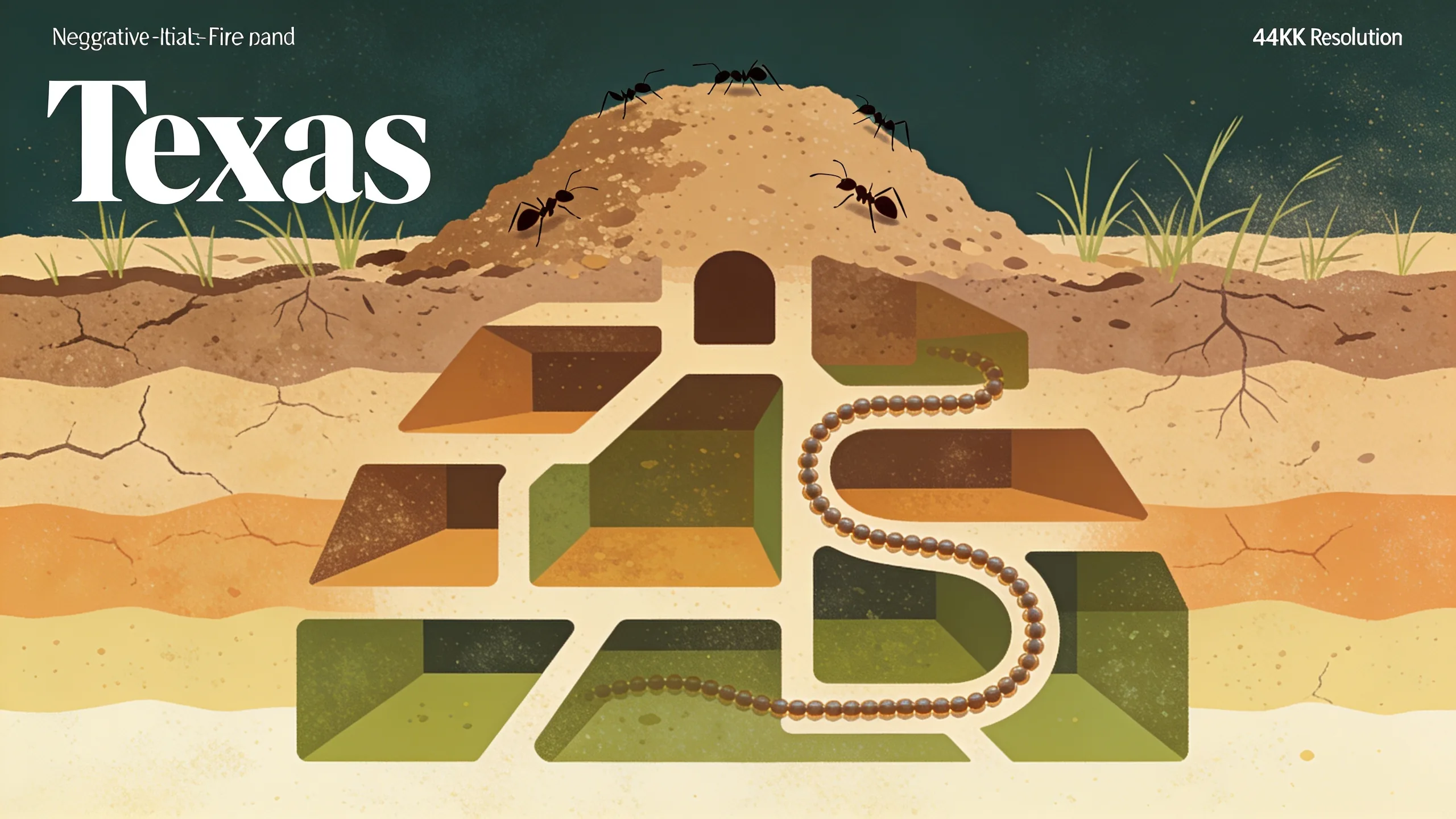
Half the Small Fire Ants Carry the Queen Gene. Nearly All the Queens Do.
In spring 2024, two entomologists in Athens, Georgia, collected fire ant colonies from two nearby counties and rebuilt them in the lab without a queen: about 2,500 workers per box, the same total weight of brood in each, half the boxes fed a meal laced with a juvenile-hormone mimic and half fed the same meal clean. Then they waited fifteen to twenty-four days and weighed what came out of the pupal cases.
The treated colonies produced pupae with a median weight roughly three times that of the untreated ones. That was the expected part. The unexpected part was who was standing at the top of the size range. Ants carrying a particular version of a 500-plus-gene package were about half of the smallest workers, roughly 65 percent of the largest workers, and 75 to 83 percent of queens, Brendan Hunt and Haolin "Horace" Zeng report in Proceedings of the Royal Society B.
The package is a supergene, an unusually long stretch of chromosome inherited as a single unit because the genes inside it are packed too tightly to be shuffled apart. "We call them supergenes because the genes are tightly linked and inherited together, almost like one big gene," Hunt, an associate professor in the University of Georgia's entomology department, said in the university's announcement of the paper. It comes in two versions. The older one, B, is what single-queen colonies carry on both copies. In invasive populations, every egg-laying queen in a colony with several queens carries one B and one b, a variant that appeared about a million years ago.
Bb queens are smaller than BB queens and worse at founding a colony alone, which should have made b a loser. Instead it keeps spreading, a pattern geneticists describe as a selfish element: it improves its own odds of reaching the next generation whether or not it helps the ant carrying it. Zeng's summary of the incentive is blunt. "If you want to pass down a gene, you'd better become a queen," he said. "You don't want to become a worker."
What the experiment actually shows is narrower than "the gene makes queens." Both genetic groups responded to the hormone treatment and both reached the same overall size range, so carriers are not capable of bigger bodies than non-carriers. They were simply over-represented among the ants that got big — and body size is one of the inputs that decides whether a female larva becomes a worker or a reproductive. "Through a developmental mechanism involving body size, a genetic element can alter caste outcomes and basically cheat its way into making a queen," Hunt said.
How the supergene bends development is still open. The team's candidates are extra time spent feeding as a larva, more efficient use of nutrients during that stage, or a specific gene they have flagged but not yet characterised. The paper is a first step, both researchers said, not a mechanism.
For Texas, the colony-level half of the story is the part that shows up in a pasture. The Texas A&M Imported Fire Ant Research and Management Project describes the state's red imported fire ants as two forms living side by side. Workers in single-queen colonies are territorial, and infested ground holds somewhere between 40 and 150 mounds an acre, rarely more than about seven million ants. Where multiple-queen colonies take hold, workers move freely from one mound to the next: 200 mounds or more per acre, and on the order of 40 million ants.
That gap is the practical stake in a genetics paper. The supergene is what sorts a population into one social form or the other, and the social form is what sets mound density — which means the difference between a yard with sixty mounds and a field with more than two hundred is not rainfall, soil type or how the last treatment was timed. It is colony structure, inherited.
None of the work was done on Texas ants. The Georgia team collected in Clarke and Oconee counties, built its lab colonies from those insects, and published a developmental finding rather than a control recommendation. There is no threshold in the paper, no product, no genotype an applicator can test for in the field. What it offers a Texas landowner is a cleaner way to read the ground: in multiple-queen country, a mound is a vent, not a headquarters.
Sources
- University of Georgia — Born to be queen: A look inside fire ant hierarchy
- Proceedings of the Royal Society B — Developmental bias of body size and caste by the fire ant social supergene
- Texas A&M Imported Fire Ant Research and Management Project — Biology
- Earth.com — Worker or queen? A genetic advantage may shape a fire ant's future
Texas Bug Slayers Editorial Team
Editorial Board
The Texas Bug Slayers editorial team brings together licensed pest control professionals, entomologists, and writers dedicated to helping Texans protect their homes and families from pests.
Related Articles
Texas A&M Scientists Target Insect Cholesterol Dependency for Next-Generation Crop Protection
Researchers develop novel IPM strategy using plant sterol modification to disrupt pest development without traditional pesticides.

Texas A&M Researchers Target Insect Cholesterol Dependency to Protect Cotton Crops
Texas A&M AgriLife scientists develop gene-editing technique that disrupts insect nutrition by altering plant sterols, offering a new approach to pest management in cotton.
UTRGV Has Two Years to Teach a Drone What an Infested Wound Looks Like
A $2.2 million USDA award sends UTRGV researchers after thermal imaging, machine learning and South Texas plant chemistry to find screwworm before a person walks the pasture.