
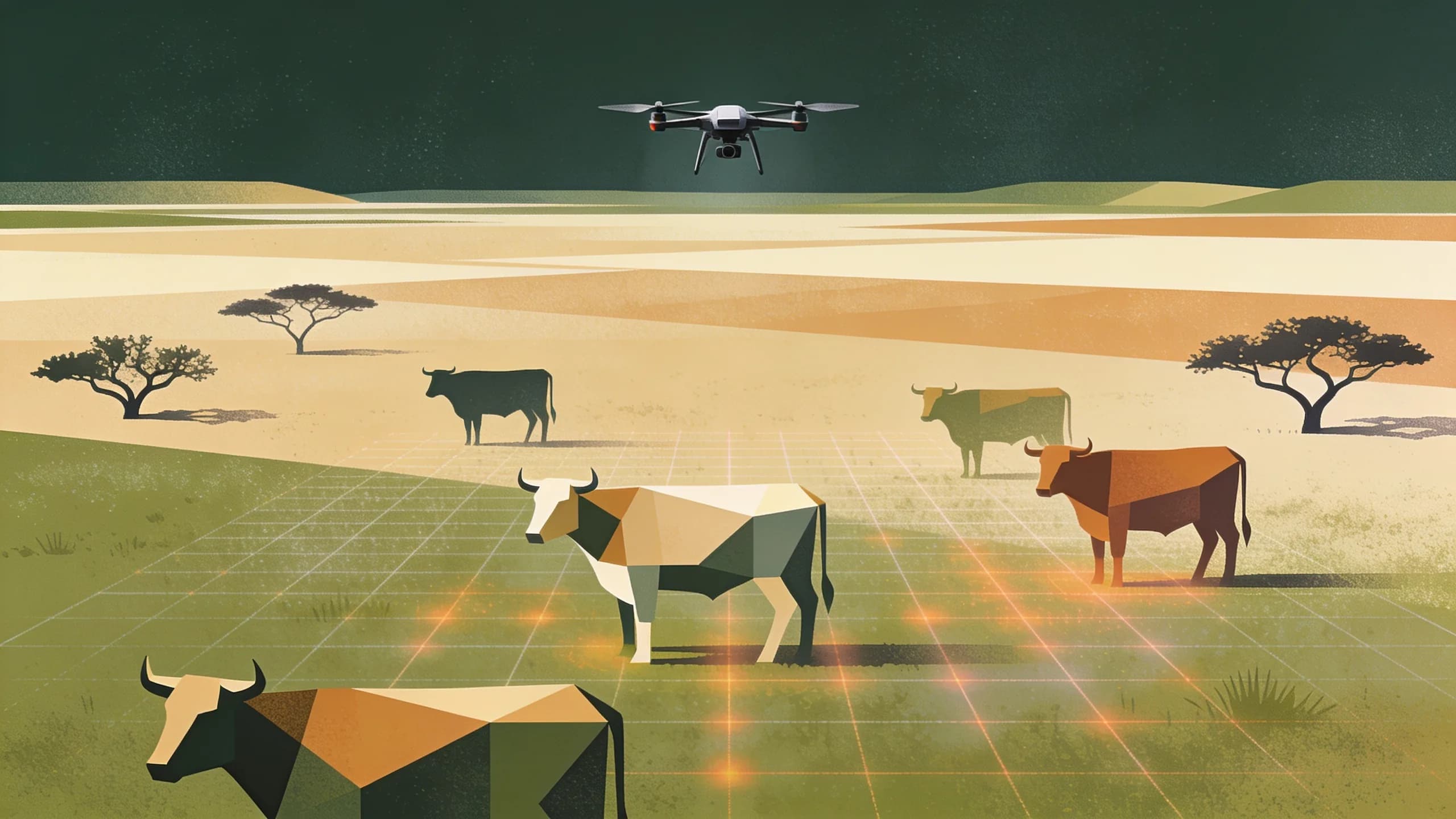
UTRGV Has Two Years to Teach a Drone What an Infested Wound Looks Like
The check presentation happened on the Edinburg campus, which is where these things happen, but the interesting part of the UTRGV announcement is the method section. The university said Monday it had pulled $2.2 million from the USDA's New World Screwworm Grand Challenge to build drone-based tools that can find infestations across South Texas livestock and wildlife range, and the two-year project is less about flying hardware than about training software to recognize what a person currently has to walk up and look at.
Sarah Mays Maestas, an assistant professor in the School of Integrative Biological and Chemical Sciences, is the principal investigator. Andrea Contina and Pushpa Soti, both in the same school, and Christopher Vitek, who directs the university's Center for Vector-Borne, Zoonotic and Emerging Diseases, are co-principal investigators. The award ran through that center. U.S. Rep. Monica De La Cruz and Dan Hunter, the Texas state executive director for USDA's Farm Service Agency, attended the announcement.
The gap the project is aimed at is the one every screwworm piece this fall has circled. Standard surveillance means examining animals for larvae in wounds and setting traps for adult flies, and the second half of that is close to impossible on wildlife. A hunter-harvested elk in Pecos County became the country's first confirmed wildlife case in October precisely because a carcass is inspectable and a live animal at 300 yards is not.
So the team will test thermal imaging paired with machine learning, looking for both active infestations and the open wounds that invite them and would justify preventive treatment. It will also evaluate drones as a delivery platform, for sterile flies and for animal treatments, which turns a surveillance tool into something closer to an operating system for the response.
The piece of the project that has no counterpart anywhere else in the Texas reporting is the vegetation work. Maestas' team plans to use high-resolution drone imagery and environmental data to model where adult flies are likely to be, and to look at compounds released by common South Texas plants to see whether any of them attract the fly. If a shrub or a grass species turns out to be part of the fly's address, trap lines and sterile fly releases can be aimed rather than spread.
The Lower Rio Grande Valley is a defensible place to do this. Cross-border livestock movement, wildlife migration and a warm, humid climate all make the region a plausible re-entry point, which is why the university frames the work as regional preparedness with national application. TAHC's own infested zone list, checked Nov. 4, runs north and west of the Valley rather than through it — Brewster, Crockett, Culberson, Edwards, El Paso, Hudspeth, Jeff Davis, Jim Hogg, Pecos, Presidio, Reeves, Schleicher, Starr, Sutton, Terrell, Val Verde and Zapata — but Starr and Jim Hogg sit on the Valley's northern shoulder and have already cycled through a designation, a release and a second designation since June.
The money comes from a competition, not a program allocation. APHIS opened the Grand Challenge in January 2026, drew 226 proposals and selected 40 projects sharing roughly $105 million, which is the same pot that funded Texas A&M's $4 million genomics project announced Oct. 28 and the irradiation and e-beam work announced in June. UTRGV's share is a little over half the size of the College Station award and aimed at a different part of the problem: not whether the fly can be killed, but whether anyone can see it in time.
What the announcement does not include is a prototype date, a partner ranch, an acreage or a performance target. It is a research award, and the deliverables named are detection methods and habitat models, not a product. Asked about the stakes, Maestas described South Texas livestock production as income for many residents and wildlife as heavily exposed, and put the goal as tools that support monitoring and control rather than a claim that the problem is solved.
That is the honest version of where this stands. The drug cabinet for dogs filled another slot on Nov. 3 with an FDA authorization for Bravecto, and the sterile fly plant at Moore Air Base is still tracking toward initial operating capability in April 2027. Detection remains the cheapest place to lose the fight, and it is the one being rebuilt last.
Sources
Texas Bug Slayers Editorial Team
Editorial Board
The Texas Bug Slayers editorial team brings together licensed pest control professionals, entomologists, and writers dedicated to helping Texans protect their homes and families from pests.
Related Articles
Texas A&M Will Sequence Thousands of Screwworms to Find Out Whether the Drugs Still Work
A $4 million USDA project will read whole genomes from Honduran outbreak samples, hunting the markers that would tell Texas if its main defense is fading.

Spinach Peptide Discovery Yields First Approved Treatment for Citrus Greening
Texas A&M AgriLife researchers celebrate federal registration of citrus greening treatment derived from spinach peptides, offering hope for Florida and Texas citrus growers.
EPA Approves Emergency Insecticide for Pasture Mealybug as Texas Counties Hit 79
Texas A&M AgriLife Extension updates fact sheet with Centric 40WG recommendations after EPA grants crisis exemption for invasive pest threatening $1 billion in annual losses.