
The Screwworm Left the Pecos Country and Turned Up on Interstate 20
The Texas Animal Health Commission's orders have run three pages for months, and the news is usually one sentence buried on page two. This one reads: "On November 4, 2026, NWS was detected in a bovine in Mitchell County."
Lewis R. Dinges, the commission's executive director, signed the order the next day. By that signature, parts of Fisher, Mitchell, Nolan and Scurry counties became Infested Zone 30, effective immediately, in country that had not appeared on a single screwworm notice all year.
That last part is worth sitting with. Put a Texas county map next to the commission's current notice and Zone 30 stands alone. No county inside it borders another county that is under restriction today. The nearest restricted ground is Schleicher County, with Sterling County in between, a hundred-odd miles south of Colorado City and a long way from the mesas and river country that has held most of this outbreak since spring.
The northern edge of the new quarantine matters too. Fisher and Scurry sit near 32.7 degrees north, above every county the commission has placed under screwworm restrictions this year. El Paso County, the previous high-water mark, tops out at about 32 degrees.
What the zone actually does
The order's operative language is unchanged from the twenty-odd orders before it, and it is worth reading once in full rather than summarized. Warm-blooded animals inside Zone 30 may not be moved outside it without prior authorization from the commission. To move one, the animal must be inspected and treated as required and issued a permit or certificate by a commission representative. Hides, carcasses and parts of any animal capable of serving as a host must be inspected and treated before they leave. Unauthorized movement is prohibited and subject to administrative penalties or criminal prosecution. The order remains in effect until the commission releases it.
Nothing in the document says how large the four "portions" of counties are, how many premises are involved, or whether a fly was trapped anywhere near the infected bovine. The detection as stated is one animal.
KCBD reported the Scurry County angle on Nov. 7 and noted the timeline operators are working against: under USDA guidance, movement restrictions and surveillance inside an infested zone stay active for a minimum of three months after the final positive case. The commission's own release orders from earlier in the year spell out what has to be true before that happens — fly trapping and monitoring data, an assessment of sterile fly dispersal in the area, visual inspection of susceptible animals, and no further detections during the surveillance window. Zones 10 and 16 came off the map that way in September and October, in the same three Rio Grande counties that went back under quarantine on Nov. 2.
Cotton, cattle, and opening weekend
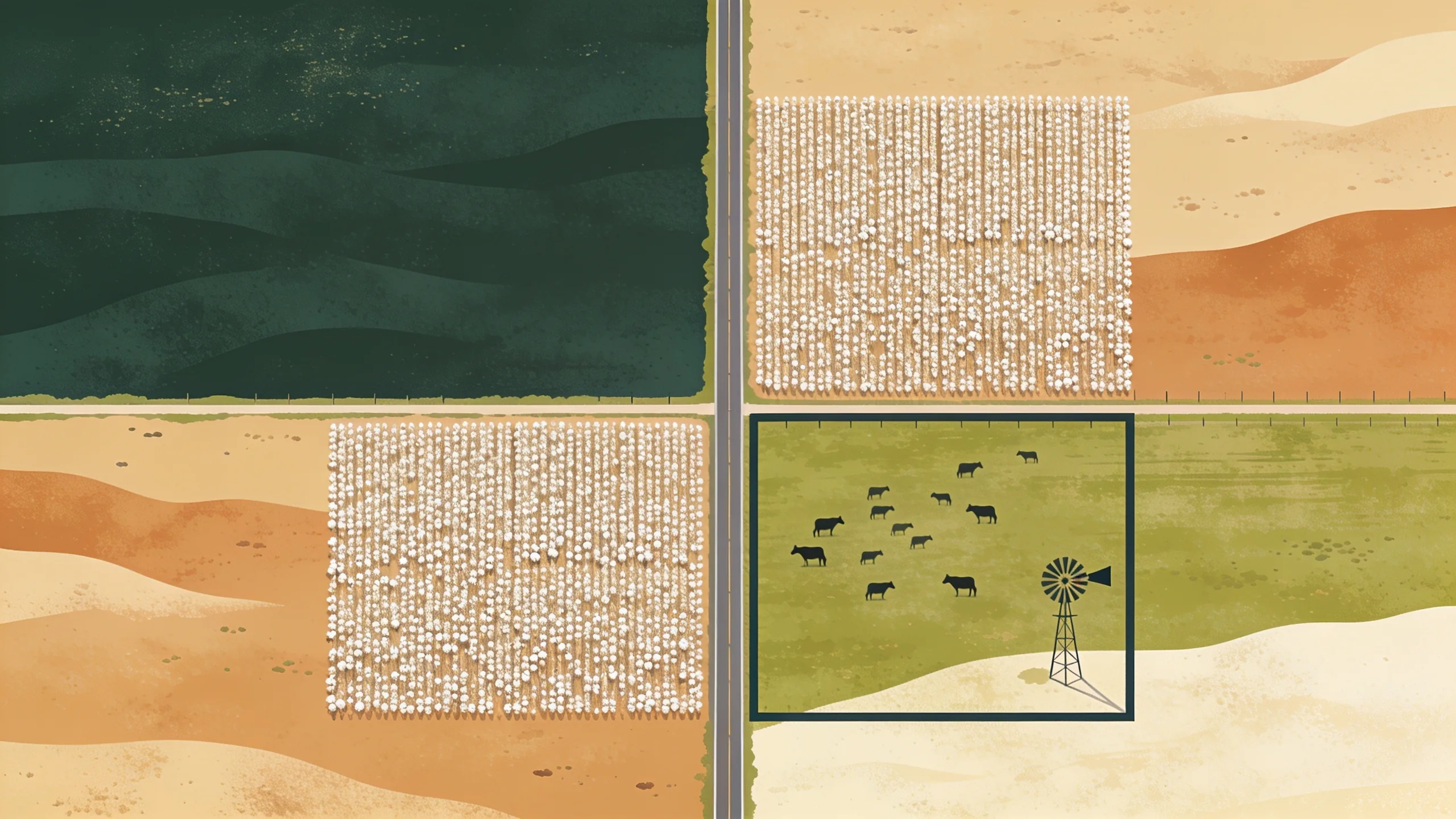
Mitchell County's seat is Colorado City, Nolan's is Sweetwater, Scurry's is Snyder, Fisher's is Roby. Interstate 20 runs through the first two. The surrounding economy is cattle and cotton with sheep, goats and wheat mixed in, and the four counties hold a lot of white-tailed deer on ranches and river bottom alike.
Texas' general white-tailed deer season opened Nov. 7 — the North Zone runs to Jan. 3, the South Zone to Jan. 17, according to the Parks and Wildlife Department's season table. That makes the hides-and-carcasses clause in the order more than boilerplate for anyone hunting inside the new boundary this weekend, and it puts a state veterinarian's certificate in the path of a cooler that would otherwise go home in the truck bed.
The order log has been busy in a way that suggests the situation is not settling. Nov. 1 brought a new order for Jeff Davis and Presidio. Nov. 2 modified El Paso. Nov. 3 modified Pecos. Nov. 4 carried three separate second-modified orders — Culberson and Hudspeth, Jim Hogg with Starr and Zapata, and Brewster with Jeff Davis, Pecos and Reeves. Nov. 5 produced Zone 30. Five consecutive days of paperwork, and the current notice now lists 21 counties with movement restrictions in place, up from 17 a week ago.
Against that, the same page keeps a released-area ledger: fourteen release or modified-and-release orders since Aug. 31, from La Salle and Webb at the bottom of that list to Crockett, Pecos and Terrell at the top of it. Release is a data finding, not a permanent status, and the reopened counties in South Texas are the proof of both halves of that sentence.
The order also recites the emergency paperwork behind all of it. Governor Greg Abbott issued a statewide disaster proclamation for screwworm on Jan. 29, 2026, then a second one on June 5 after the Zavala County detection, renewing it on July 4, Aug. 3, Sept. 2, Oct. 2 and Nov. 1.
What the order does not say
It does not say the Mitchell County detection is connected to the western zones, and it does not speculate about how the insect arrived in a county that had not appeared on any previous notice. It does not mention a fly catch, a wildlife detection, or a neighboring positive premises. Those absences are not a gap in the commission's paperwork so much as the limit of what a quarantine order is for: the order exists to stop animals from moving, not to explain an epidemiology.
National totals are running in the range Texas Public Radio's tracker reported on Nov. 5 — 116 U.S. cases with 56 still active across three states. Those figures are the outlet's read of the federal data and move independently of any single state's order log, which is why the commission's own pages still carry the June index case as their background and nothing resembling a running count.
For anyone in the four counties moving cattle, horses, sheep, goats, dogs or a deer carcass out of the boundary, the operative fact is procedural: an inspection and a certificate from the commission or a certified inspector, arranged before the trailer is loaded. The commission's number for that is 800-550-8242.
Sources
- Texas Animal Health Commission — Executive Director Order Declaring Animal Movement Restrictions Due to New World Screwworm in Fisher, Mitchell, Nolan, and Scurry Counties (signed Nov. 5, 2026)
- Texas Animal Health Commission — New World Screwworm: current infested zone notice, current and released executive director orders (checked Nov. 7, 2026)
- Texas Parks and Wildlife Department — White-tailed deer seasons, 2026-27
- KCBD — Scurry County included in New World Screwworm infested zone by Texas Animal Health Commission (Nov. 7, 2026)
Texas Bug Slayers Editorial Team
Editorial Board
The Texas Bug Slayers editorial team brings together licensed pest control professionals, entomologists, and writers dedicated to helping Texans protect their homes and families from pests.
Related Articles
Zone 29 Lands Five Days Before Deer Season in Three Counties TAHC Already Cleared Twice
A bovine in Zapata County on Nov. 2 put Jim Hogg, Starr and Zapata back under screwworm quarantine — counties the commission released in September and again in October.
Eight South Texas Counties Still Quarantine a Tick, and Hunting Season Just Walked Into It
TAHC's Oct. 9 reminder: deer, nilgai and other wildlife taken inside a fever tick quarantine zone in South Texas must be inspected before they leave.
Two Traps Caught Fertile Screwworm Flies, and Texas Redrew the Map in a Day
USDA identified fertile wild screwworm flies in Pecos and Hudspeth counties on Oct. 30. Within a day, TAHC rewrote two infested zones and added Culberson County.