
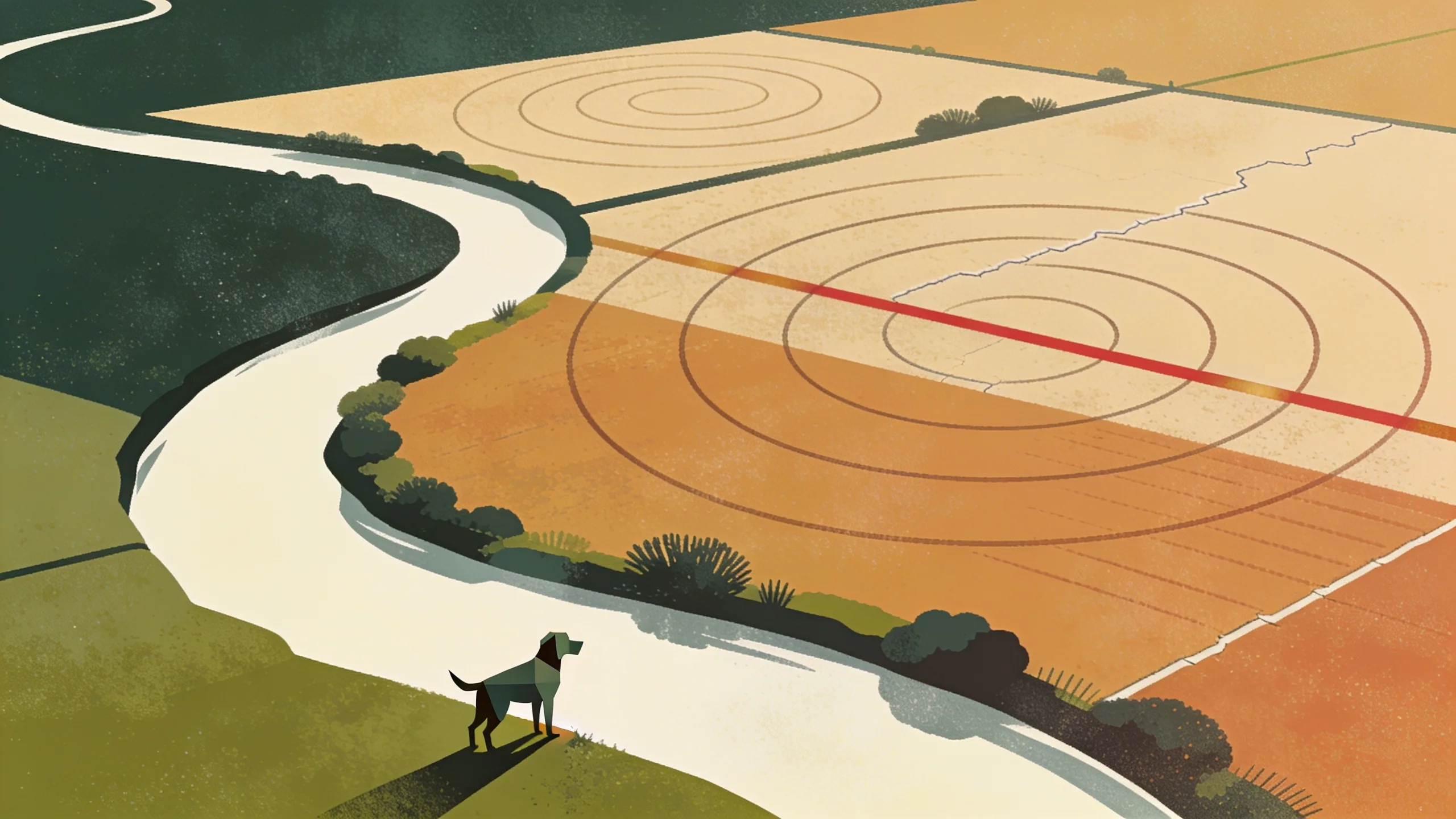
The Valley's First Screwworm Dog Turned Up While the Fly Factory Is Still Catching Up
Starr County has been on the screwworm map since Nov. 2, when the Texas Animal Health Commission drew Infested Zone 29 around Jim Hogg, Starr and Zapata counties after a bovine detection in Zapata. What the county had never recorded was a pet. The U.S. Department of Agriculture confirmed two New World screwworm cases there this week, and one of them is an active case in a dog, according to KRGV. ValleyCentral reported it as the first dog case in the Rio Grande Valley.
The distinction is not bureaucratic. A bovine inside a quarantine zone gets inspected, certified and counted. A dog in a Valley neighborhood sits on no list at all until it comes home with a wound that keeps bleeding and something moving in it. That is how the parasite reaches a household: not through the cattle chute, but through the back door.
The federal counter, as of Thursday, stood at 56 active cases on the USDA's public dashboard, the figure KRGV cited. KBTX reported the cumulative count at 113 confirmed infections nationally, with 36 recorded in October and 24 already in November, spread across Texas, New Mexico and Arizona. Those numbers have climbed by single digits every few days since June, and they are now climbing in a month when the fly is supposed to be slowing down.
It isn't, entirely. Texas A&M entomologist Aaron Tarone told KBTX that milder fall weather is probably part of the reason. Screwworm adults do poorly in hard cold, but a warm October in South Texas is not hard cold, and the insect's breeding cycle does not read a calendar.
The response still runs on sterile flies, and the supply is the constraint everyone in the program keeps naming. Dudley Hoskins, the USDA under secretary for marketing and regulatory programs, put it plainly: "Until we can get those production facilities ramped up at the max production level, we will continue to be in a response posture." The plants in Panama and Mexico together produce roughly 140 million sterile flies a week, and the historical figure needed to push the fly out of the United States was about 500 million. The new facility at Moore Air Base near Edinburg is due to finish construction in April, with a goal of 100 million flies a week there by this time next year.
Which leaves the Valley in an awkward position for the next several months: closest to the front line, last to get the volume of flies that would end it.
Agriculture Commissioner Sid Miller, who has spent the autumn pressing for a faster federal tempo, made the pet argument directly. "It can affect anybody," he said. "Nearly every American family has a pet."
There is also a production idea in testing that would not need a new plant at all. Researchers at Texas A&M's National Center for Electron Beam Research are experimenting with electron beams instead of radioactive cobalt to sterilize the flies. Suresh Pillai, who directs the center, said results so far look good; the work has not been peer reviewed, and USDA says the technology still needs validation. Tarone's interest is speed — an electron beam delivers a sterilizing dose in seconds where other methods take minutes, which is the difference between a plant that can scale and one that cannot.
For a pet owner in Starr, Hidalgo, Cameron or Zapata County, none of that changes this week's checklist. Look at the animal's ears, eyes, nose, mouth and any cut or scrape, every day, especially on outdoor dogs and cats. A wound that smells wrong and enlarges is an emergency, not a wait-and-see. The FDA authorized Bravecto for exactly this treatment on Nov. 3, and it remains a prescription a veterinarian has to write, for the safety reasons laid out when the authorization landed. Over-the-counter nitenpyram products authorized in September cover prevention as well as treatment, on a label the agency revised for that purpose.
Suspected cases go to a veterinarian first and to the Texas Animal Health Commission at 800-550-8242, which is also the number for reporting wildlife. USDA's position is that the parasite is not a food safety risk and that most pets outside the infested counties are at low risk.
The honest summary of this week is that the map grew by one infected dog in a county that was already red, and that a county already red is where the next one will be found.
Sources
Texas Bug Slayers Editorial Team
Editorial Board
The Texas Bug Slayers editorial team brings together licensed pest control professionals, entomologists, and writers dedicated to helping Texans protect their homes and families from pests.
Related Articles

Travis County Declares Disaster Over Screwworm Threat Before First Case Appears
Austin-area county takes unprecedented proactive step, signing disaster declaration to streamline response resources as New World screwworm spreads through South Texas.

Texas A&M AgriLife Launches Statewide Alert System for Agricultural Threats and Invasive Pests
New Texas Agriculture Alert System delivers real-time notifications about pest outbreaks, wildlife diseases, and quarantine actions to farmers, ranchers, and residents across the state.
New World Screwworm Confirmed in Texas: 12 Cases Reported as Parasite Spreads
USDA confirms New World screwworm in Zavala County calf, triggering statewide response. Quarantine now covers 13 Texas counties as cases rise.