
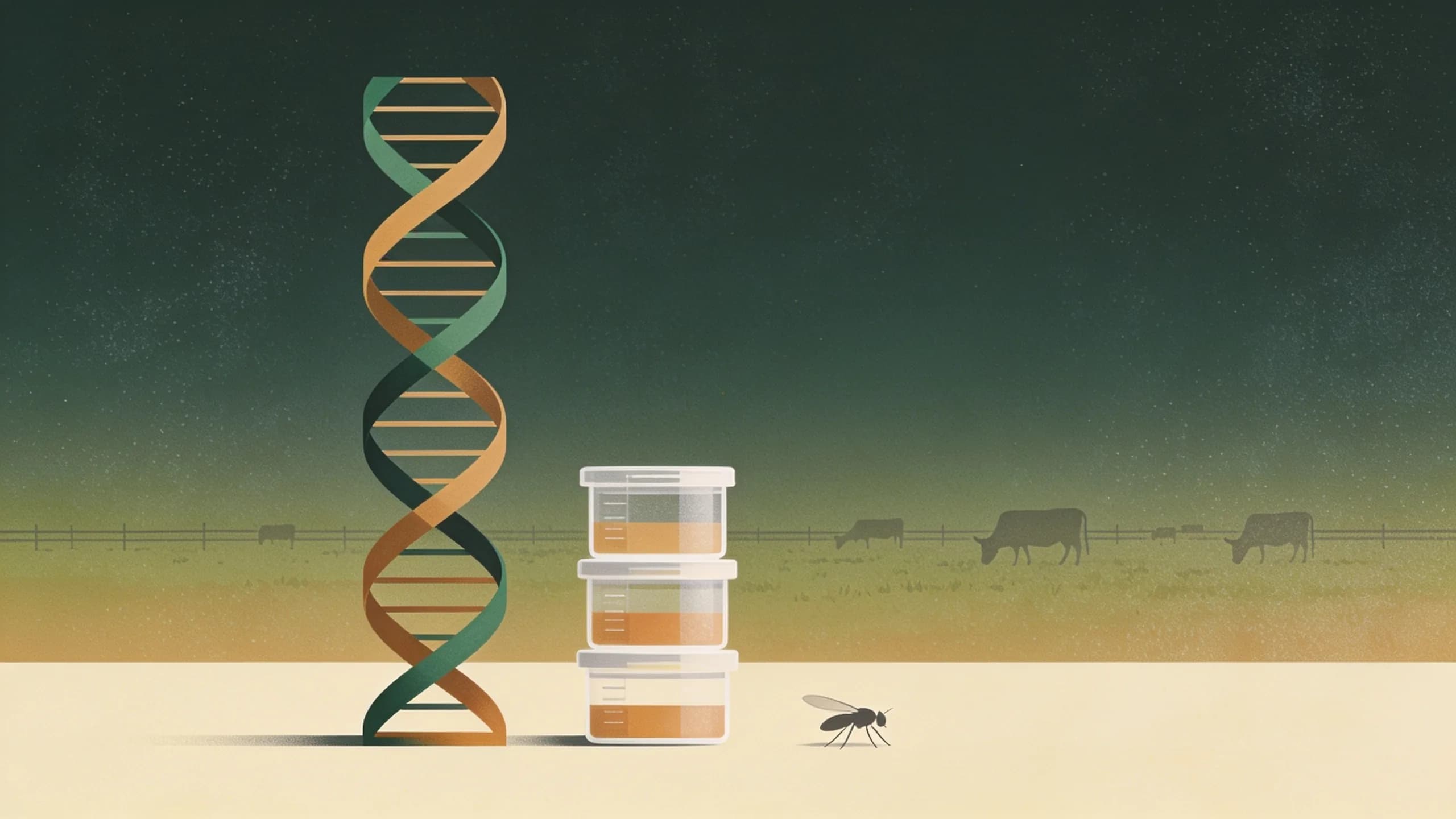
Texas A&M Will Sequence Thousands of Screwworms to Find Out Whether the Drugs Still Work
The number that will decide how the current screwworm response ends is not on any of the outbreak maps. It is whether the fly still dies when the drug reaches it. On Oct. 28, Texas A&M's College of Veterinary Medicine & Biomedical Sciences said it had pulled roughly $4 million through the USDA's New World Screwworm Grand Challenge for a two-year project that will sequence whole genomes from thousands of individual screwworms, most of them collected during the outbreak in Honduras, and go looking for the genetic signatures of resistance to the compounds used to prevent and treat infestations.
Texas moves livestock under a paperwork regime built on the assumption that treatment works. Animals inside an infested zone cannot leave without authorization from the Texas Animal Health Commission; outside the zone, a certified inspector completes a movement and treatment certificate naming the product used for prevention or treatment and the animal's official ID, which travels with it. Fourteen counties sit in the current notice, among them Brewster, Crockett, El Paso, Hudspeth, Jeff Davis, Pecos, Presidio and Val Verde. Every one of those movements leans on a chemical step. If the product on the certificate is losing its edge, the certificate is a piece of paper.
Nobody has said it is. Researchers do not yet know whether screwworms in the current outbreak carry resistance markers at all. What exists is a precedent — drug-resistant populations have previously been reported in endemic areas of South America. That is the difference between a worry and a finding, and settling it is what the project is for.
The samples are the reason this can be answered at all. The U.S. outbreak is months old and comparatively small; Honduras has been running hot long enough to leave a trail. Guilherme Verocai, an associate professor in the Department of Veterinary Pathobiology and director of the Parasitology Diagnostic Laboratory, started building the relationship before the parasite reached Texas — representatives of Honduras' National Service of Agricultural Health and Food Safety, the country's counterpart to USDA, visited College Station in late 2025 for a meeting Texas A&M AgriLife hosted. When the Grand Challenge was announced, that door was already open.
What Honduras sends is not just vials. Each sample arrives with when and where it was collected, which species the fly infested, and, when the records exist, how the animal was treated. That last field is the whole design: a genotype on its own says what a fly is; a genotype paired with the dose someone applied to a wound says whether the fly shrugged.
Brian Davis, a geneticist in the same department, explained the methodological shift. Earlier work on the species chased specific genes researchers already suspected, including ones tied to drug response. This project abandons the guess-and-check approach for the whole genome, roughly 99.99% of it, per individual, across time and geography, compared on Texas A&M's high-performance computing cluster. "It's going to be by far the largest genetic study of screwworm ever," Davis said.
The deliverable is concrete: a validated molecular test that screens screwworms for resistance markers. Verocai's phrasing is that the test "could remain available and potentially be implemented in the U.S. or across endemic countries" — a permanent tool rather than a one-off answer. Veterinarians working cases in Honduras feed the other half of the dataset; if a particular treatment appears to underperform in the field, the team can compare that observation against the genetics of the flies pulled from the same wounds.
There is a second use that has nothing to do with drugs. Comparing genomes across locations lets researchers reconstruct how populations are related, which turns a detection into a lineage question. "If there was a potential outbreak in Florida, we could understand how related it might be to what's going on in Texas," Verocai said. The same comparison can flag stretches of the genome that stay constant across populations — candidate targets for future drugs or genetic control methods. The data will be released to other researchers when the analyses finish.
Some context on the money. USDA opened the Grand Challenge in January, drew 226 proposals and selected 40 projects under a program worth about $105 million. Texas A&M's share was announced in June as a portfolio — seven projects led, seven more contributed to — with the sterile-fly irradiation work the only award described in any detail. This release adds a team, a method and a deliverable for one of the others. The fly was pushed south to Panama by a campaign that began in the 1950s, climbed again in Panama in 2021 and 2022, and reached the United States in June.
Texas' current defense is largely reproductive — sterile flies by the hundred million, released to swamp wild populations with mates that produce nothing. Genomics addresses the other flank. Sterile insects stop the next generation; chemotherapy keeps this one alive long enough to be worth saving, and a parasite that can be treated cheaply is a parasite that can be managed at a border. Whether that remains true is what the sequencer is for. Track the case map on our Texas screwworm tracker while the lab work runs; the two clocks are not the same length.
Sources
- Texas A&M VMBS — Texas A&M Researchers To Study New World Screwworm Genetics To Strengthen U.S. Response (Oct. 28, 2026)
- dvm360 — Texas A&M team to sequence thousands of screwworms in search of drug resistance markers (Oct. 29, 2026)
- Texas Animal Health Commission — New World Screwworm: Texas Current Situation
Texas Bug Slayers Editorial Team
Editorial Board
The Texas Bug Slayers editorial team brings together licensed pest control professionals, entomologists, and writers dedicated to helping Texans protect their homes and families from pests.
Related Articles

Spinach Peptide Discovery Yields First Approved Treatment for Citrus Greening
Texas A&M AgriLife researchers celebrate federal registration of citrus greening treatment derived from spinach peptides, offering hope for Florida and Texas citrus growers.
EPA Approves Emergency Insecticide for Pasture Mealybug as Texas Counties Hit 79
Texas A&M AgriLife Extension updates fact sheet with Centric 40WG recommendations after EPA grants crisis exemption for invasive pest threatening $1 billion in annual losses.
Texas A&M Engineers $1.86M Push for Fast-Acting Screwworm Wound Treatments
Texas A&M System researchers develop rapid wound treatments for New World screwworm infestations, backed by $1.86 million to protect livestock from the invasive parasite.