

Beeville's Rodent Reports Came From Two Subdivisions, and the City's Answer Was Trash
The City of Beeville put out a notice this week that most small cities only circulate internally: enough people in two subdivisions had reported rats that the Developmental Services Department decided to say something publicly.
The reports came from Bordeaux Estates and Park Hill, according to KRIS 6, and the city described them as "several," with health concerns attached. What the department asked for in return was not a spraying program. It was four chores.
Keep properties free of accumulated trash, debris and overgrown vegetation, the city said, because that is what gives rodents somewhere to live. Secure garbage. Don't leave pet food outdoors overnight. And when feeding outdoor animals, take the leftovers up when the bowl is empty.
Residents who see rodents, or conditions that feed them, were pointed to the department at 361-358-4641.
If that reads like the city outsourced the problem to homeowners, the reason is partly structural. A municipal department can clear public right-of-way, cite a property for accumulated debris and push a landlord on a nuisance complaint. It cannot walk into a shed, seal a soffit gap or pull a woodpile away from a fence line on private property — which is where the animals actually are. Beeville's notice says as much in one sentence: "taking care of the problem is a community effort."
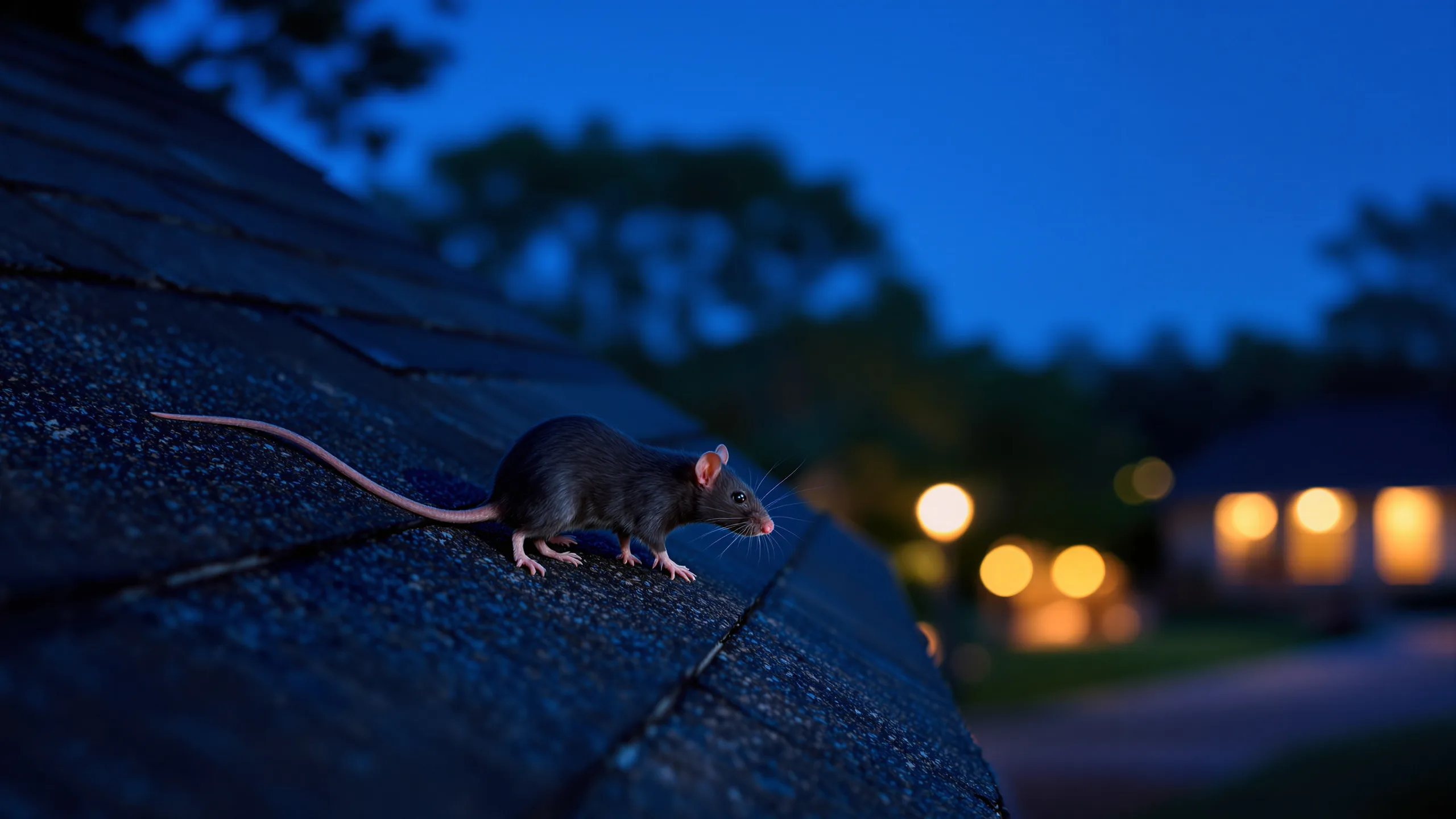
Bee County is cotton, grain sorghum, corn and hay country, and a county seat in the middle of that has two rodent populations to worry about rather than one. The roof rat is the climber — attics, palm fronds, pecan canopies, the top shelf of a garage, any gap where a utility line meets an eave. The Norway rat stays low, working dumpsters, foundation gaps, sewer breaks and the dirt under a shed. The house mouse is a third animal entirely and the one most likely to be underestimated: the National Pest Management Association's guidance notes a mouse can pass through a hole the size of a dime and a rat through one the size of a quarter.
Both rat species need the same three things, and a subdivision supplies all three efficiently. Food is a garbage can with a loose lid, a bowl of cat food left out, fallen fruit under a tree, grease on a grill. Water is a dripping hose bib, an air-conditioner condensate line, a saucer under a pot. Cover is a woodpile stacked against a fence, ivy on a wall, a shed with a gap at the sill, a vacant lot with three months of growth on it. Remove one of the three and the population thins. Remove none and baiting becomes a subscription.
What tends to work, in the order it works: close the openings first — steel wool packed with sealant into gaps around pipes and utility penetrations, door sweeps, vent screens, a sill repair on the shed — then cut back anything that touches the roof, then move food and water indoors or into metal and glass. Trash goes out the morning of pickup rather than the night before. Traps go along the wall where the grease marks are, not in the middle of the floor. Rodenticide indoors is a decision with consequences beyond the rodent: a poisoned rat that dies in a wall or gets carried off by a hawk or a dog passes the problem along, which is why for-hire applications in Texas sit with licensed structural pest control operators who carry the label compliance and the insurance with them.
None of this requires a subdivision-wide campaign to start. It requires the neighbor with the woodpile and the neighbor with the outdoor cat bowl to do the same week's worth of work, which is exactly the coordination problem Beeville's notice is trying to solve with a phone number and a list.
The city has not published a count of reports, trappings or confirmed species, and a report is not a treatment — the department's notice asks residents to call, not to expect a truck in the driveway. For now the useful part of the story is the part that travels: two named subdivisions, four specific asks, and a reminder that October in South Texas is when the cover in the fields disappears and the cover in town starts looking better.
Sources
Texas Bug Slayers Editorial Team
Editorial Board
The Texas Bug Slayers editorial team brings together licensed pest control professionals, entomologists, and writers dedicated to helping Texans protect their homes and families from pests.
Related Articles

Houston Cracks Terminix's Rodent Top Five, With Dallas-Fort Worth Not Far Behind
Terminix's fall ranking of America's worst cities for rodents puts Houston at No. 5 and Dallas-Fort Worth at No. 9, just as cooling weather starts pushing rats and mice indoors across Texas.

Texas Termite Swarm Season: What Homeowners Need to Know in 2026
Spring termite swarms are peaking across Texas. Learn how to identify winged termites, protect your property, and when to call a professional.
Fall Rodent Invasion in Texas: How to Rat-Proof Your Home Before the First Cold Snap
Roof rats and house mice push indoors every Texas fall. Identify which rodent you have, find every entry point, and seal it — the complete homeowner guide.