
Pasture Mealybug Spreads to 70 Texas Counties, Threatening $15.5 Billion Cattle Industry
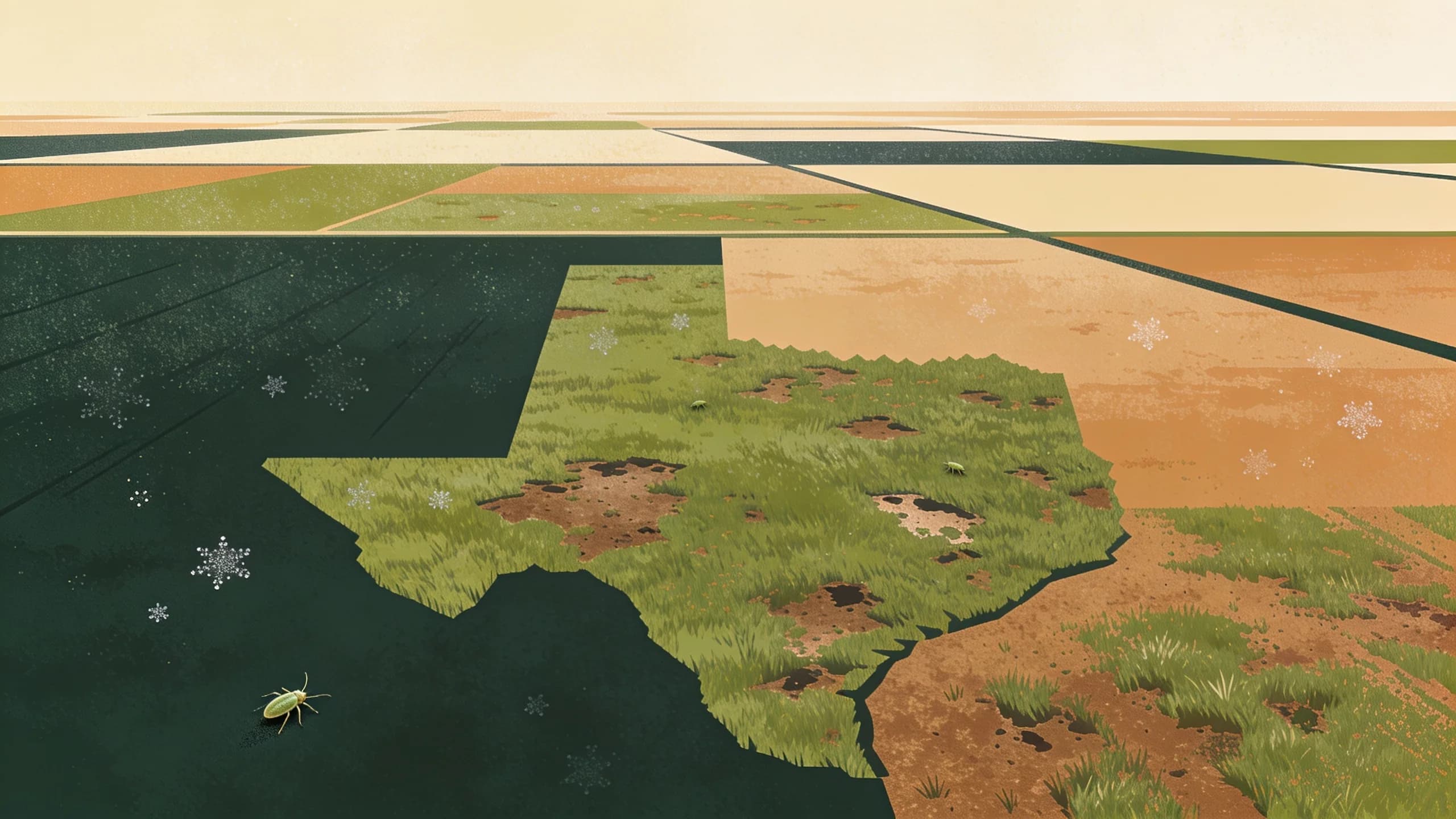
As Texas livestock producers grapple with the unprecedented New World screwworm outbreak, a second invasive threat has emerged that could prove equally devastating. The pasture mealybug, first confirmed in Texas just last year, has now spread to 70 counties and is casting what Texas A&M AgriLife Extension Service experts describe as a "growing shadow" over the state's $15.5 billion cattle industry.
For the running case count and the affected-county map, follow our Texas screwworm tracker.
The speed of this pest's expansion has caught agricultural officials off guard. David Kerns, Ph.D., AgriLife Extension's statewide integrated pest management coordinator, reports that new counties are being added to the infestation map weekly — sometimes daily. "I get up to a dozen calls every day from producers who think they have them in their pastures," Kerns said. "We have counties with confirmed cases, and there's probably another 56 that we consider as being imminently threatened."
An Invisible Destroyer of Forage
The pasture mealybug feeds on a wide range of native and improved warm-season grasses that form the foundation of Texas livestock operations. Bermuda grass, Bahia grass, bluestems, johnsongrass — all critical forage species are vulnerable. Immature mealybugs extract plant sap and inject toxins that weaken plants, often causing a condition known as pasture dieback. In severe infestations, entire fields turn brown, thin dramatically, or die outright.
What makes this pest particularly insidious is its ability to devastate pastures before producers even realize they have a problem. The mealybugs thrive in tall, dense grass canopies, making early detection difficult. By the time visible damage appears, significant portions of a pasture may already be compromised.
No Chemical Silver Bullet
Perhaps most alarming for producers is the complete absence of effective pesticide controls. After extensive testing, AgriLife Extension and Texas A&M AgriLife Research have found no labeled pesticide products that can effectively control pasture mealybug populations. One product, Sefina, has shown limited ability to suppress low populations, but it offers no meaningful protection against established infestations.
Kerns is currently submitting an emergency insecticide use exemption request to the U.S. Environmental Protection Agency for pesticides that have shown effectiveness in trial applications. However, even if approved, such exemptions typically take months to process — months that Texas producers may not have as the pest continues its march across the state.
Economic Impact Could Reach Billions
The potential financial toll is staggering. AgriLife Extension economists estimate that 20.4 million rangeland and improved pasture acres already lie within infested counties. When counties under imminent threat are included, that figure jumps to 35.7 million acres — a substantial portion of Texas's total forage base.
David Anderson, Ph.D., AgriLife Extension economist, projects annual direct forage and grazing losses could range from $100 million to over $1 billion, depending on infestation severity and acreage affected. If widespread pasture replanting becomes necessary, one-time reestablishment costs could reach $1 billion to $2 billion statewide.
The ripple effects extend throughout the livestock economy. Reduced grazing capacity means higher supplemental feed costs, lower stocking rates, and increased financial pressure on ranching operations. Hay producers face reduced yields and declining stand quality. Even wildlife enterprises and hunting operations may suffer from widespread habitat degradation.
Wind May Be Spreading the Pest
How the pasture mealybug has spread so rapidly remains something of a mystery. While equipment and livestock movement certainly contribute, Kerns suspects wind dispersal of early life stages may be playing a significant role. The pest's current distribution pattern is too widespread to be explained by mechanical transmission alone.
Researchers are actively investigating this hypothesis, which, if confirmed, would make containment extraordinarily difficult. Unlike managed livestock movements, wind patterns cannot be regulated or controlled.
What Producers Can Do Now
With chemical controls unavailable, current recommendations focus on cultural practices that may slow spread and reduce damage:
Early detection remains critical. Producers should scout pastures regularly, paying particular attention to areas where grass appears stressed or discolored. Contacting local AgriLife Extension offices for identification assistance can help confirm suspicions.
Reducing grass canopy density through grazing or hay harvest can make pastures less hospitable to mealybugs. Kerns emphasizes that cutting and baling infested pastures can reduce populations considerably, and the resulting short grass becomes less attractive to surviving insects.
Preventing mechanical spread requires careful attention to equipment sanitation. Mowers, balers, and other machinery should be cleaned before moving between fields, particularly when leaving known infested areas.
Hay movement presents lower risk than many producers assume. Testing has shown that pasture mealybugs are highly unlikely to survive beyond two weeks in baled hay, making hay commerce less of a transmission vector than originally feared.
A One-Two Punch for Texas Agriculture
The confluence of pasture mealybug and New World screwworm creates what Anderson calls a "potential one-two punch" for Texas producers. One pest threatens the grass that feeds their animals; the other threatens the animals themselves.
"To have one pest threatening the grass our animals need and another threatening the animals themselves poses some serious challenges," Anderson acknowledged. "But ranchers are a resilient bunch."
That resilience will certainly be tested in the months ahead. With no quick fixes on the horizon and the mealybug continuing its expansion across Texas landscapes, producers face difficult decisions about stocking rates, supplemental feeding, and whether to replant damaged pastures — all against a backdrop of uncertain weather markets and the ongoing screwworm quarantine.
For now, the watchword is vigilance. As Kerns and his colleagues work to understand this new threat and develop management strategies, Texas livestock producers find themselves on the front lines of yet another battle against an invasive species that shows no signs of slowing down.
Producers who suspect pasture mealybug in their fields should contact their local AgriLife Extension office for identification assistance and updated management guidance.
Sources
Texas Bug Slayers Editorial Team
Editorial Board
The Texas Bug Slayers editorial team brings together licensed pest control professionals, entomologists, and writers dedicated to helping Texans protect their homes and families from pests.
Related Articles

The Cotton Jassid Vanished This Season. Experts Say That's No Reason to Relax
After 2025's invasive cotton jassid surge, winter freezes have kept 2026 populations low across the Southeast. UGA's Phillip Roberts warns growers — including in Texas — to keep scouting.
Pasture Mealybug Spreads Across 70 Texas Counties, Threatening Hay Production
A newly invasive pasture mealybug is devastating Texas hay fields and pastures, with confirmed infestations in 70 counties. Learn identification tips and prevention strategies.
Texas A&M AgriLife Extension Deploys Massive Screwworm Education Campaign Across Texas
AgriLife Extension launches statewide educational events on New World screwworm, having already reached 23,000 Texans through 316 programs. Find upcoming workshops in your county.