
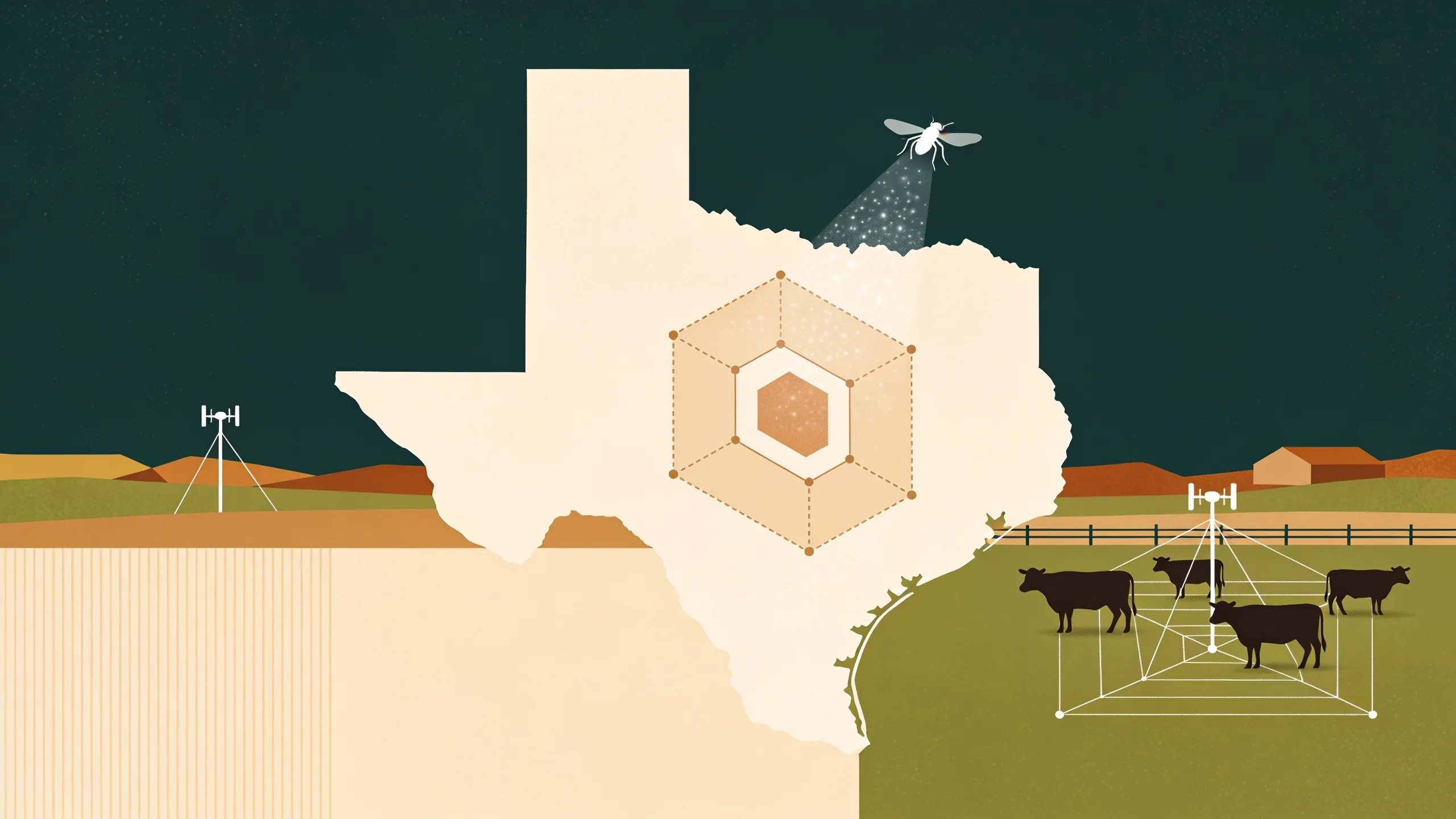
New World Screwworm Cases Rise to 25 in Texas as Response Efforts Expand
The New World screwworm infestation sweeping through South Texas has reached 25 confirmed cases across multiple counties, prompting federal and state officials to accelerate containment operations and deploy new technologies against the parasitic threat.
Our live Texas screwworm case tracker keeps the running count and county map as USDA updates land.
U.S. Secretary of Agriculture Brooke Rollins outlined the escalating response during a June 8 press conference in Texas, joined by Governor Greg Abbott, APHIS Associate Administrator Admiral Michael Schmoyer, and Texas Animal Health Commission Executive Director Bud Dinges. The coordinated appearance underscored the severity of an outbreak that began June 3 with a calf in Zavala County—the first U.S. screwworm case in six decades.
Rollins identified expanded sterile fly production as the cornerstone of eradication strategy. A dispersal facility launched last year in South Texas is now operational, supplemented by millions in retrofitting investments at a companion facility in Metapa, Mexico. These sterile insects interrupt the parasite's reproductive cycle by mating with wild flies that produce no offspring.
"Those sterile flies will begin to come online this month, so very good timing," Rollins said. "The massive facility we're building in Moore—the production facility—we broke ground just a couple of months ago, expecting to reach in the hundreds of millions of additional sterile flies by mid next year."
The USDA is conducting its first-ever ground vehicle releases of sterile screwworm flies along the U.S.-Mexico border, complementing traditional aerial dispersal methods. This tactical innovation allows precise targeting of high-risk corridors where the parasite might otherwise establish breeding populations.
Beyond immediate containment, the USDA is accelerating next-generation solutions through its $100 million New World Screwworm Grand Challenge. The program has reviewed over 226 applications from private sector innovators and is beginning rapid deployment of promising technologies. Rollins indicated announcements will come "week by week" as selected projects advance.
The Knipling-Bushland U.S. Livestock Insects Research Laboratory, newly opened in Kerrville, Texas, provides what officials describe as the world's most advanced research capabilities for livestock pest management. The facility honors the scientists who developed the sterile insect technique that eliminated screwworms from the United States during the 1960s.
Surveillance infrastructure has expanded dramatically since 2024. USDA now monitors over 8,000 traps along the border, having examined more than 59,000 fly samples and 19,000 wildlife specimens since January of last year. Mounted patrols and "tick riders"—veterinary inspectors on horseback—provide additional eyes along remote border sections.
Governor Abbott, who issued a statewide disaster declaration covering all 254 Texas counties, announced several state-level initiatives. Texas A&M University is deploying mobile fly testing facilities to affected areas, while AgriLife Extension has positioned equipment in Uvalde for rapid on-site diagnostics.
The state's certified inspector program, launched in mid-June, allows ranchers and cattlemen to complete online training that qualifies them to inspect their own animals for screwworm infestation. This approach maintains livestock movement continuity while ensuring rigorous health monitoring.
"Ranchers and cattlemen can be certified to inspect their animals to ensure no interruptions to the continuity of business," Abbott explained. The training modules became available through the Texas A&M AgriLife Extension platform on June 13-14.
Texas officials emphasize that screwworm infestation is highly treatable when detected early. The parasite lays eggs in wounds—even minor injuries like tick bites or navel openings—where larvae hatch and feed on living tissue. Daily animal inspection, prompt wound treatment, and fly population reduction around operations provide effective protection.
Suspected cases should be reported immediately to the Texas Animal Health Commission's 24-hour veterinary line at 1-800-550-8242. Wildlife showing unusual wounds can be reported to Texas Parks and Wildlife at 512-389-4505. Officials stress that anyone—not just veterinarians—can and should report suspected infestations.
The expanding case count reflects both the parasite's aggressive spread and enhanced surveillance detecting infections that might previously have gone unreported. With sterile fly production ramping up and new technologies entering the field, officials express cautious optimism that the outbreak can be contained without the devastating economic impacts screwworms historically inflicted on livestock industries.
Sources
Texas Bug Slayers Editorial Team
Editorial Board
The Texas Bug Slayers editorial team brings together licensed pest control professionals, entomologists, and writers dedicated to helping Texans protect their homes and families from pests.
Related Articles
USDA Unveils Quarterly Review Roadmap for Screwworm Response Playbook
USDA APHIS shares comprehensive roadmap for quarterly reviews of New World Screwworm Response Playbook as parasite cases reach 45 infestations across Texas and New Mexico.
Screwworm Count Reaches 44 as Brewster County Adds Two More Cases and the Infested Zone Extends Into Presidio
USDA's dashboard now lists 44 confirmed New World screwworm cases — 43 in Texas — after two cattle cases in Brewster County and a sheep in Pecos County closed out July. TAHC has extended the infested zone into Presidio County, bringing movement restrictions to parts of 23 counties.
Screwworm Count Reaches 42 as Three More Texas Counties Join the Case Map and Pet Transport Rules Tighten
USDA's dashboard now lists 42 confirmed New World screwworm cases — 41 in Texas — after goats tested positive in Sutton County on July 21. Jim Hogg, Pecos and Uvalde counties also carry confirmed cases, and interstate pet transport rules are squeezing Texas shelters.