
UC Riverside Scientists Develop Pinene-Based Method to Lure Termites to Their Death
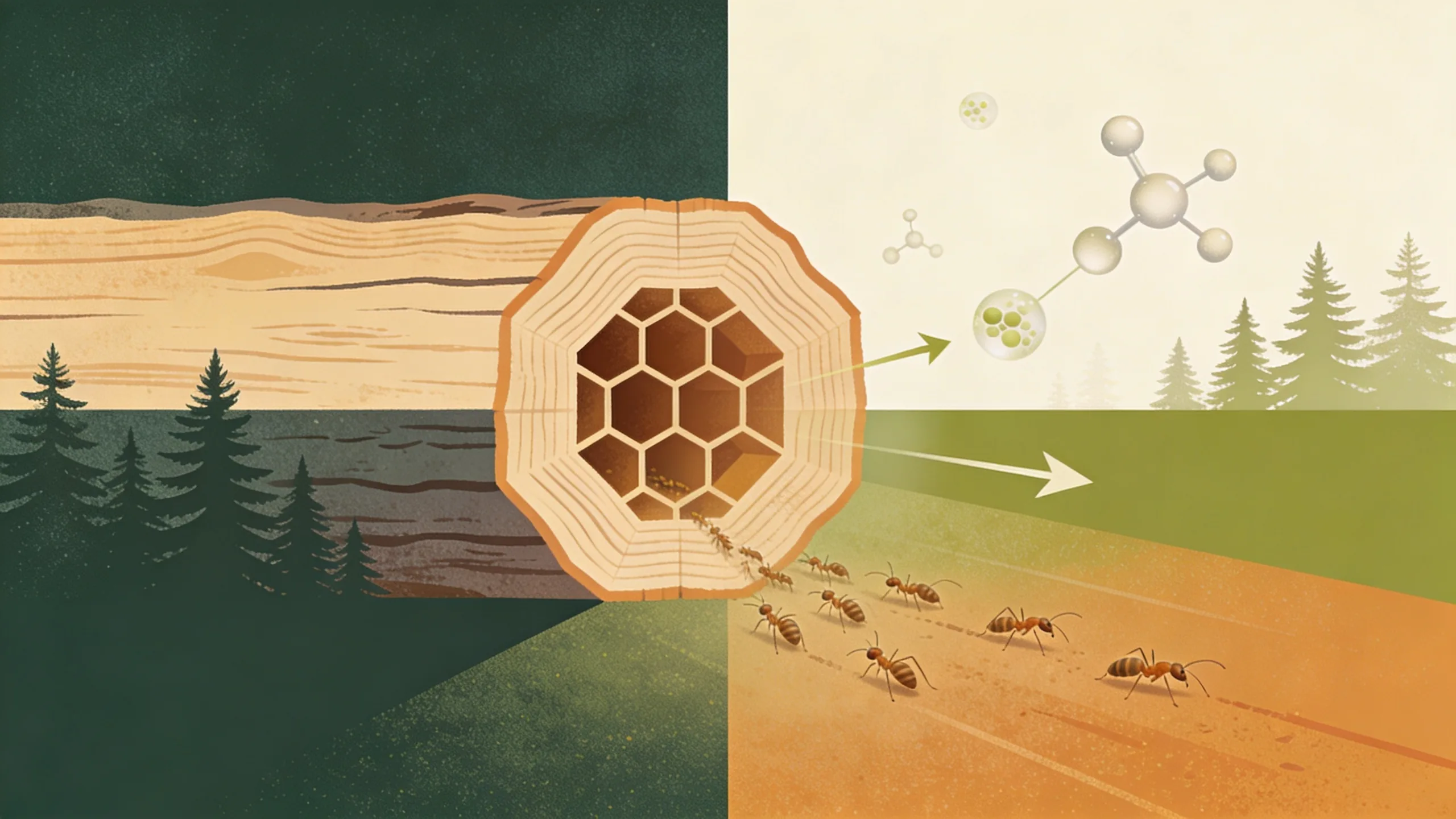
Researchers at the University of California, Riverside have identified a surprisingly simple way to dramatically improve termite control effectiveness: using pinene, a fragrant compound released by forest trees, to lure the insects toward insecticide rather than hunting down every hidden colony.
In experiments detailed in the Journal of Economic Entomology, the UC Riverside team demonstrated that adding pinene to insecticide treatments boosted mortality rates from approximately 70% to over 95% against western drywood termites. The discovery could reshape how pest management professionals approach one of the most persistent and costly structural pests in warm-climate regions.
"We saw significant differences in the death rates using insecticide alone versus the insecticide plus pinene," said Dong-Hwan Choe, the UC Riverside entomologist who led the study. "Without pinene, we got about 70% mortality. When we added it in, it was over 95%."
Western drywood termites, native to North America, serve an important ecological function by breaking down dead wood above ground with help from microorganisms in their digestive systems. In natural settings, they are recyclers. In human settings, they are destructive invaders that do not distinguish between fallen trees and structural lumber.
"It's only a matter of time before termites attack a house, especially in warmer parts of the states," Choe noted. California, Florida, parts of Texas, and regions of Mexico and Canada all face significant pressure from these insects, which establish colonies inside wood without requiring soil contact.
The traditional response to drywood termite infestations has been fumigation—sealing a structure under a tent and filling it with sulfuryl fluoride gas. California relies on this approach more than any other state. Yet fumigation carries substantial drawbacks: the chemical is toxic to humans, acts as a greenhouse gas, carries significant cost, and critically, provides no residual protection against reinfestation.
"Even though it is very thorough, a home can be reinfested the day after fumigation," Choe explained. "The gas kills what's there, but it doesn't prevent new colonies from establishing."
Localized injection offers an alternative, with technicians drilling into infested wood to reach termite galleries directly. The challenge has always been finding every hidden colony. Termites burrow deep into structural timbers, and missing even one gallery means survival and continued damage.
Pinene changes the equation by turning termite biology against them. The compound, which gives pine forests their characteristic scent, attracts termites rather than repelling them. When added to insecticide treatments, it draws insects from hiding toward treated zones, eliminating the need to locate every gallery precisely.
For Texas pest control operators, the implications are considerable. The state ranks among the highest-risk regions for termite damage due to soil composition, humidity gradients, and the presence of multiple destructive species. Texas A&M AgriLife Extension estimates that termites damage approximately 600,000 homes nationwide annually, with the financial burden falling heavily on warm-climate states.
While the UC Riverside research focused specifically on western drywood termites, the approach of using behavioral attractants to improve control efficacy could apply more broadly. Subterranean termites, which pose the greatest threat to Texas structures, also respond to chemical cues in their environment. Adapting pinene-based lures or similar compounds for subterranean species could offer new options for bait systems and barrier treatments.
The pest control industry has faced mounting pressure to reduce reliance on sulfuryl fluoride fumigation due to environmental and safety concerns. Pinene offers a potential path forward: a natural, plant-derived compound that enhances existing treatment methods without requiring entirely new infrastructure or application techniques.
Practical implementation would likely involve incorporating pinene into localized injection formulations or developing new bait matrices that exploit termite attraction to the compound. The research suggests that relatively modest concentrations are sufficient to trigger the behavioral response that leads termites toward lethal exposure.
For homeowners in termite-prone areas, the development represents a potential shift toward more targeted, less disruptive treatment options. Fumigation requires vacating the premises for days and carries significant expense. Localized treatments enhanced with attractants could offer comparable efficacy with far less inconvenience.
The UC Riverside team is continuing to refine the approach, exploring optimal concentrations, delivery methods, and potential applications across different termite species. Commercial development will depend on further testing and regulatory review, but the foundational research establishes a clear proof of concept.
As termite pressure continues across Texas and other warm-climate states, innovations that improve treatment accuracy and reduce environmental impact will play an increasingly important role in protecting structures. The pinene discovery demonstrates how understanding insect behavior can lead to control methods that work with natural tendencies rather than against them—a principle that could guide future developments across the pest management industry.
Sources
Texas Bug Slayers Editorial Team
Editorial Board
The Texas Bug Slayers editorial team brings together licensed pest control professionals, entomologists, and writers dedicated to helping Texans protect their homes and families from pests.
Related Articles
New Termite Treatment Kills 95% of Colonies Without Harming Humans
UC Riverside researchers develop bistrifluron, a targeted termite treatment that eliminates 95% of drywood colonies while avoiding toxic fumigation risks.

Texas Termite Swarm Season: What Homeowners Need to Know in 2026
Spring termite swarms are peaking across Texas. Learn how to identify winged termites, protect your property, and when to call a professional.

Texas A&M AgriLife Hosts Greenhouse Pest Symposium in Dallas Oct. 1
Integrated Pest and Pathogen Management Symposium for Controlled Environment Agriculture brings experts on biocontrol, AI pest monitoring, and disease-resistant crops to Dallas.