
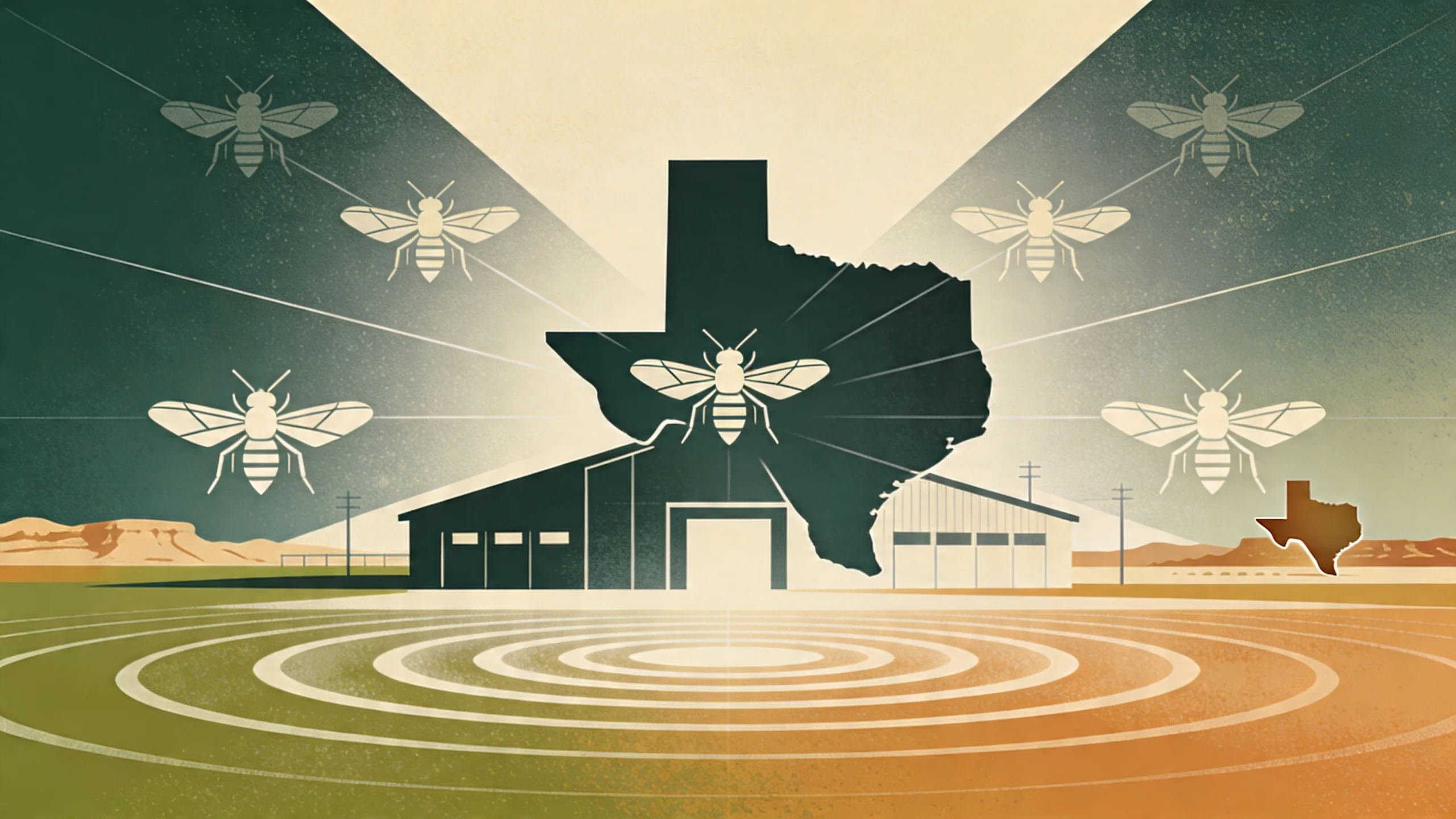
USDA Breaks Ground on $750M Sterile Fly Facility in Texas to Combat Screwworm Threat
The first shovels hit dirt on April 17 at Moore Air Base in Edinburg, Texas, marking the beginning of a $750 million federal investment that could reshape how North America defends against one of agriculture's most devastating parasites.
Track every confirmed case on our live Texas screwworm tracker and county map.
U.S. Secretary of Agriculture Brooke Rollins and Lieutenant General William H. "Butch" Graham of the Army Corps of Engineers led the groundbreaking ceremony for a new sterile fly production facility—the cornerstone of USDA's five-pronged strategy against New World screwworm. The parasite, which has advanced to within 90 miles of the Texas border, poses an existential threat to the nation's cattle industry.
"This puts NWS sterile fly production in American hands," Rollins told attendees, "so we do not have to rely on other countries for the best offensive measure to push screwworm away from our borders."
The stakes could hardly be higher. Texas ranks first nationally in cattle production, and an unchecked screwworm infestation could cost producers billions while disrupting food supply chains across the continent. The fly lays eggs in open wounds of warm-blooded animals; hatched larvae feed on living tissue, creating a death spiral for infected livestock if left untreated.
The Edinburg facility represents a dramatic expansion of domestic biosecurity infrastructure. When initial operations begin in November 2027, the plant will produce 100 million sterile flies weekly. Full capacity, targeted for completion shortly thereafter, will triple that output to 300 million flies per week—enough to maintain a protective barrier stretching from the Rio Grande through Central America.
The science behind the facility relies on a biological quirk: female screwworm flies mate only once. By flooding target areas with irradiated sterile males, the technique ensures that wild females produce non-viable eggs. This approach, refined over decades, eliminated screwworm from the United States in 1966 and from Central America north of Panama by 2006.
But maintaining that barrier has grown increasingly precarious. Until now, the United States relied entirely on the COPEG facility in Panama, which produces roughly 100 million sterile flies weekly. Political instability, supply chain disruptions, or equipment failures at that single site could compromise the entire defense system.
The new Texas facility eliminates that vulnerability while complementing ongoing international efforts. USDA has separately committed $21 million to modernize Mexico's Metapa facility, expected to reach full operation this summer.
Representative Monica De La Cruz, whose district includes the construction site, called the investment "just the beginning" of federal commitment to border-area agriculture. The Texas & Southwestern Cattle Raisers Association, representing 28,000 producers across the Southwest, has identified expanded sterile fly production as a key legislative priority for three consecutive sessions.
Construction management falls to the Army Corps of Engineers, which brings decades of experience building biosecure facilities. The project timeline—aggressive by federal infrastructure standards—reflects both the urgency of the screwworm threat and streamlined procurement processes implemented specifically for this initiative.
For Texas ranchers, the facility offers something more valuable than statistics: operational independence. Should Panama's production falter, domestic capacity can maintain the sterile insect barrier without international coordination delays. That speed matters when dealing with a pest capable of establishing permanent populations within weeks of crossing an undefended border.
The groundbreaking comes as USDA simultaneously deploys additional surveillance teams along the Rio Grande Valley and expands public outreach to border-area veterinarians and livestock producers. Combined with the sterile insect program, these measures form a layered defense against what agriculture officials increasingly view as an inevitable incursion rather than distant threat.
Ground crews have already begun site preparation at Moore Air Base. Foundation work is scheduled to commence within weeks, with structural framing following by early fall. The November 2027 operational target leaves little margin for weather delays or supply disruptions—but for an industry facing a pest that hasn't breached U.S. borders in nearly 60 years, the urgency is entirely warranted.
Sources
Texas Bug Slayers Editorial Team
Editorial Board
The Texas Bug Slayers editorial team brings together licensed pest control professionals, entomologists, and writers dedicated to helping Texans protect their homes and families from pests.
Related Articles
USDA Fast-Tracks Texas Screwworm Facility by 7 Months to Combat Parasite Spread
USDA accelerates construction of sterile fly facility at Moore Air Base by seven months as New World screwworm cases reach 45 in Texas.

Texas Launches Agricultural Defense Program to Combat Pests and Disease
Commissioner Sid Miller announces AgDefense, a new TAFA-funded initiative to protect Texas farmers from agricultural pests, diseases, and predators.

Texas Hay Growers Are Cutting Three Times Where They Used to Cut Eight
Drought, six-dollar diesel and the pasture mealybug are squeezing Texas hay growers at once. AgriLife says Coastal Bermuda fields have dropped from 7-8 cuttings to 3-4.