
Fire Ant Control That Leaves the Rest of Your Yard Alive
Fifty-five horned lizards went into the grass on a Texas ranch in late October, bringing the San Antonio Zoo's reintroduction program to 428 animals since 2017. The zoo's own accounting of why the species needed rescuing is the uncomfortable part. It lists habitat loss, non-native grasses, pesticide use, and red imported fire ants — two of which are decided by whoever treats the yard.
Horned lizards eat ants. Not the ants filling most Texas lawns now, but native harvester ants: the large rusty-brown ones that clear a bare disc in the grass and file across it in a seed-gathering column. Fire ants are a direct threat to a lizard that sits still for a living, and a competitor that pushes the harvester colonies out. So the ordinary fall bait pass, the one that makes a yard feel handled for a season, is aimed at the state reptile's pantry. The reintroduction effort that put 55 more lizards on ranchland is mostly a story about ant communities — something a homeowner actually controls.
What a broadcast bag does that the label doesn't say
Most homeowner fire ant products are granular bait: hydramethylnon, indoxacarb, spinosad, methoprene, or fipronil granules, scattered across the whole lawn and carried back to the colony by foragers who think it is food. That mechanism is the problem and the solution at the same time. A bait granule cannot tell a red imported fire ant from the harvester ants, pyramid ants, and pavement ants that share the same ground. Whatever forages the day you spread it takes the dose home.
A knockdown looks dramatic for about six weeks. Then fire ants refill from the fence line, the easement, and the neighbor's untended back acre, faster than most native colonies rebuild — a single multi-queen fire ant colony in Texas can hold dozens of reproductives, while a harvester colony runs on one queen and grows slowly. Treat the same acreage twice a year with blanket bait and the yard can end up with fewer of the ants that belong here and the same number of the ones that don't.
None of this means stop treating. It means treating narrower, and knowing which mounds to walk past.
First, learn which mound is your problem
Fire ant mounds are fresh-worked domes of crumbly soil with no visible opening, spongy underfoot, often tucked against a foundation edge, sidewalk joint, or the sunny side of a utility box. Push a stick in and the surface erupts. Those are the ones worth killing.
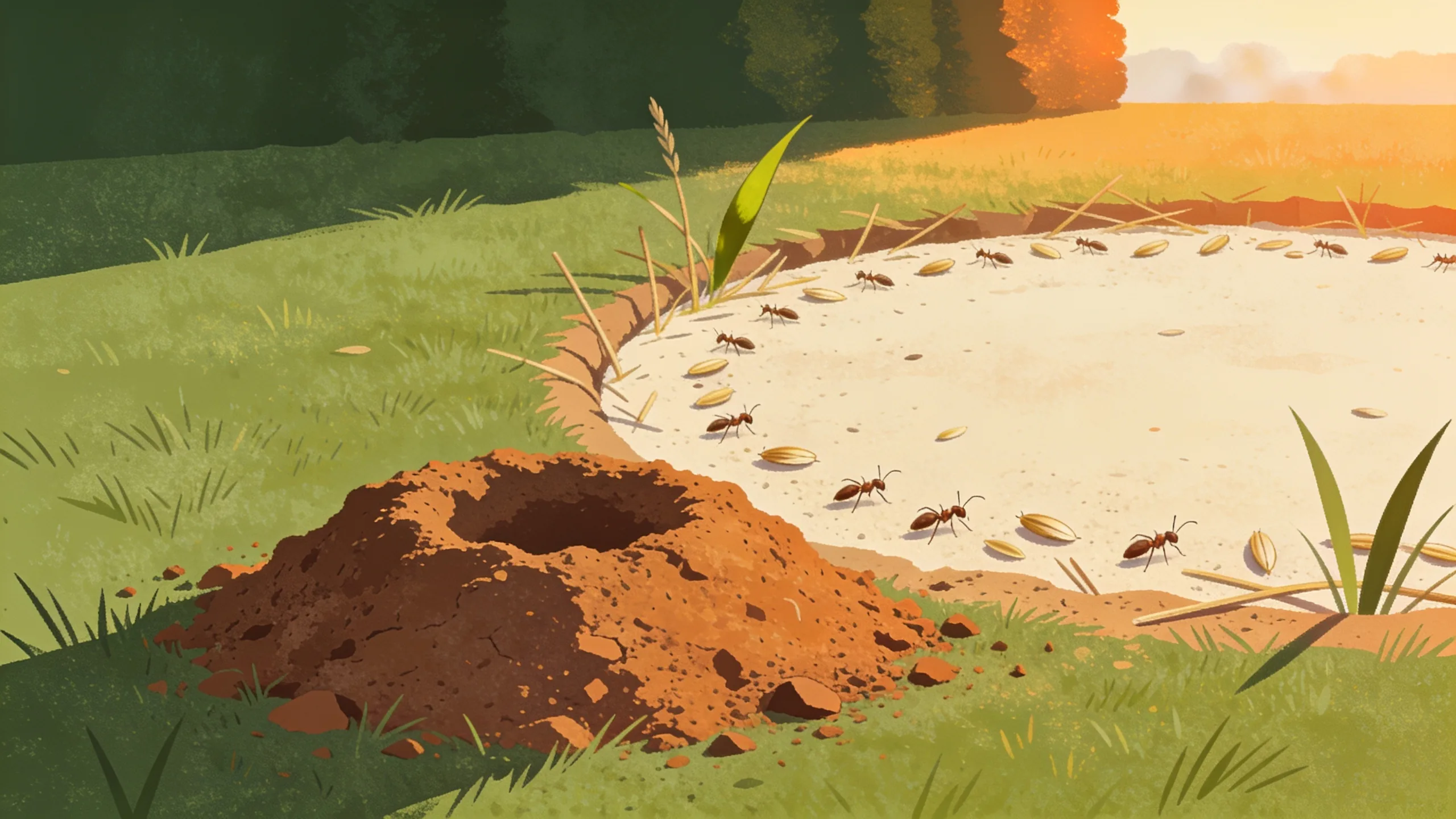
Harvester ant colonies look nothing like that once you have seen one: a flat, cleared circular patch a foot to several feet across, a small crater near the middle, rings of seed chaff and husks around it, and a lane of big slow ants moving in single file. They nest in open, compacted, sun-baked ground — caliche, old pasture, the bare strip between a fence and the alley. They sting badly and they will not be relocated politely, but a harvester colony is the one ant mound in a Texas yard worth leaving alone. Nothing in state law requires you to spare them, and no homeowner ever got a citation for a bait application. It is a choice about what the ground is for.
East Texas pine country adds the Texas leafcutting ant and its crescent craters; Gulf Coast yards get tawny crazy ants, which build no mound at all and nest in mulch and wall voids. Neither answers to a bag of granules.
The two-step method, run the way extension agents mean it
The sequence county agents teach is broadcast bait first, mound drench second — and the details are where most DIY attempts fall apart.
Bait has to be fresh. The soybean oil carrier goes rancid in a hot garage, and ants refuse stale granules, which is why a bag that sat through a Texas summer just lightens your wallet. Buy what you will use in one season.
Timing beats dosage. Ants forage when the soil is warm enough to move them, which means late afternoon and early evening through the warm season, and midday once the nights cool off in November. Bait needs dry ground and a dry forecast; irrigating the day before, or spreading ahead of a rain band, dissolves the granules the ants were supposed to carry. Put it around the yard rather than on top of mounds, because mounds are the one place foragers are not working.
Then wait. Two weeks is not too long, and a drench the same afternoon just kills the ants that were going to do the carrying. The drench is a spot tool for colonies that are genuinely in the way: along the slab, under the A/C pad, at the gas meter, beside the sandbox, in the seam where the driveway meets the garage.
Treat the seams, not the acre
Most yards do not need whole-lot coverage to stay livable. Fire ants follow edges and moisture, and Texas construction hands them both: the expansion joint in a slab, the gap behind brick veneer, the valve box that floods every Tuesday. A two- to three-foot band along the foundation, plus the utility penetrations and anything that stays damp, covers the ground where ants reach people.
Inside the fence there is a second half to the job, and it is not chemical. Pet food left out overnight, grease on a grill drip tray, fallen fruit under a backyard pear, a leaking hose bib, a compost pile turned once a month — all of it feeds colonies that then spread outward. Fixing drainage and getting the lawn care routine right beats a second bait pass in December.
Making the yard worth something to the ants that belong there
Nobody should promise that a Katy subdivision lot will draw horned lizards back. The species needs ranchland, open ground, and harvester colonies that have been there for years. What a homeowner can do is stop removing the pieces: mow a little higher in late fall, keep some unpaved edge, go easy on broad-spectrum lawn sprays, skip the urge to treat every mound in sight. A yard with a working native ant community carries fewer of the pests those ants compete with — a quieter benefit than a horned lizard on the patio, and a far likelier one.
Around San Antonio, where subdivisions keep landing beside ranch country, and in Fort Worth, where a second zoo program raises hatchlings, the line between habitat and lawn is measured in feet.
What to ask before you hire someone
Fire ant work for hire in Texas sits under TDA licensing, and the two categories homeowners actually meet are P for general pest control and L for lawn and ornamental. A category describes the license, not the service, so ask rather than assume.
Questions that sort out the difference: is this a broadcast bait application or a spot treatment, and over how much of the property? Which active ingredient, and how fresh is it? Will the technician drench a harvester ant disc along the fence by default? What is the re-entry time for kids and pets?
Ask for the targeted perimeter pass by name and listen to whether the answer sounds like a plan or a shrug. The Texas pest control directory lists licensed operators by city, and a crew that walks the property and asks where the kids play is a better sign than a flat rate quoted over the phone for professional pest control service.
Frequently Asked Questions
Does treating fire ants hurt horned lizards? Only indirectly, and only if the yard still has harvester ants for them to eat. Horned lizards are rare in dense subdivisions, so the realistic concern is the ant community rather than the lizard itself. If you have seen one on the property, spot treat near the house and leave the open ground alone.
How can I tell a harvester ant mound from a fire ant mound? Harvester colonies clear a flat disc of bare soil with a small crater in the middle and piles of seed husks, and the ants are large, slow, and reddish-brown. Fire ant mounds are loose domes with no opening. Watch from several feet away before you decide.
Is fall a good time to bait fire ants in Texas? Yes. September through November is one of the two solid windows, along with spring, because colonies are actively foraging and the ground is workable. Bait spread on dry soil with no rain in the forecast beats the same bait spread ahead of a downpour.
Can I just drench the mounds I can see? That handles the colonies you found and none of the ones you did not, which in a Texas yard is most of them. Broadcast bait at a labeled rate covers the ground; drenches close to the slab handle the colonies that matter most.
For products and rates built around the two-step method, Texas A&M AgriLife's fire ant library is the reference to read first.
Texas Bug Slayers Editorial Team
Editorial Board
The Texas Bug Slayers editorial team brings together licensed pest control professionals, entomologists, and writers dedicated to helping Texans protect their homes and families from pests.