
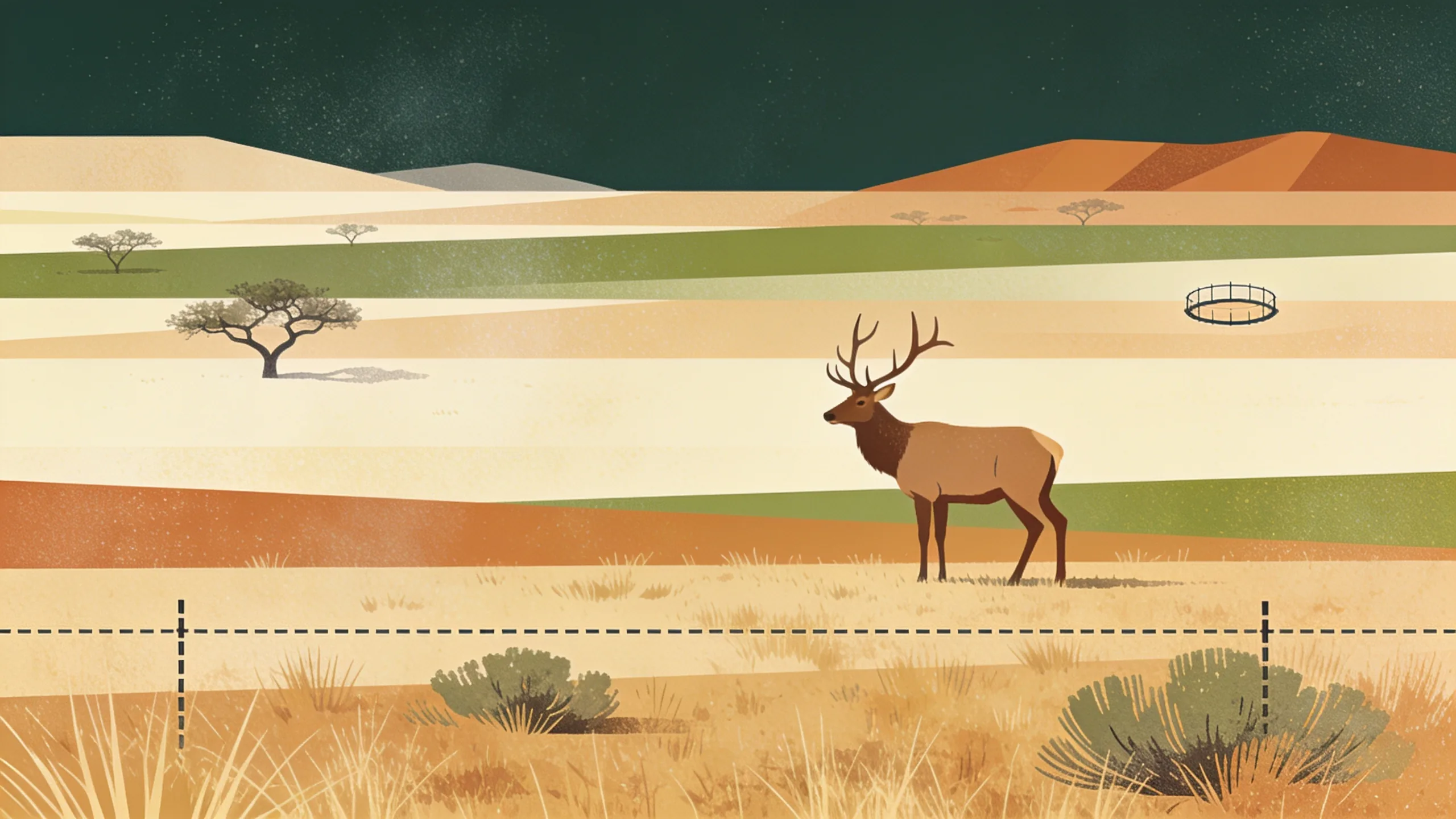
A Wild Elk in Pecos County Is the First American Wildlife Case of Screwworm
For five months the New World screwworm outbreak in Texas had a shape everyone could describe: a calf in Zavala County, goats in Crockett County, a dog in Brewster County, cattle in Pecos County. Individual animals, on individual premises, each one a line in a spreadsheet that a state veterinarian could point to. On Wednesday that shape changed.
The Texas Parks and Wildlife Department announced Oct. 21 that it had received confirmation of screwworm in a hunter-harvested female elk in Pecos County. The elk was on a game ranch, according to USDA's Animal and Plant Health Inspection Service, and was reported after a hunter took it. A sample went to the Agricultural Research Service's Knipling-Bushland U.S. Livestock Insects Research Laboratory in Kerrville — the lab named for the two USDA scientists who built the sterile insect technique — and came back positive. It is the first detection of New World screwworm in American wildlife in this outbreak, and APHIS said so in a release posted the same evening.
The arithmetic behind that sentence: 59 confirmed U.S. animal cases since June, 54 of them in Texas and five in New Mexico, according to Texas Public Radio's running tracker, updated Wednesday. A beef cow in New Mexico was confirmed the same day as the elk. Before it came a horse and a calf in Grant County, New Mexico, on Oct. 15, and cattle in Pecos County on Oct. 10. Separate from the animal count, officials recorded a single wild screwworm fly in a surveillance trap in Brewster County on Sept. 25 — traps are tracked on their own ledger, and always have been.
What matters about the elk is not the number. It is the category.
A feedlot calf can be inspected, treated and accounted for. A wild animal cannot. TPWD's own guidance lists the species most likely to be hit — white-tailed deer, jackrabbits, cottontails, small mammals, turkeys — which is to say the resident wildlife of every ranch, lease and highway shoulder between the Pecos River and the Gulf. An infested deer that dies in a mesquite thicket is not a data point anyone collects unless a hunter, a landowner or a biologist happens to find it first. And an infested animal that keeps walking is a dispersal mechanism that does not respect a quarantine line drawn around a pasture.
That is the part state officials are now working on. TPWD said the Texas Animal Health Commission will modify a previously established infested zone — Pecos County already had one, from the cattle case eleven days earlier — and that USDA and TPWD are running additional wildlife surveillance in the area. Animal movement restrictions remain in effect in portions of twelve Texas counties, including Brewster, Crockett and Pecos; nothing leaves a designated infested zone without prior authorization from the commission. Sterile fly releases, the mechanism that cleared this parasite from the country once already, continue over the affected range.
"We encourage all hunters and landowners to be vigilant for signs of New World screwworm while they are out in the field this season," said Alan Cain, TPWD's Wildlife Division director. "The partnership between TPWD biologists and local hunters and landowners expedited the identification and confirmation of this new detection." That is bureaucratic phrasing for something real: a hunter shot an elk, noticed something wrong, and reported it, and the report traveled fast enough to reach a federal lab and come back confirmed.
Which is the other thing that changed this week. Texas has spent the fall treating hunters as a public that needed warning about a livestock disease. As of Wednesday they are the surveillance network. The department's inspection instructions are specific — check the eyes, ears, nose, mouth, genitalia and any mucous membranes; run your hands along the body; look at the feet and between the toes for wounds that smell wrong or move. Signs in a live animal include irritated or depressed behavior, lost appetite, head shaking, the smell of decaying flesh, isolation from the herd.
The timing is unforgiving. Archery season opened Oct. 3 and the general white-tailed season opens Nov. 7, putting hundreds of thousands of people with rifles and knives into exactly the counties under movement restriction. That is a lot of eyes. It is also a lot of carcasses moving on trailers, which is why the reporting channels matter more than the warnings: suspected cases in wildlife go to a TPWD wildlife biologist or 512-389-4505, suspected cases in livestock or pets to the TAHC region office or the veterinarian on call at 1-800-550-8242.
Federal and state officials have been careful not to overstate what one elk means. APHIS did not announce a case count, a zone map or a treatment plan in its release; it announced a detection and a reporting appeal. The agency's language — "this detection highlights the critical role hunters, landowners, outdoor enthusiasts, and wildlife professionals play" — is the language of an organization that has just discovered its detection system works and wants more of it.
The outbreak's bigger bets are unchanged and still months out. The sterile fly plant at Moore Air Base in Edinburg is aiming at initial operating capability in April 2027, with flies for now coming from a converted facility in Metapa, Chiapas, and the binational commission's plant in Panama. Cattle ports along the southern border are reopening one at a time, the third at Columbus, New Mexico, on Oct. 26. Canada wants 21-day-old paperwork; Colorado wrote an emergency rule.
None of that reaches a deer standing in a Pecos County draw. What reaches it is a hunter who knows what a screwworm wound looks like and a phone number to call. As of this week, that is officially part of the response plan.
Sources
- USDA APHIS — USDA Confirms First Detection of New World Screwworm in U.S. Wildlife (Oct. 21, 2026)
- Texas Parks and Wildlife Department — New World Screwworm Detected in Hunter-Harvested Elk in Pecos County (Oct. 21, 2026)
- Texas Public Radio — Screwworm cases reach 59, including first wildlife detection in Texas (Oct. 21, 2026)
- Texas Parks and Wildlife Department — New World Screwworm in Texas (reporting and guidance)
Texas Bug Slayers Editorial Team
Editorial Board
The Texas Bug Slayers editorial team brings together licensed pest control professionals, entomologists, and writers dedicated to helping Texans protect their homes and families from pests.
Related Articles
Screwworm Count Reaches 50 as New Mexico Confirms a Second Horse Case
USDA confirms the 50th U.S. New World screwworm case — a horse in Grant County, New Mexico, the outbreak's second equine case in two weeks — while the Texas count holds at 48 and a border port prepares to reopen to Mexican livestock.
Screwworm Count Reaches 49 as First Horse Case Lands in Presidio County
USDA confirms the 49th U.S. New World screwworm case — a horse in Presidio County, Texas, the outbreak's first equine detection — while TAHC's September orders cut the quarantine map from 19 counties to 14.

USDA Marks Billionth Sterile Fly Release in Texas Screwworm Fight
USDA marked its billionth sterile fly released over Texas as Secretary Rollins reported three active screwworm cases and no cattle case in over a month.