
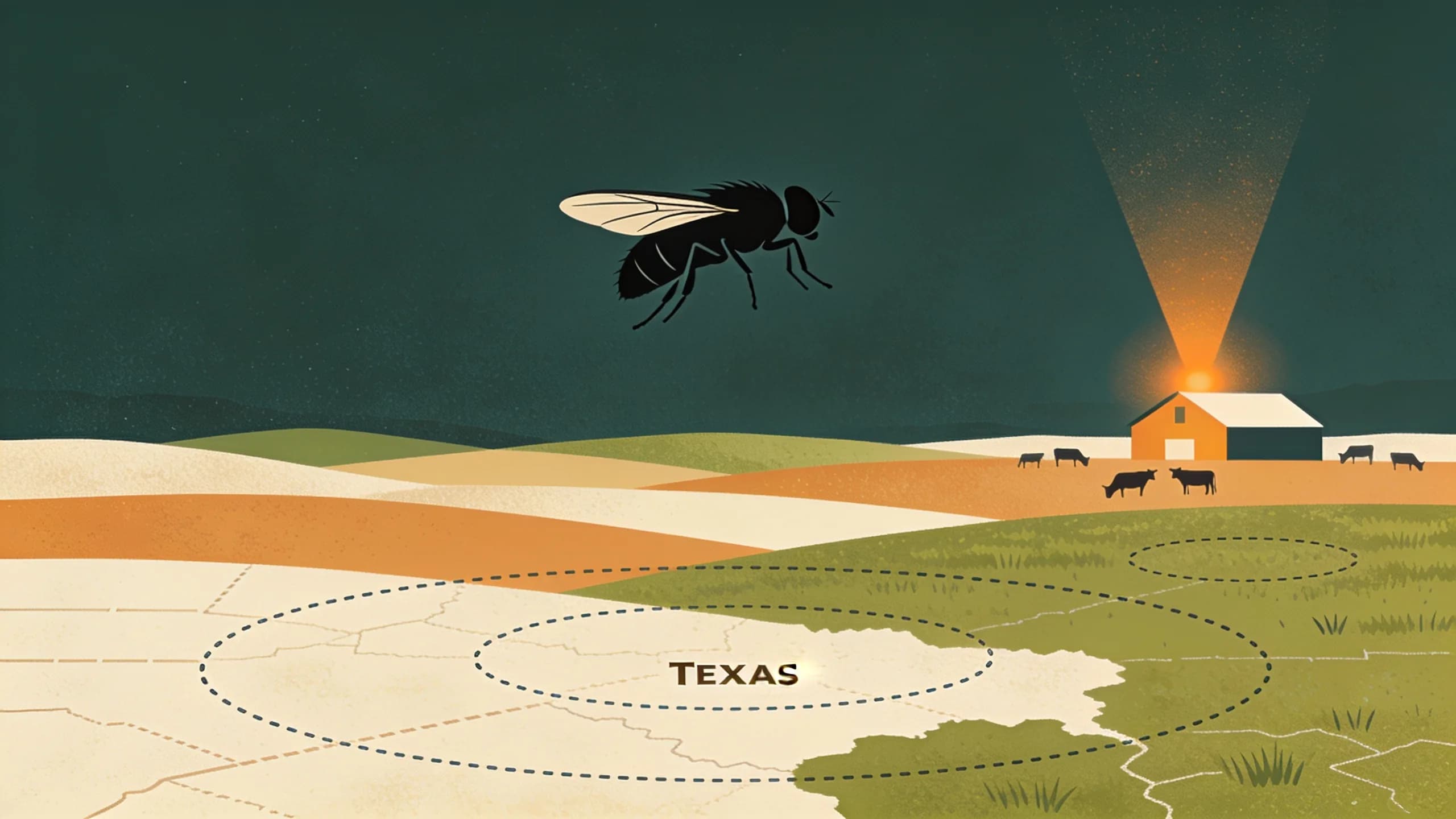
Screwworm Infestations Hit 45 as Texas Activates Emergency Operations Center
The New World screwworm outbreak in Texas crossed another threshold this week. The U.S. Department of Agriculture has now confirmed 45 infestations—44 in Texas and one in neighboring New Mexico—as state officials escalate a response that has grown from scattered rural detections into a full emergency operation.
Track every confirmed case on our live Texas screwworm tracker and county map. Local residents can browse licensed pest control companies in Terrell County in our directory.
The latest case, confirmed August 5, involved sheep in Terrell County, a West Texas ranching county that had not previously appeared on the infestation map. It follows a recent cluster of detections in sheep in Pecos County, cattle in Brewster County, goats in Sutton County, and sheep in Schleicher County—evidence that the Edwards Plateau and Trans-Pecos regions remain the outbreak's active core.
Against that backdrop, Gov. Greg Abbott has activated the State Operations Center in Austin to coordinate the multi-agency response, KPRC reported Wednesday. The move puts the same emergency machinery used for hurricanes and wildfires behind the screwworm fight, bringing the Texas Division of Emergency Management into daily coordination with the Texas Animal Health Commission and federal officials.
From the Hill Country to the Rio Grande Valley
The outbreak's geography keeps widening. In July, a calf in western Starr County became the Rio Grande Valley's first confirmed detection, reported north of Roma and confirmed the same day. Part of Starr County was already under quarantine restrictions tied to an earlier case in neighboring Jim Hogg County. Movement restrictions—requiring inspections before certain livestock can be transported—now cover parts of 22 Texas counties, stretching from the Valley through West Texas and the Hill Country.
For ranchers, the parasite is a direct economic threat. The screwworm fly lays eggs in open wounds, and its larvae feed on living tissue rather than decaying flesh. Untreated infestations can kill cattle, sheep, goats, horses, deer and pets. State guidance urges producers to inspect animals after branding, procedures or injuries, and to call a veterinarian before moving any animal with a worsening or larvae-bearing wound.
A Warning From Across the State Line
New Mexico's lone confirmed case—a dog in Lea County identified in early June after a veterinarian recognized the parasite—may not stay lone for long. State Veterinarian Dr. Samantha Holeck told lawmakers Tuesday that additional detections are expected as the parasite presses north through Mexico and Texas, according to KRQE.
Holeck put hard numbers on the containment challenge: when the United States eradicated screwworm decades ago, the sterile fly program was producing 500 million flies a week. Current production runs at roughly 20 percent of that capacity. Relief is coming but slowly—a reconditioned facility in Chiapas, Mexico, is expected to begin operating by the end of August, lifting combined production with the Panama plant to around 200 million sterile flies weekly, while a new Texas production facility slated for early 2027 should add another 300 million per week.
The regional picture explains the urgency. Officials report more than 189,000 animal cases and over 2,300 human cases across Mexico and Central America, a reservoir that keeps pressure on the border regardless of how aggressively Texas responds.
Ranchers Get the Briefing in Person
The outbreak dominated conversation at this week's Texas A&M Beef Cattle Short Course in College Station, where more than 2,000 ranchers gathered August 3-5 and received updated screwworm guidance from AgriLife Extension specialists, according to KXXV. Texas A&M AgriLife has also published a field guide for cattle producers and continues running its free inspector training program, launched by the governor to certify more eyes on livestock moving through the state.
Animal health officials stress that the public risk remains low—human infestations are rare and screwworm is not a food safety concern—but they ask rural residents and hunters to report unusual wounds in wildlife, particularly white-tailed deer, to the Texas Animal Health Commission.
Sources
Texas Bug Slayers Editorial Team
Editorial Board
The Texas Bug Slayers editorial team brings together licensed pest control professionals, entomologists, and writers dedicated to helping Texans protect their homes and families from pests.
Related Articles
Screwworm Count Reaches 50 as New Mexico Confirms a Second Horse Case
USDA confirms the 50th U.S. New World screwworm case — a horse in Grant County, New Mexico, the outbreak's second equine case in two weeks — while the Texas count holds at 48 and a border port prepares to reopen to Mexican livestock.
Screwworm Count Reaches 49 as First Horse Case Lands in Presidio County
USDA confirms the 49th U.S. New World screwworm case — a horse in Presidio County, Texas, the outbreak's first equine detection — while TAHC's September orders cut the quarantine map from 19 counties to 14.

USDA Marks Billionth Sterile Fly Release in Texas Screwworm Fight
USDA marked its billionth sterile fly released over Texas as Secretary Rollins reported three active screwworm cases and no cattle case in over a month.