
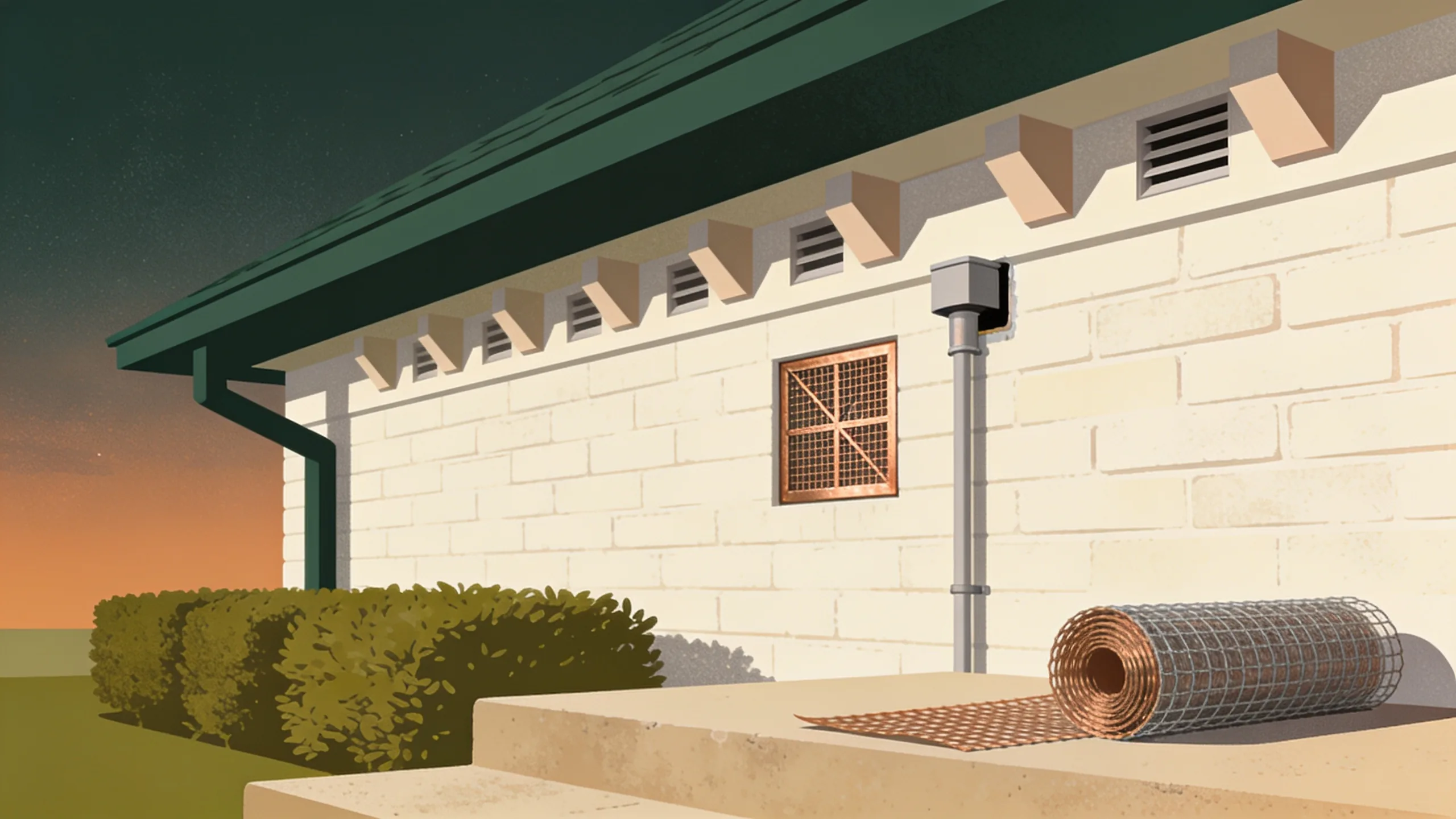
How to Prepare Your Texas Home for Fall Rodent Season
The sound arrives in the small hours, somewhere above the bedroom ceiling: a soft scuff, a pause, then a scratch that travels four feet and stops. It is not the house settling. Texas attics are quiet places for eight months of the year and busy ones in November, and the difference between those two states is a weather front.
Rodents do not migrate here in the fall. They are already in the woodpile, under the shed, along the greenbelt behind the subdivision. What changes is the arithmetic: a cold snap cuts their outdoor food supply and makes the warm side of a wall enormously attractive, so a population that spent the summer dispersing converges on the one structure nearby with insulation, stored food and a hundred small gaps.
What the first cold front actually does
The timing is local, and that matters because it sets your deadline. Dallas–Fort Worth, Lubbock and the Panhandle usually flip within a week of the first genuine front in late October or early November. Along the Gulf Coast it is different: Houston and Corpus Christi rarely get cold enough to drive rodents in, but a wet fall does the same work, flushing rats out of sewers and low vegetation into the nearest dry structure. El Paso and the Trans-Pecos run on their own schedule, with cooler nights arriving earlier.
Work backward from your average first hard front and give yourself two weekends.
Three animals, three sets of clues
Most Texas homes are dealing with one of three rodents, and which one you have changes where you look.
The roof rat is the classic suburban invader across the southern half of the state. Slim, dark, tail longer than its body, it climbs brick, stucco, live oak trunks and power lines, and prefers attics, soffits and the space above a garage. It also raids citrus and pecan trees before it ever considers your kitchen, which is why roof rat complaints spike after the fall harvest.
Norway rats are the burrowers — heavier, tail shorter than the body, working at ground level in crawl spaces, garage slabs and trash enclosures. They dominate older neighborhoods and restaurant loading docks.
Then there is the house mouse, which needs a gap the width of a pencil and nests in wall voids, drawer bottoms and stored holiday boxes. It is the rodent most people notice first, because of droppings in a pantry. AgriLife Extension publishes Texas-specific rodent guidance if you want to confirm an identification, and the CDC's rodent pages cover the health side.
Walk the envelope before you buy anything
Before traps, before bait, before a service call, spend one hour outside with a flashlight. You are looking for openings, not rodents, and Texas construction offers plenty.
Start at the roofline: every soffit, ridge and gable vent, every roof-to-wall junction. Roof rats and squirrels routinely tear a screen or widen an existing gap, and a vent screen left torn since spring is an open door by October. Check the roof jacks around plumbing vents and the chase where the HVAC line set enters the attic — then check that same line set at the condenser, where the hole is often sealed with nothing but a wad of old putty.
Work down the walls. Every brick-veneer house in Texas has weep holes at the base, and an open weep hole sits at exactly the height rodents travel. Dryer vents without a working damper, hose bibs, exterior outlets, gas stub-outs, cable entries, and the gap under the bottom course of brick where it meets the slab all deserve a look.
Finish at the floor. Garage door bottom seals bake brittle in a Texas summer and curl off the slab; daylight under the door is a highway. On pier-and-beam homes, inspect the skirting, the vent screens and the access hatch — old lattice with a two-inch gap is a standing invitation.
Seal to a quarter inch
Exclusion is unglamorous and it is the highest-value thing you can do. The standard to aim for is a quarter inch: if a pencil slides into a gap, a mouse can use it, and if a thumb fits, so can a rat.
Steel wool alone is not the answer — it rusts, and rodents eventually pull it out. The durable version is copper mesh or hardware cloth packed into the gap first, then sealed over with exterior-grade sealant or mortar. Weep holes get manufactured inserts that still drain and vent. Door bottoms get a proper sweep or rubber threshold seal, rechecked after the first cold snap. Torn vent screens and gaps at the top of a garage wall are usually same-day hardware-cloth fixes.
One caution that genuinely matters: never seal a gap while animals are still inside. Deal with the occupants first, or you will trap them in the wall void and the smell will be far worse than the noise.
The yard is half the job
Trapping and sealing while leaving a rodent cafeteria outside is a losing sequence. Roof rats travel along limbs, so prune anything within a few feet of the roofline — pecans, live oaks, crape myrtles, ligustrum. Woodpiles, stacked lumber and compost bins belong well away from the foundation. Bird feeders are a food source in their own right, and fallen fruit and pecans get cleaned up rather than left to rot. Pet food left out overnight, or spilled in the garage, teaches a rodent your house is worth crossing the yard for.
Water counts too: a dripping hose bib or a wet condensate line gives rodents what they need most in a dry Texas fall.
If they are already inside
Observe, trap, exclude, then clean. Snap traps remain the most effective indoor tool, set along walls and in corners rather than the middle of a room, and baited with something aromatic — peanut butter works, but a piece of pecan gets roof rats that have never met a trap. Place several and check them daily.
Be cautious with rodenticide indoors. Poison carried into a wall void creates a smell you cannot reach, and it puts pets at risk of secondary poisoning. Outdoors, use bait stations, not loose blocks.
Cleanup is where homeowners get careless. Droppings and nesting material should never be dry-swept: wear gloves and a respirator, mist with disinfectant before removing anything, bag the waste, then wash up. Hantavirus is uncommon in Texas, but the routine costs nothing.
When to call it in
One mouse and a sealed gap is a DIY job. A pattern is not. If you are still catching animals after two weeks, if they reach kitchen cabinets or a nursery, if attic insulation is tunneled and soiled, or if you own a pier-and-beam home with a crawl space you cannot inspect properly, an inspection beats another box of traps. A technician finds entries you cannot see and sets a monitoring plan for the season.
Start with our Texas pest control directory to find a licensed provider. In the northern half of the state, where the cold-front rush hits hardest, line up Dallas pest control providers before November. Coastal homeowners dealing with flooding-driven pressure do better with Houston pest control providers, where the work is different — more slab penetrations and drainage problems, fewer freezing nights.
A quarterly pest control service with an exterior perimeter and rodent monitoring is the low-effort version of all of the above, and in most Texas markets it costs less than one insulation replacement. Do it before the front arrives — rodents are easier to keep out than to evict.
Frequently Asked Questions
When does rodent season start in Texas?
It tracks weather, not the calendar. North and West Texas typically see movement begin with the first strong front in late October or November. Along the Gulf Coast, heavy fall rain and flooding push rats out of sewers and low vegetation instead. Finish exclusion two to three weeks before that point.
How do I tell rats from mice?
Size and evidence. Mouse droppings look like rice grains; rat droppings are raisin-sized and often clustered along a wall. Rats leave grease smears on the paths they use and noticeably larger gnaw marks. Mice rustle; roof rats run; a Norway rat in a crawl space sounds like something much larger.
Is it true mice fit through a pencil-sized hole?
Roughly, yes. A house mouse passes through a gap about a quarter inch wide, and a young rat can use one the size of a half dollar. That is why sealing to a quarter-inch standard matters more than patching the one obvious hole.
Do ultrasonic repellents work?
They are not a substitute for exclusion. Studies generally find that rodents ignore ultrasonic devices or habituate within days, and sound does not travel through wall voids and cabinetry the way the packaging implies. Copper mesh, hardware cloth, sealant and a fixed door sweep will still be working next fall.
Texas Bug Slayers Editorial Team
Editorial Board
The Texas Bug Slayers editorial team brings together licensed pest control professionals, entomologists, and writers dedicated to helping Texans protect their homes and families from pests.