
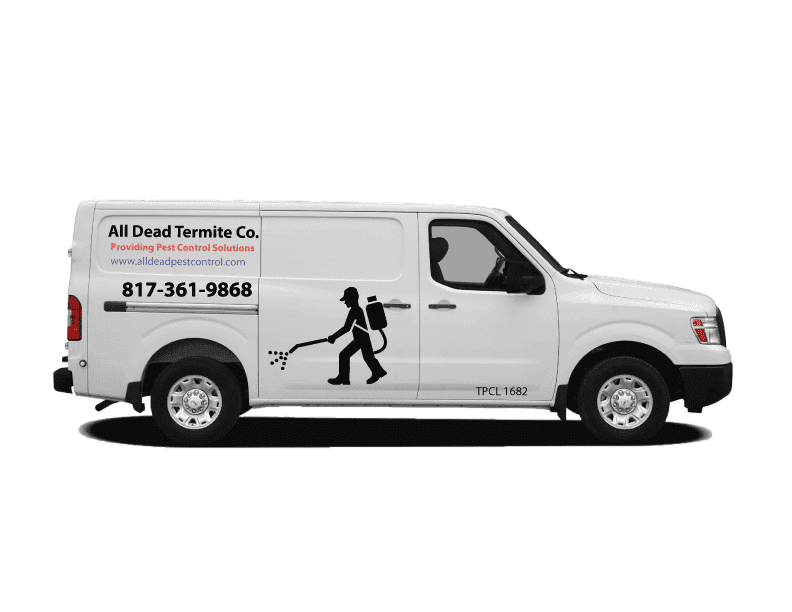
All Dead Termite Co.
DBA of CHRISTOPHER K SWAFFORD
All Dead Termite Co. is a pest control provider based in Fort Worth, TARRANT County, Texas. They operate under Structural Pest Control Business License TPCL #566221, issued by the Texas Department of Agriculture.
Their licensed service areas include pest control, and termite treatment.
Customers have rated All Dead Termite Co. 4.8 out of 5 stars on Google, with 20 reviews reflecting their service track record in Fort Worth.
Licensed for 2 service categories under TPCL #566221
Also listed on Google as
| Day | Hours |
|---|---|
| Monday | 8 AM to 5 PM |
| Tuesday | 8 AM to 5 PM |
| Wednesday | 8 AM to 5 PM |
| Thursday | 8 AM to 5 PM |
| Friday | 8 AM to 5 PM |
| Saturday | Closed |
| Sunday | Closed |
All Dead Termite Co. holds TPCL #566221 with 1 authorized service category
Common questions about pest control services in Fort Worth, TX
How long does a pest control treatment take?
A standard interior/exterior treatment takes 30–60 minutes for an average-sized home. Termite inspections take 1–2 hours. Full termite treatments may require a full day. Fumigation involves 2–3 days of preparation, treatment, and aeration. Your technician will provide a time estimate based on your property.
What happens if pests come back after treatment?
Most pest control companies offer re-treatment guarantees — if pests return between scheduled visits, they will re-treat at no additional charge. This is standard with ongoing service plans. For one-time treatments, ask about the warranty period. Persistent issues may indicate entry points that need sealing or environmental factors that need addressing.
Should I get multiple quotes before choosing a pest control company?
Yes. Getting 2–3 estimates is recommended. Compare not just price but also the scope of service, products used, guarantees offered, and customer reviews. The cheapest option is not always the best — look for licensed, well-reviewed companies that clearly explain their treatment plan.
What does it mean when a pest control license is inactive?
An inactive license means the company has not renewed their TPCL with the Texas Department of Agriculture. This could be due to business closure, failure to meet insurance requirements, or voluntary non-renewal. Companies with inactive licenses cannot legally perform pest control services in Texas.
What are the different pest control license categories in Texas?
The TDA issues licenses with specific category codes: P (General Pest Control), T (Termite Treatment), L (Lawn & Landscape), W (Wildlife Removal), C (Crack & Crevice), S (Structural Fumigation), and D (Waste Disposal). Each category authorizes different types of pest management work.
What pest control challenges are unique to Texas?
Texas faces unique challenges including Formosan termite colonies in the Gulf region, fire ant infestations across most of the state, extreme heat that drives pests indoors, a long warm season that keeps pests active year-round, and a diverse geography ranging from humid coastlines to arid deserts, each with different pest pressures.
What pesticides do Texas pest control companies use?
Licensed Texas companies use EPA-registered products approved for residential and commercial use. Common categories include pyrethroids (synthetic insecticides for general pest barriers), fipronil (effective against ants and termites), neonicotinoids (for various insects), and growth regulators (which disrupt pest reproduction). Your technician should identify specific products used.
- TPCL #
- 566221
- License Type
- PT
- Issued
- N/A
- Renewed
- N/A
- Expires
- February 28, 2026
- Insurance Exp.
- N/A
- Operator
- CHRISTOPHER K SWAFFORD
- Legal Name
- CHRISTOPHER K SWAFFORD
Licensed by the Texas Department of Agriculture. Verify at texasagriculture.gov
- CityFort Worth
- CountyTARRANT
- Services2
- Reviews20
More Pest Control in Fort Worth

Urbanex Pest Control

Webb Pest Service Control & Extermination
Buzz Kill Pest Control

Critter Call Pest Control

Alliance Pest Solutions
