
White House Orders a 90 Percent Cut in Invasive Mosquitoes, and Texas Already Runs the Playbook
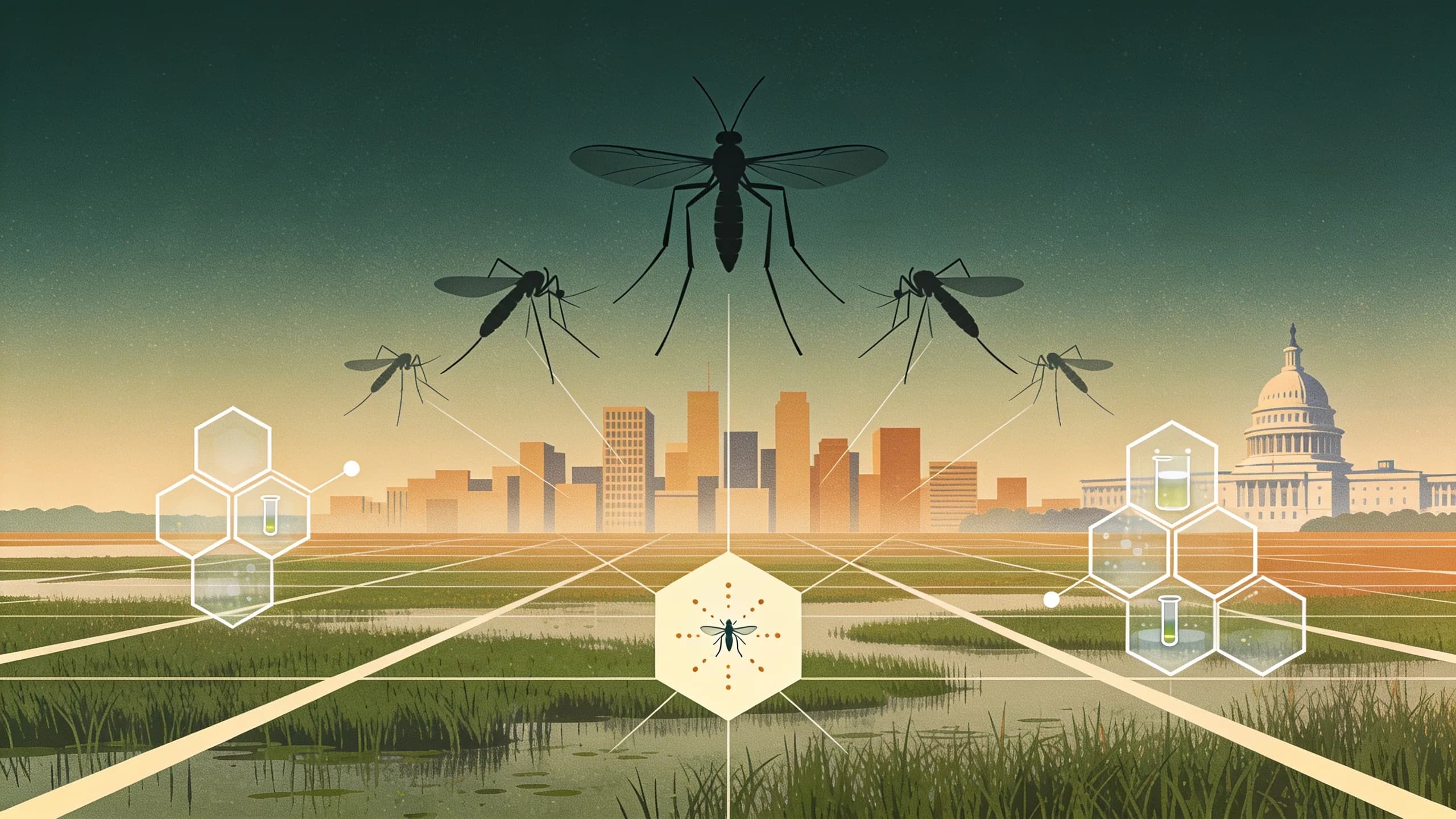
President Donald Trump signed an executive order on Sept. 29 titled "Eliminating Disease-Carrying Pests and Restoring Enjoyment of the Great Outdoors," and its most concrete target is a numbered one: a 90 percent reduction in invasive mosquito populations across Washington, D.C. by 2028, alongside a 50 percent cut in ticks.
The order directs the Departments of the Interior and Agriculture, the Environmental Protection Agency and the General Services Administration, in consultation with Health and Human Services, to design and run that campaign within 60 days. The named species are the Asian tiger mosquito and the Egyptian mosquito — Aedes albopictus and Aedes aegypti, the two container-breeding mosquitoes that dominate many urban areas and carry dengue, chikungunya, Zika and yellow fever. West Nile and other viral infections are listed among the diseases the order aims to address.
What makes the document unusual for a pest-control story is the toolbox it names. Beyond drainage and landscaping work — mowing, rain gardens, habitat remediation on federally managed land — the order explicitly tells agencies to control "host reservoir or amplification populations, including rodents and deer," and to prioritize "sterile insect techniques for mosquitoes or other safe and effective biotechnologies."
That is a familiar formula in Texas, just applied to a different insect. The state sits at the center of the world's largest sterile-fly effort against the New World screwworm, with the USDA's facility at Moore Air Base in Edinburg rearing sterile males for aerial dispersal. Sterile insect technique works the same way regardless of species: release enough sterilized males and wild females mate without producing offspring, and the population collapses over generations. Texas A&M AgriLife has also pushed the technology forward on screwworm specifically, including research into electron-beam sterilization as a replacement for cobalt-60 gamma irradiation.
The order goes further into biotechnology than federal vector-control policy usually does. Within 60 days the EPA is to deliver a regulatory framework for the "planned development and release into the environment" of advanced tick and mosquito control technologies, explicitly weighing sterilization, "safe genetic modification," and beneficial bacteria — a reference to Wolbachia, the bacterium used to suppress mosquito reproduction and block pathogen transmission. The agency is also told to "prioritize and expeditiously advance or register novel tick and mosquito control methods or products" it deems safe and effective. For pest control operators and manufacturers, that second instruction is the one with commercial consequences: a faster registration pathway can change which products reach the market, and when.
Elsewhere the order sets 90-day deadlines. HHS is to issue prize competitions or direct research programs for rapid diagnostics, prophylactics and therapeutics for tick- and mosquito-borne disease, and to review candidate immunotherapies for alpha-gal syndrome — the red-meat allergy linked to lone star tick bites that is well documented across Texas and the South. USDA gets a parallel 90-day window to fund non-chemical means of reducing mosquito- and tick-borne disease. Both departments are also told to explore labeling food and drug products containing significant alpha-galactose, in the manner of other allergy warnings.
The order frames the D.C. effort as a model to be "expanded nationwide," and links it to two earlier directives: Executive Order 14252 on making the District safe and beautiful, and Executive Order 14292 on the safety and security of biological research. It also requires that the campaign avoid harm to beneficial insects, native plants and animals — language that tracks the integrated pest management principles state extension services already teach.
For Texas, the practical read is straightforward. Aedes aegypti and Aedes albopictus are both established here, and the state's own vector programs have spent years on the same problems the order now assigns to federal agencies. If the accelerated registration pathway and the push toward non-chemical tools hold up, Texas mosquito control districts and private operators could be working with a changed product landscape well before the 2028 deadline arrives. The rest — habitat reduction, host management, source elimination — is work Texas crews were already doing.
Sources
Texas Bug Slayers Editorial Team
Editorial Board
The Texas Bug Slayers editorial team brings together licensed pest control professionals, entomologists, and writers dedicated to helping Texans protect their homes and families from pests.
Related Articles
Google Seeks EPA Permit to Release Wolbachia-Infected Mosquitoes in Texas and Beyond
Tech giant Google applies for experimental use permit to deploy Wolbachia-infected male mosquitoes as biological control against West Nile virus vectors.

Texas A&M AgriLife Launches Statewide Alert System for Agricultural Threats
Texas A&M AgriLife Extension debuts AgriLife Alert, a new digital notification system for invasive pests, wildlife diseases, and quarantine updates across Texas counties.
FAO and IAEA Launch Nuclear-Powered Project to Combat Screwworm Outbreak Threatening Texas
International agencies deploy sterile insect technique using radiation to halt the spread of New World screwworm across Texas, Mexico, and Central America.