
Your Mosquito Plant Isn't Working. What Actually Clears a Texas Patio
The citronella geranium is still on the patio, four months after it came home from the nursery in a plastic pot with a tag that promised relief. It has grown. It smells like lemon when you brush past it. And the mosquitoes are still landing on your ankles at 7 p.m. while you water it.
That is not a failure of gardening. It is what the science said would happen, and nobody had run the experiment to prove it out loud.
What sixteen weeks in the field actually showed
A study published in the Journal of Medical Entomology put seven plants marketed as mosquito deterrents in front of mosquitoes — first in a lab olfactometer, where insects choose between air that passed over a plant and plain air, then for sixteen weeks in the field with BG-Sentinel traps set beside citronella geranium, beside prostrate rosemary, and beside a metofluthrin device.
The lab numbers were flat. Roughly half the mosquitoes preferred plain air to the geranium. Lavender drew 38%, white sage 47%. Lemongrass came in at 31%, which made the most heavily marketed plant in the group a statistically significant attractant. In the field, over four months and nine species of Culex and Aedes, neither the geranium nor the rosemary reduced trap catches in any configuration — including the version where researchers damaged the leaves to push more volatiles into the air. The metofluthrin device did suppress catches, which is how they knew the traps could detect a real repellent when one was present.
The Texas reading of all this is in our report on the study, and the researchers are not asking anyone to rip out the garden. The plants are fine. They are just not pest control, and October is a poor month to find out.
Dose, footprint, and wind
The compounds in lemongrass, citronella geranium and rosemary genuinely do repel mosquitoes — at concentrations reached in a formulated product, applied to skin or released from a heated device. A living plant releases them at a fraction of that dose, from a footprint measured in inches, into whatever direction the breeze is moving.
An EPA-registered repellent has been tested at the concentration it is sold at. A shrub had never been tested at all, which is the gap this study closed. The honest framing is not that plants are useless: a plant is decoration with a scent, and protection is a separate purchase.
Texas is not done with mosquito season
The state's arbovirus surveillance treats mosquitoes as an October problem, correctly. The DSHS report for week 40, covering the seven days ending October 10, counted 1,389 West Nile-positive mosquito pools, 80 human West Nile cases — 64 of them neuroinvasive — and four deaths. Harris County alone accounted for 413 positive pools, with Dallas at 188, Montgomery 162, Fort Bend 161 and Tarrant 159.
Those numbers are why vector crews are still running traps in mid-October. The season historically stretches into November and ends when a hard freeze shuts it down, which in Houston may not happen at all in a mild year. DSHS publishes the weekly arbovirus report if you would rather watch your own county than guess.
Two different mosquitoes drive that curve, and they behave nothing alike. Culex quinquefasciatus, the southern house mosquito, bites at dusk and dawn and breeds in stagnant, organic-rich water — clogged gutters, untended fountains, the bottom of a drain that never quite dries. It is the West Nile vector. Aedes aegypti and Aedes albopictus bite in broad daylight, breed in any container holding a cup of water, and are the reason dengue outbreaks elsewhere in the Gulf matter here. Florida's record dengue season this year involves the same mosquito that lives in your flowerpots.
Which is why dumping water and wearing repellent are the whole mechanism.
The audit that beats any plant
Fifteen minutes, once a week, and a willingness to look under things. Walk the yard and turn over every object that can hold water. In Texas yards the reliable offenders are pot saucers under the very plants you bought for mosquito control; rain barrels without a screen and the lid trough that collects an inch after every storm; the HVAC condensate line dripping onto a slab that never drains; corrugated downspout extensions, which are mosquito condominiums with a ribbed interior; tarps over a boat or a woodpile, where water pools in the folds; birdbaths, dog bowls and the kiddie pool that has been "rinsed out later" since August. Bromeliads and any plant with a leaf axil that holds water belong on the list too — a known Aedes habitat in Gulf Coast landscaping.
For water you cannot dump — a pond, a fountain, a French drain that stays wet — Bti dunks or granules are the standard larvicide answer, sold in every hardware store in the state. For water you can dump, dumping is faster and free.
Then fix the drainage rather than chasing puddles. Gutters that overflow at the same corner, a yard that holds water for three days, a downspout discharging against the slab — permanent breeding sites, and exactly what a lawn program looks at when it walks the property.
What to put on your skin, and what to put on the patio
The repellent shelf is crowded with things that do not work. The four active ingredients with a real evidence base are DEET, picaridin, IR3535 and oil of lemon eucalyptus — the last as a formulated product, not a bottle of essential oil, and not on children under three. The EPA's repellent search tool filters by active ingredient and registered hours of protection, a more useful number than the picture on the label. Concentration is about duration, not strength: 10% DEET and 30% DEET both work, the second one longer.
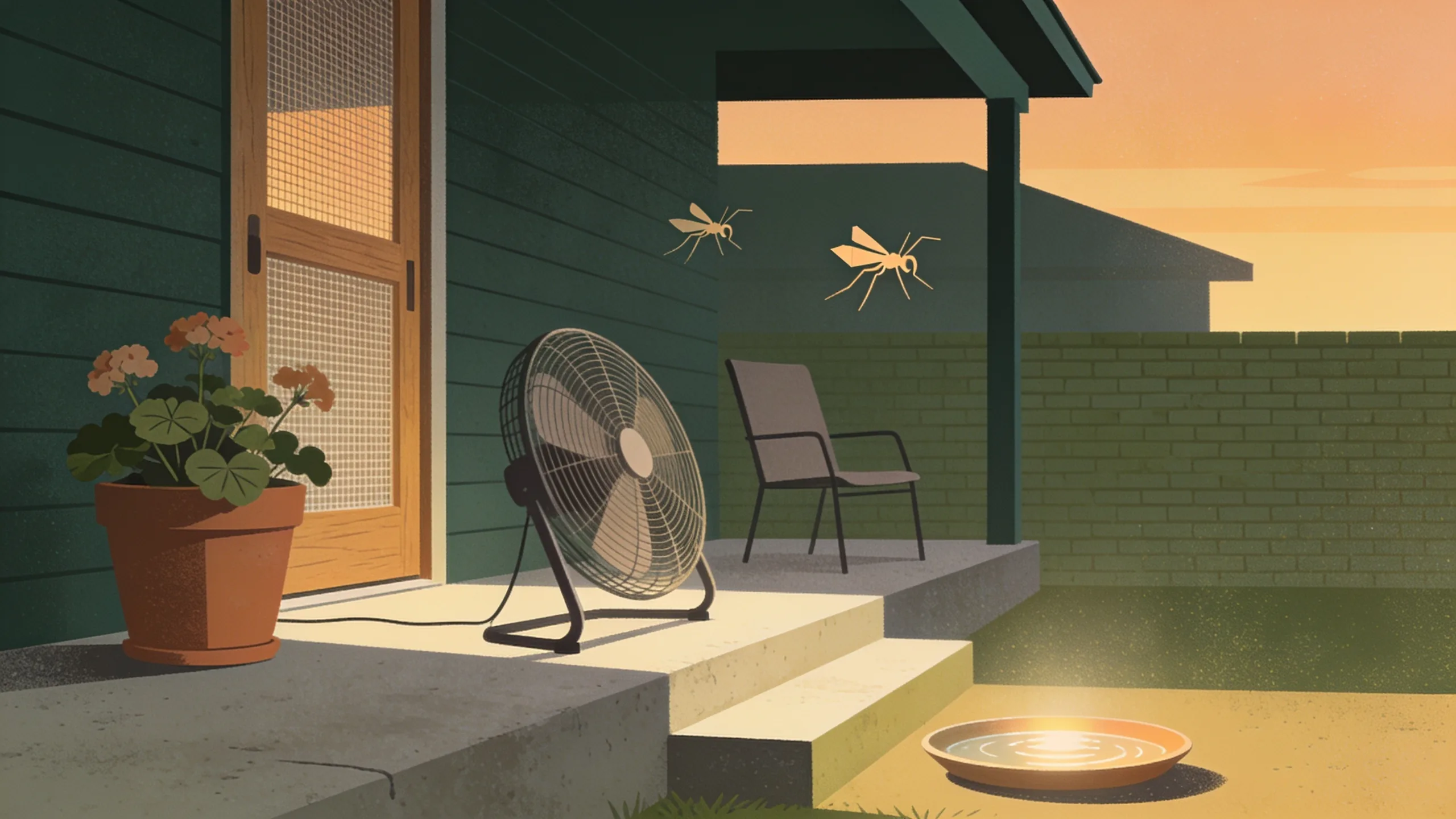
On the structure side, the interventions that survive a Texas summer are unglamorous. A fan moving air across the seating area works because Aedes are weak fliers. Screens in good repair, including the weep holes along a brick veneer — which need the manufactured inserts, not steel wool that rusts and falls out by spring. Standing water gone. A metofluthrin device if you want a chemical zone around a chair, used per the label rather than left running for a month.
Barrier treatments — foliage, eaves and shaded resting sites — have a real but limited window, usually weeks, and only against mosquitoes that rest in vegetation. They do not fix a breeding site in your own saucer. If you pay for a recurring service, the walkthrough should include a conversation about water, not just a spray.
When it is worth calling someone
Most mosquito pressure in a subdivision is generated within a few hundred feet of the house, which is why a neighbor's water source can defeat a perfectly good yard routine. That is where a licensed company earns its fee: finding resting sites you cannot see, treating on a schedule that matches the species, and telling you honestly that the empty pot saucer was the problem.
If the household includes an infant, someone pregnant, or anyone with a history of neuroinvasive illness, the calculation shifts: an assessment before the last warm weeks is reasonable. You can find a licensed pest control company in Texas through our directory, or start with the profile for mosquitoes and the pest control and lawn care pages to see what a program typically covers. Homeowners in the two counties carrying most of this year's West Nile load may want the local versions: Houston and Dallas.
Frequently Asked Questions
Do mosquito-repelling plants work at all? Not as growing plants. Their compounds can repel mosquitoes when concentrated into a product, but a live plant releases too little across too small an area. In the field, neither citronella geranium nor rosemary changed trap catches.
Does lemongrass attract mosquitoes? In the lab arm of the study it was the only plant that drew significantly more mosquitoes than plain air — 31% chose the plant side. It is decoration that works against you.
Is DEET safe for kids? The American Academy of Pediatrics considers DEET appropriate for children over two months at concentrations up to 30%, applied by an adult and washed off at the end of the day. Oil of lemon eucalyptus is the exception: not recommended under age three.
How late does mosquito season run in Texas? Into November across most of the state, and effectively year-round on the Gulf Coast in mild winters. Activity drops after a hard freeze, but Culex mosquitoes overwinter as adults and resume once temperatures hold in the sixties.
Keep the geranium. It looks good, it survives neglect, and it smells like a lemon when you water it. Just do not let it be the reason you skipped the repellent in a month when the state is still counting positive pools by the thousand.
Texas Bug Slayers Editorial Team
Editorial Board
The Texas Bug Slayers editorial team brings together licensed pest control professionals, entomologists, and writers dedicated to helping Texans protect their homes and families from pests.